REVIEW · 2022-04-28
Dorfromantik
Between Cosy and Cutthroat: Reading the Split Over a Single Tile
First Impressions
Dorfromantik has you draw hexagonal tiles one at a time and place them so the artwork on their edges — forest, field, houses, river, rail — lines up with the neighbours. It was made and published by Toukana Interactive, founded by four game design students in Berlin; early access on 25 March 2021, 1.0 on 28 April 2022. I am writing this from the Steam review pool rather than from notes of my own play.
The numbers first. Of 29,385 reviews, 28,313 are positive and 1,072 negative; the 27,210 Steam-purchaser reviews carry the label 'Overwhelmingly Positive'; the 15,603 English reviews sit at 96% (snapshot 2026-08-03). The last 30 days are 92% of 131. On the numbers alone this looks like a settled question.
Read the text, though, and it is the praise that breaks the premise first. One helpful positive with 291 votes opens by telling you not to believe the store description, insists there is nothing relaxing here and that the game is in fact one of the more hardcore puzzlers around — then concludes that this is why it is great. Another with 426 votes says the opposite: the moment they read a guide and learned to optimise, the whole thing was ruined, so don't try to get good at it. The pro camp cannot agree on what the game is. That disagreement is the most interesting thing in the pool.
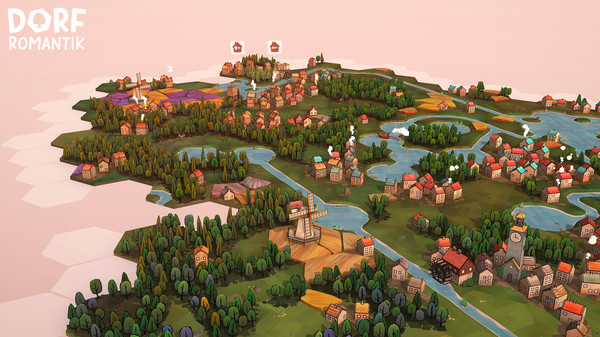 A green landscape crossed by a blue river, a large windmill in the foreground and red- and brown-roofed houses along the bank, under a pink sky, with part of the game logo in the top-left corner — Steam store screenshot
Putting the Mechanics into Words
Pull the verbs out of the pool and there are two. Place, rotate. You do not choose from a hand; the top of the stack is handed to you, and you pick a slot and an orientation. There is no undo. A positive with 153 votes disposes of the whole thing in one line: it is Carcassonne solitaire.
The grammar reduces to edge matching. Match an edge and you score; surround a tile so all six edges match and the 'perfect' bonus hands tiles back. Quest tiles add conditions — thirty or more trees in one forest, exactly twelve houses in one village — and completing them hands more tiles back. Tiles are the only resource in the game, and the verb 'place' is simply the act of spending it. Under the cosy surface runs a severely trimmed survival economy. That is what a 899-hour positive means by saying you run out of tiles fast if you don't place them wisely.
The sharpest negative in the pool (37 votes) attacks the same grammar from the other side: replace the trees, houses and fields with plain coloured edges and the game plays identically, so the pastoral art contributes nothing mechanical. The same writer adds that a microchip aesthetic would have made misplaced edges easier to read. In our terms that is a point about observation resolution: the art does not raise the board's legibility, it deliberately lowers it. Set against a design like Into the Breach, which discloses everything and leaves only the judgement, this game runs the other way.
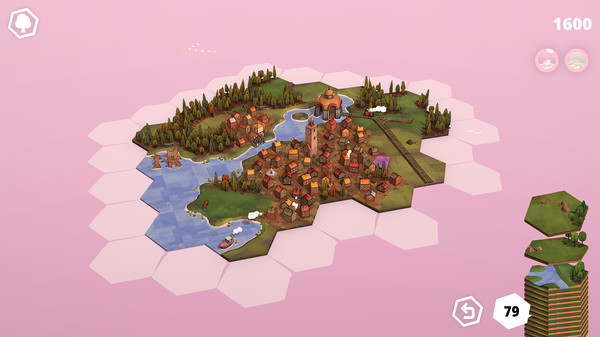 A small board floating against a sunset-pink backdrop: red-roofed houses gathered round a lake, forest and a rail line running off. Score 1600 at top right, 79 tiles remaining at bottom right beside the stack of tiles to come — Steam store screenshot
The World
And yet the overwhelming majority of reviews open on the look. The soft click of wood on a board, the feel of sitting under an oak with a small tray on your lap, the thumb-sized trains and deer. The helpful reviews of the last six months are written almost entirely in that vocabulary. Night mode and new biomes arrived after launch, and one reviewer summarises them neatly as a measure against aesthetic fatigue.
What is interesting is that the same art pulls the verdict in two directions. Positives take the board's growing beauty as the reward in itself; an early one asks to be able to save a finished landscape and ride a train through it. A negative standing in the same spot says the town looks patchworked and fake no matter how many perfect placements you stack, and that calling this a city builder is a misrepresentation. City Builder does sit in the store tags, and there is no city anywhere in the mechanics.
As design this is a deliberate offset between surface and system. The offset is not a fault in itself — A Little to the Left works by laying a strict alignment system under domestic imagery. The trouble is that the offset points opposite ways for different players. Read the countryside as a blanket around the system and you get the best game of its kind; read it as a haze hiding the system and you get emptiness. That is very nearly the whole reason 96% and 2/10 were written about the same board.
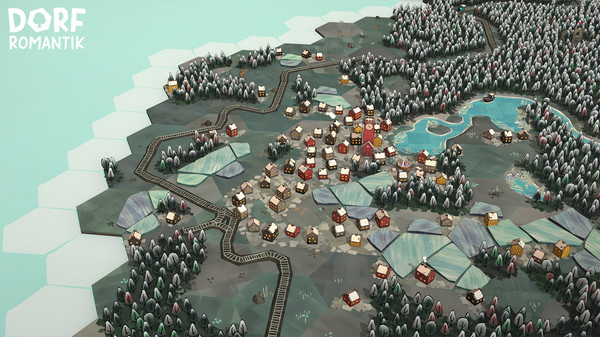 A snow biome: pale grey-green tundra, frozen teal lakes and dark spruce forest, with a rail line curving past a small huddled village, part of the game logo at top left — Steam store screenshot
The Texture of Difficulty
'Relaxing' and 'not relaxing' live on the same board. Gather the places where reviewers stall and the difficulty sorts into three kinds. Luck: the edge you need does not come. A negative with 101 hours notes that with no way to swap, discard, recycle or look ahead, a bad run simply ends you. Simultaneity: a quest for four hundred or more trees runs alongside a quest for exactly twelve houses, and feeding one breaks the other. Legibility: at the game's oblique angle it is hard to spot by eye which empty slot would give you a perfect placement.
The positives convert the first two into virtues under different names. Luck becomes the craft of compromise — a review with 165 votes calls this a game where you slowly perish on a blade forged from your own compromises. Simultaneity becomes management; a 344-hour positive files the game under pattern recognition, spatial reasoning, handling randomness and compromise. Only the third kind is treated as a complaint by both camps.
On design grounds the first two count as difficulty and the third does not: it is feedback resolution, friction unrelated to the judgement the board is asking for. One negative is right to say there is not a single setting with which to shape your experience. A design that never lets you choose the texture of its difficulty sits badly with randomness. It is less that difficulty varies by player than that the random draw assigns it for you — which is also what the completionist means by never reaching the satisfaction of completion while the goalposts keep receding.
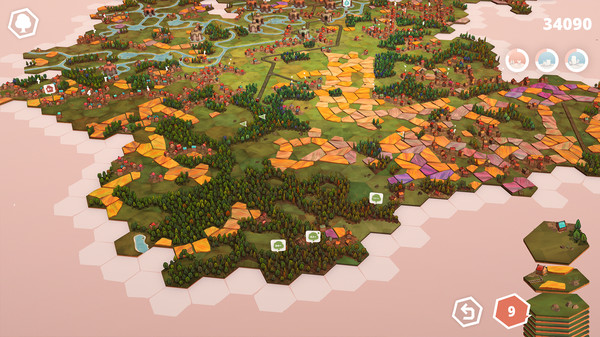 Score 34090, and the remaining-tile counter at bottom right down to nine and highlighted in red. Green and yellow fields and villages spread out under a pink sky, dotted with white hexagonal quest markers — Steam store screenshot
Subtraction
The developers write their own design thesis into the store page. Under a heading listing what Dorfromantik does not offer, they name five things: 4X strategy, trading, resource management, combat and violence, multiplayer. It is rare for a game to be more specific about what it withholds than about what it provides. As a declaration of subtraction it could not be plainer.
The subtraction reaches the verbs too. No hand to choose from, no discarding, no replacing, no visibility beyond the next two tiles. One negative asks for a hand of a few tiles just to introduce some determinacy; another says they felt they had no agency at all. Subtraction removes options and, in exchange, makes each move heavier. One camp calls that concentration, the other calls it powerlessness — the disagreement is not about values but about what they see in the space where the options used to be.
One thing, though, was never subtracted: the randomness. In the terms of handcrafted versus procedural levels, this game hands level design entirely to the generator. No handmade levels means no teaching levels, so the learning curve lives outside the game, in community guides. That is presumably why the 426-vote positive warns you not to try to get good: touch the curve outside and the experience inside breaks. The one thing this design forgot to account for is the path to improvement itself.
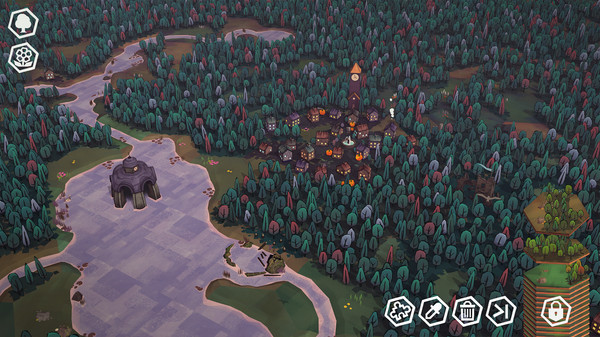 A dark night-toned conifer forest, a large purple-tinted lake and a rock outcrop. A row of editing buttons — brush, picker, delete, skip — sits at bottom right, and there is no score display — Steam store screenshot
Sources
Written by reading the Steam user review pool as of 2026-08-03. No review text is quoted directly; typical claims are reconstructed.
- Steam: Dorfromantik (Overwhelmingly Positive — 28,313 positive and 1,072 negative of 29,385 reviews; 27,210 Steam-purchaser reviews; 96% of 15,603 in English; 92% of 131 in the last 30 days)
- Read in full: the top 10 most helpful English positives (all time), the top 10 most helpful negatives, the top 10 most helpful of the last six months, and the 10 most recent — 40 in total, posted between March 2021 and August 2026
- Also consulted: the Kotaku, 4Players and Vice quotes carried on the store page, and the developer's own description including its list of what the game does not offer
- Figures: twelve candidate images were pulled from Steam's official screenshots API, displayed and inspected one by one, and the six whose contents were legible were assigned to sections. Captions describe only what was actually visible.
Closing
The aggregate once more: Overwhelmingly Positive, 96% of 29,385 reviews (snapshot 2026-08-03). Hours on record in the pool scatter wildly, from people who refunded after an hour to one at 899 hours. The median sits around fifteen, though 'completion time' does not really apply here: the stack runs out, and you start again.
On design grounds I give it 8.2. A notch below 96% because the subtraction is beautifully thorough while the randomness alone was left outside it, and the result is that no path to improvement exists inside the game. Even a positive with 244 hours writes that they still cannot work out how to score well. A design with no teaching level trades the freedom of generation for the player's ability to measure their own progress — which is also why reports of the game turning monotonous after a few hours come from both camps.
Who it fits is legible straight from the pool. If choosing a small compromise every single turn is itself the entertainment, there is little better. If you want the board to answer your judgement — the thing the negatives all describe as agency — it will not suit you. That is design scope, not quality. Still, it is worth recording that the word the store leads with, 'relaxing', does not describe that scope accurately. The most helpful positives are the first to say so.
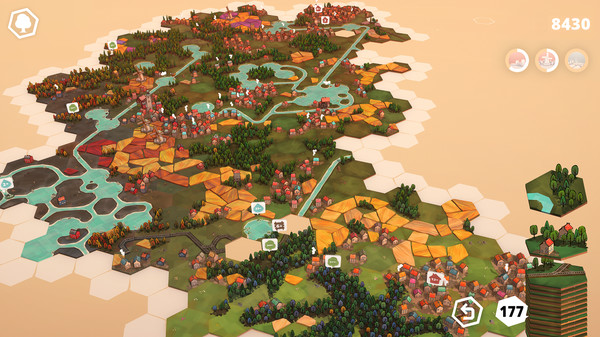 A board sprawling wide under an orange sky, mixing teal rivers and lakes, orange fields and dark forest, with white hexagonal quest markers scattered across it. Score 8430, 177 tiles remaining — Steam store screenshot
Where are you with this game?
Press one and the game goes on your shelf. You can see it on your account page.
Reactions (no login)
Anonymous • one of each per visitor per day
Read next
Related reviews
Isle of Arrows
A puzzle-leaning tower defense: place randomly drawn tiles onto a floating island, grow the paths yourself, and line up towers against the waves. Unwanted tiles can be skipped, one at a time, for coins. Gridpop's crossbreed of board game and tower defense.
Sokobond Express
A grid puzzle in which you draw one unbroken path for a single atom, bonding it to the atoms it passes until the target molecule is assembled — a minimalist crossbreed of Sokobond and Cosmic Express, published by Draknek & Friends.
Railbound
An overhead track-laying puzzle where you place a limited number of rails so a moving locomotive links its carriages in the right order, avoids collisions, and brings everyone home. Tunnels, barriers and switches blow the board up into timing permutations, all solved with a single verb: lay track. From Afterburn, the studio behind Golf Peaks.


