REVIEW · 2024-02-22
Sokobond Express
Reading the "it's easier" verdict on a hybrid sequel
First Impressions
What happens when you crossbreed two puzzle games? Sokobond Express lays the systems of Sokobond — push atoms, build molecules — and Cosmic Express — draw one unbroken line — onto a single board. The store page lists a 22 February 2024 release, design by José Hernández, published by Draknek & Friends.
I write this from the Steam review pool. The label is 'Very Positive': 90% of 83 Steam-purchaser reviews are positive, and across all review types the count is 106 (94 positive, 12 negative), snapshot 2026-07-28. On the numbers, a quiet success. Open the text, though, and the most helpful entries are qualified recommendations that score themselves — 7/10, 8/10.
What interests me is that both sides are pointing at the same fact: this sequel is easier than either parent. One camp reads that as an open door, the other as a gutting. My job is to move that fork into design language.
 The title logo with H, N, C and O atoms strung along coloured pipes — Steam store key art
Place in the Lineage
The most frequent proper nouns in the pool are neither the developer nor a genre: they are the two parent games. The positive formula is 'greater than the sum of its parts'; the negative formula is 'a worse version of Sokobond.' The same crossbreed reads as addition to one camp and subtraction to the other. Many reviewers arrive via A Monster's Expedition or Bonfire Peaks, which raises the bar further.
The pool is specific about what went missing. Sokobond's bond-strengthening play is absent here. And against Cosmic Express's free wiring, this game adds rules: you cannot cross a cell twice, and you must finish at a fixed terminus. In Puzzlebyrinth terms, elements were subtracted and constraints added at the same time.
My reading: a hybrid inherits as many rulers as it has parents. Sokobond readers measure depth of grammar; Cosmic Express readers measure freedom of routing. On either ruler it falls short of its parent. To a reader who knows neither, it looks like a small, complete thing with both pleasures on one board. The split maps which shelf people reached from, more than it maps quality.
 A wide grid on a pale green background; N and H atoms scattered, a path just begun from the top-left atom — Steam store screenshot
Putting the Mechanics into Words
Line the reviews up and the rule summary is remarkably consistent. You draw one unbroken path from a start to a fixed terminus for a single atom. That atom travels the path and bonds automatically with atoms it passes. The path cannot cross itself, the growing molecule cannot collide, every atom must end inside the board, and no free electron may be left over. The verb is subtracted down to one: draw a line.
One verb, but a stiff grammar. Each element has a fixed electron count, so the order of pickup decides the molecule's shape, and that shape constrains the topology of the path. Here the two camps read the same feature in opposite directions. The negative side calls the no-crossing rule and the fixed terminus arbitrary restrictions that remove options; the positive side notes that the terminus lets you deduce the final molecule's shape. Constraint as loss, or constraint as evidence.
Difficulty spikes late, when a board asks for two molecules at once. You are sorting atoms between molecules and checking that two paths don't obstruct each other, both at the same time. When reviewers say the later levels are hard to hold in the head, that combinatorial blow-up is what they mean. The verb stays at one; only the number of objects on the board goes up. Plain, but effective.
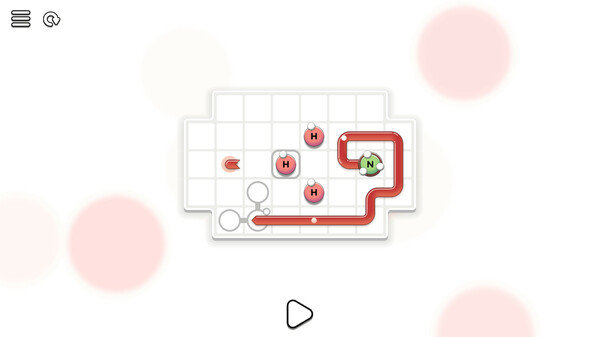 A red path drawn across the grid, with cells jutting outside the board; three H atoms and one N — Steam store screenshot
The Texture of Difficulty
On difficulty the pool splits cleanly. One side writes that progress never stalls, that the game is accessible, that it doesn't overstay its welcome. The other writes that it lacks the bite expected from a Draknek release, that the levels are few and mostly easy. As far as I can tell, almost everyone in the second group has played the parents. The same board reads as well-tempered to a newcomer and lukewarm to a veteran.
The second fault line is the kind of difficulty. The sharpest negative claim is that trial and error beats logic here: one reviewer reports failing for half an hour with deduction, then dropping an assumption, trying something arbitrary, and clearing it first try. The positive side answers that the board previews the outcome in real time as you draw, so moving your hands is part of the reasoning. The same behaviour again, filed once as sloppiness and once as kindness.
I read the difficulty as three kinds. First, deducing the shape of the final molecule. Second, fitting an unbroken path into the board's topology. Third, managing collisions between two molecules. Logic bites cleanly on the first and poorly on the third, where prediction is hard. If the complaint and the compliment are both about how much of the third kind you happened to hit, they can be true at once. Completion times mentioned in reviews sit roughly in the four-to-eight hour band, across something like a hundred levels.
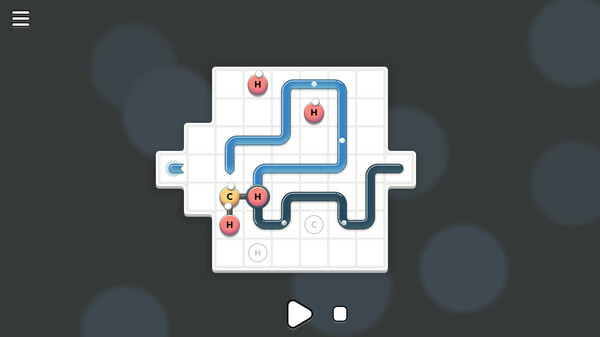 Two paths in different shades drawn simultaneously on a dark-theme board — Steam store screenshot
Design Craft
One feature draws praise from both camps: the hint. It never gives the solution — it shows the shape of the finished molecule. That single piece of information prunes the search hard while leaving order and topology to you. Even a negative review notes that the hints are as good as ever and still require thought. As hint design, it's a clean subtraction: cut the space, not the puzzle.
The second is the display. As you draw, the resulting state is rendered in real time over the starting layout, so redrawing the middle of a long path doesn't force you to replay it in your head. One long review names this as the main reason the game feels easier than its parents. In my terms: raise the observation resolution and convert a memory load into a reasoning load. The complaint that hands beat logic here is the same design, seen from the back.
Smaller calls are visible too. The level map branches, so a stuck player can go elsewhere. Reviewers point out that achievements are pegged to learning a new mechanic rather than to clearing a level. On the other side, positive reviews list the gaps plainly: no move-level undo, no keyboard control for building the molecule. The launch-era complaint that the price was steep for the length has faded as a talking point since discounts arrived.
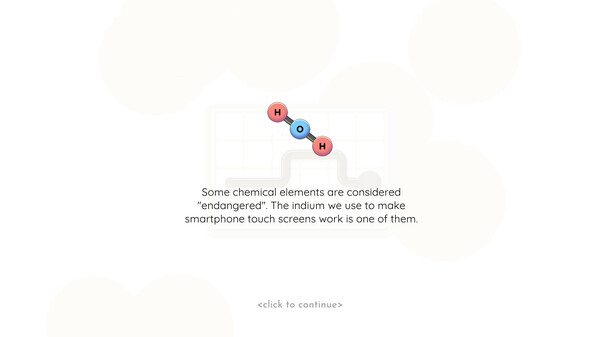 The chemistry trivia screen that follows a cleared level, a water molecule shown in the centre — Steam store screenshot
Sources
This piece was written by reading the user reviews on the Steam store page as of 2026-07-28. No review text is quoted directly; typical claims are reconstructed.
- Steam: Sokobond Express (Very Positive, 90% of 83 Steam-purchaser reviews; 106 across all review types = 94 positive / 12 negative)
- Read: the top 10 helpful positive, top 10 helpful negative, and 10 most recent reviews (English, Chinese, Japanese, Russian and Korean among them)
- Also referenced: the press scores printed on the store page (EDGE 8/10, GameGrin 9.5/10) and the store's own development and release credits
Closing
Steam reads 90% positive; my design-critique score is 7.5. I sit below the aggregate not because the game is rough but because its mechanism stops developing partway. Line-drawing crossed with bonding could have grown in directions other than 'put more molecules on the board,' and the 'it's easy' that the pool repeats is, I think, another name for that unspent room. The hint and the live preview, by contrast, deserve more credit than the aggregate gives.
Who is it for? For anyone who wants the feel of drawing a line and watching a shape fall out of a few rules, it is a well-made four-to-eight hours. For anyone arriving in search of the beating the hardest levels of Sokobond or Cosmic Express delivered, it is outside the reach. Both readers post on the same store page, which is why the verdict looks split. The game isn't wobbling; there are simply two rulers.
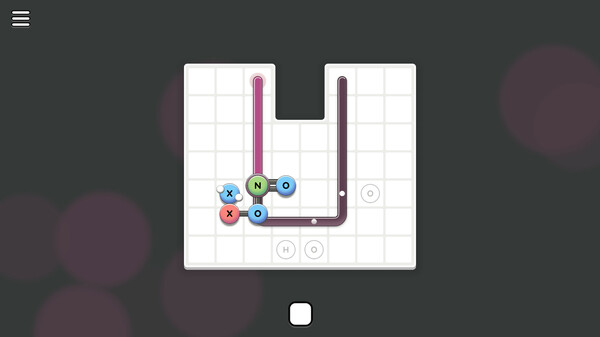 A purple path, two tiles marked with an X, and an N bonded to an O by a double bond — Steam store screenshot
Where are you with this game?
Press one and the game goes on your shelf. You can see it on your account page.
Reactions (no login)
Anonymous • one of each per visitor per day
Read next
Related reviews
Wilmot Works It Out
A puzzle-building game: open the weekly package, pull out square pieces, assemble the pictures, and hang the finished ones on your walls. Each package mixes pieces from several pictures, so sorting comes before building. The sequel to Wilmot’s Warehouse, from Hollow Ponds and Richard Hogg.
Paper Trail
A top-down puzzle game in which the screen is a sheet of paper: fold it over and the terrain on the reverse joins the front, building a path for Paige as she journeys through a hand-drawn world. From Newfangled Games.
Arranger
A grid puzzle-adventure where taking one step moves everything sharing your row or column, and the board loops at its edges. No sword or keys — you shove the things on the floor to open the way. The debut from Furniture & Mattress, folding movement, combat, and exploration into a single verb.


