REVIEW · 2014-07-21
Sokobond
A Sokoban about chemistry: move an atom, build a molecule
Introduction
In Sokobond you move a single atom around a grid, bond it with the atoms it touches, and build a target molecule. Each atom has a fixed number of free 'hands' (its valence); whenever a free hand meets another, they link automatically. You only ever move one thing. Made by Alan Hazelden and Lee Shang Lun, published by Draknek & Friends in 2014 — a Sokoban puzzle dressed in chemistry.
I write this from the Steam review pool. Steam reads 'Very Positive': 93% of 540 buyer reviews are positive; across all sources, 657 of 706, with only 49 negatives (snapshot 2026-06-24). The last 30 days hold at 84% of 13, so the verdict has barely moved in over a decade. Metacritic critics sit at 82; Edge and Eurogamer both gave 9/10.
On the numbers, this is a tidy minor classic. But read the pool closely and praise and complaint keep pointing at the same quality — how much has been stripped away. This piece turns that single coin over into design terms.
 Move one atom, bond by valence, assemble the molecule. — Steam store
First Impressions
Line up the helpful positives and the vocabulary rhymes: elegant, minimalist, clever, relaxing, 'simple but not easy.' Most are surprised that one rule — valence — yields such depth, with no chemistry knowledge required. Many find the post-level trivia charming.
The negatives and qualified positives use a different set: guess-and-check, 'I solved it but don't know what I did,' only C, O, H, N, He so 'the late game feels monotonous.' The single most-helpful negative attacks the UI — blinding all-white, no dark mode 'requested and ignored for 10+ years' — and the $10-to-$15 price hike.
What's interesting is how often the same trait is read two ways. One reviewer's 'clean' is another's 'under-explained'; the absent tutorial is either 'the joy of noticing' or 'unfriendly.' My job isn't to stage a fight, but to translate where the verdict forks.
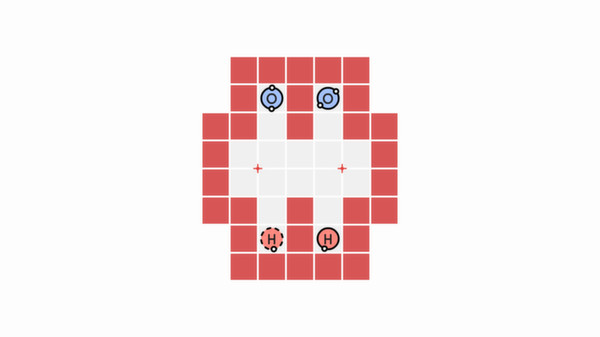 'Simple but not easy' — the split orbits that one line. — Steam store
Putting the Mechanics into Words
What positives praise most is how small the controls are: there is essentially one verb — move the selected atom up/down/left/right. Bonding isn't commanded; it just happens when free hands touch. In Puzzlebyrinth's terms, the verb is subtracted down to one — the same lineage as Cosmic Express drawing a line or A Monster's Expedition pushing once.
One verb, but the grammar lives on the atoms: hydrogen has one hand, oxygen two, carbon four, helium none. Later chapters add tiles that break bonds, double them, or rotate a molecule's shape — one at a time. 'The first half is casual, the back half hurts,' a reviewer writes; that is the grammar table going in one row at a time.
Let me settle one misreading the pool keeps surfacing. The store says 'no chemistry knowledge required,' and reviewers agree — correctly. But that doesn't mean the chemistry is mere decoration. Valence is just 'how many connections a cell may hold,' a combinatorial grammar; the element symbols are labels stuck onto it. The depth players feel isn't chemistry — it's the combinatorial explosion of connection counts.
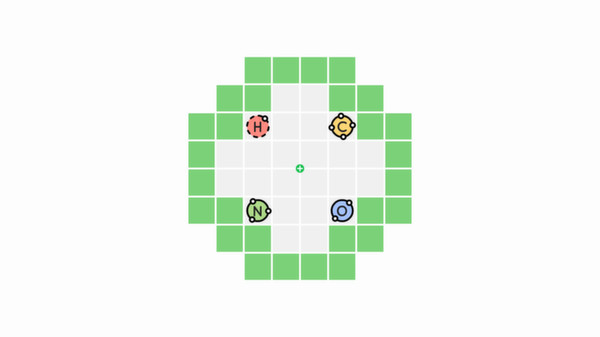 Hydrogen 1, oxygen 2, carbon 4 — 'hands' are the grammar. — Steam store
Design Craft
Where positives praise a 'natural difficulty curve,' the design term is teaching. Sokobond introduces each new tile alone on an easy board, then crosses it with the grammar you already know. One reviewer nails it: 'each mechanic is introduced on its own, then combined.' Nearly all of its ~144 levels are either one new rule or a synthesis of old ones.
The much-debated 'lack of explanation' also reads as subtraction. There's almost no tutorial text; the inputs are four directions plus undo and reset. Positives call the board itself the textbook; negatives note that even bonding priority goes unexplained. The same quiet reads as trust to one camp, unfriendliness to the other — a question of reach, not quality.
Easy to miss: Allison Walker's score and the per-level chemistry trivia are design too — ambient cover for sinking into thought, and punctuation that lets the tension out. Next to the austere hush of English Country Tune, Sokobond is positioning itself as 'minimal but not cold.'
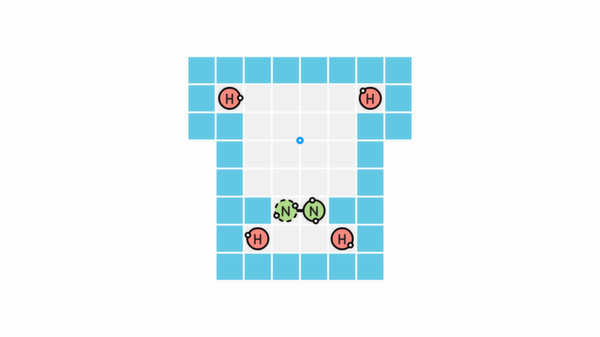 Introduce a rule alone, then cross it with the old — teaching by design. — Steam store
The Texture of Difficulty
Difficulty is where the pool splits most cleanly, and reading it, the stuck-points sort into roughly three kinds. One: missing the grammar — misreading what a break or double-bond tile does. Two: order traps — bonding in the wrong sequence breaks the board irreversibly. Three, the one negatives target: guess-and-check, where multiple solutions or opaque bonding priority let you stumble through.
The first two yield to higher observation resolution; positives call that 'solving it like a diagram.' The third is the real problem — 'I solved it but don't know why' marks places where the design doesn't quite repay observation. Next to Stephen's Sausage Roll, which keeps every move legible to the end, Sokobond has a few levels you can fumble past.
On the label: I set difficulty to 4. The pool agrees on 'casual early, very tough late,' and the experience swings hard by player. Not chemistry but the patience to plan ahead decides whether a board feels elegant or unfair. Read the difficulty as a slope steepening toward the end, not a uniform wall.
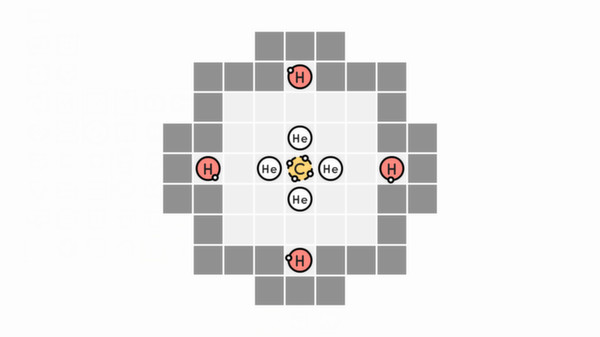 Break, double, rotate — late grammar compounds; the slope steepens. — Steam store
Sources
This piece was written by reading the Steam store and community user reviews as of 2026-06-24. No review text is quoted directly; typical claims are reconstructed.
- Steam: Sokobond (Very Positive — 93% of 540 buyer reviews; 657 of 706 positive and 49 negative across all sources; 84% of 13 in the last 30 days)
- Read via WebFetch: top helpful positives, the most-helpful negative, and recent reviews — confirming the recurring complaints (no dark mode, the price hike, guess-and-check, limited atom variety)
- Press: Metacritic (critics 82), Edge (9/10), Eurogamer (9/10). I also checked the developer's official framing ('minimal and beautiful, no chemistry needed') against the reviewers' sense that the back half turns very tough
Closing
Steam reads about 93% positive; my design-critique score is 8.4, and the two don't diverge. One verb — move — with the bonding grammar handed to the atoms' valence, and chemistry used not as decoration but as a combinatorial language: that purity has aged remarkably little for a 2014 game. Marks come off for a few late levels that don't repay observation (the guess-and-check holes) and for thin quality-of-life, the decade-old missing dark mode chief among it.
Across the split, the pool's advice converges: if you like minimal thinking puzzles, buy it without hesitating. For anyone who loves pulling combinatorial depth from a single rule — the 'subtract to deepen' design of Cosmic Express or English Country Tune — it's a near-perfect ten hours. For anyone wanting ample explanation, flashy updates, or an easy-on-the-eyes UI, it's outside the reach.
Every hand joined — the payoff of betting that less goes deeper. — Steam store
Where are you with this game?
Press one and the game goes on your shelf. You can see it on your account page.
Reactions (no login)
Anonymous • one of each per visitor per day
Read next
Related reviews
Tetrobot and Co.
A grid-based thinking puzzle in which you steer Psychobot, a microscopic repair robot, swallowing and spitting blocks to mend the insides of a broken giant. Swing Swing Submarine build fifty-odd levels out of little more than three materials — wood, sand, stone — and one rule: like sticks only to like.
The Talos Principle
A robot solves trials in Roman-style ruins while a voice in their head questions their selfhood and divinity.
Escape Goat 2
A 2D puzzle platformer about escaping a trap-filled stronghold with a goat and its mouse companion. Each room is a single screen, solved with jumps, an immortal mouse that crawls walls and stands on switches, and a magic hat that swaps the goat's position with the mouse's. Over a hundred rooms across ten zones, from MagicalTimeBean in 2014.


