REVIEW · 2024-05-21
Paper Trail
Folding a single sheet — reading the verdict on a one-verb puzzler
First Impressions
Paper Trail is a top-down puzzle game where the screen is a sheet of paper: fold a corner over and the terrain on the reverse lands on the front, forming a path. Made and released by Newfangled Games on 21 May 2024. I am writing this from the Steam user review pool rather than from my own playthrough.
The label is 'Overwhelmingly Positive.' 95% of 644 Steam-purchaser reviews are positive; across all 875 reviews, 833 are positive and 42 negative (snapshot 2026-07-31). Metacritic sits at 80. Worth discounting, though: 231 of those 875 came from outside Steam purchases, and several of the top helpful reviews carry the 'product received for free' marker.
What interests me is that both sides agree on the facts. Art and music are lovely, the folding idea is unusual, the story is thin — positive and negative reviewers write the same sentences that far. The split sits in exactly one place: how much possibility they think the verb 'fold' contains. The store copy promises something that quickly becomes devilishly tricky while the tags read Cozy, Relaxing, Casual; the helpful positives warn you not to be fooled by the cute art, and part of the negative side reports being irritated after expecting calm.
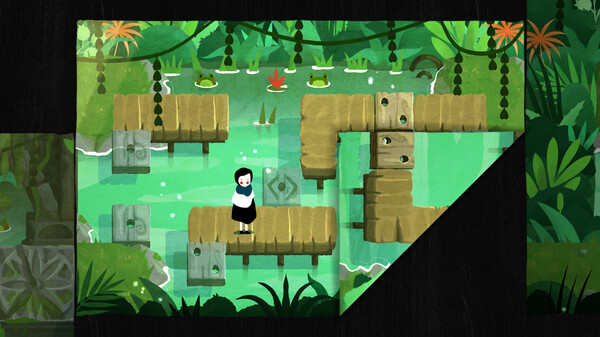 A green swamp crossed by wooden walkways; the page's corner is folded back at bottom right — Steam store screenshot
Putting the Mechanics into Words
The pool describes the system consistently. The screen is one sheet with a front and a back; grab an edge or a corner, fold it over, and the terrain from the reverse lands on the front, joining paths that were cut. A click shows you the reverse at any time, so nothing is hidden. The recurring positive words are unique, clever, mind-bending, and — tellingly — visualization and spatial imagination.
In design terms the game has essentially one verb: fold. And folding does two jobs at once, moving you and generating terrain in the same gesture. The unit of a move is not a step but a crease, which makes the board itself mutable. Where Patrick's Parabox touched the definition of space through nested boxes, this game adds exactly one extra layer: the back of the picture.
The observation design is equally plain. The reverse is always inspectable, mistakes are never punished, creases can be undone. When positive reviewers praise how low-stakes it feels, they are describing that reversibility. But a search space that is both safe and fully visible is also one you can wander through without thinking — which is where the disagreement starts.
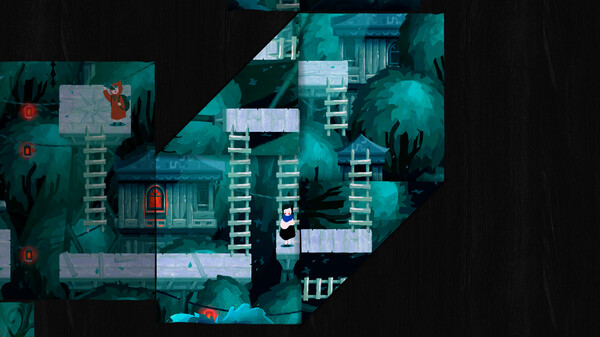 A teal ruin full of white ladders, a large triangular fold laid over the board from the upper left — Steam store screenshot
Subtraction
The most concrete complaints target the limits of the fold. You cannot fold twice, cannot stack sheets, cannot overlap a crease — so the possibility space bottoms out early. One long Russian-language negative says the developers explained on their blog that repeated folds broke the integrity of the grid, so the idea was dropped; I have not read that post myself, so I record it as the reviewer's account.
That is subtraction. Limit folding to one crease and the combinatorial explosion never happens; the board is always one move from its original state. The 'easygoing' the positives praise and the 'shallow' the negatives mourn are two faces of one decision, the sort I wrote about in designing with fewer verbs. Cutting a verb always leaves the author owing that difficulty back somewhere.
Here the debt is paid with other machinery: pressure plates, moving platforms, light beams, portals, pushable boulders. And both the negative and the recent reviews land on the same observation — the later additions feel designed for sokoban rather than for folding. Even a friendly recent review says it wasn't fond of how the sokoban elements were implemented. When a one-verb game fills its gaps with another genre's verbs, reviewers detect the seam with real accuracy.
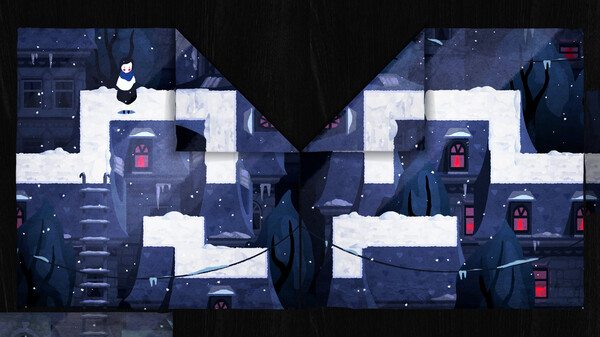 A snowy night townscape with a black V-shaped notch where the page has been folded away — Steam store screenshot
The Texture of Difficulty
The testimony about difficulty looks contradictory. People with 17 or 20 hours logged say they were unexpectedly stuck and reached for a guide; someone who cleared it in just under four hours calls it well balanced. Sort the reviews by where they got stuck, though, and three different kinds of difficulty separate out.
First, difficulty of visualization: predicting what the reverse will do once it lands on the front. That is what positives mean when they say a dormant part of their brain woke up. Second, difficulty of procedure: everything between seeing the solution and finishing the execution — walking speed, fold animations, nudging a boulder one tile at a time. Almost every use of sluggish, tedious and chore belongs to this layer. Third, difficulty of search, which mostly lives in the optional origami collectibles. The positives largely enjoy the first and third; the negatives mostly quit at the second.
Between the two sits guess-and-check. Try folds in all eight directions and you can hit the answer without understanding it. The negatives call that busywork; some positives shrug and admit they solved plenty of screens by folding at random. The same behaviour reads as a design failure to one side and as generosity to the other. The author does provide hints, but ties an achievement to never using one — not a punishment, just a price tag, which is the calibration I discussed in hint system design.
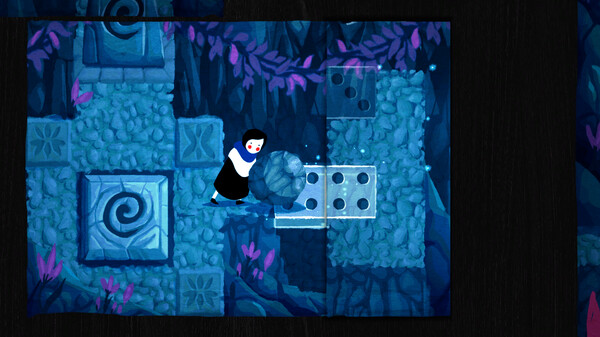 In a blue cave, the protagonist pushes a large boulder toward a dotted tile — Steam store screenshot
Place in the Lineage
Count the proper nouns in the pool and other games outnumber the developer's own name: Gorogoa, Monument Valley, Carto, Solo, A Little to the Left, Sizeable. The interesting part is that the same names appear on both sides. One positive says fans of Carto can buy safely; a Korean negative that quit after thirty minutes says Carto came to mind and the comparison did not flatter this game.
I read the game as sitting between two lineages. One takes the picture plane itself as the object of manipulation — Gorogoa's sliding panels, Monument Valley's impossible geometry. The other tidies everyday clutter by hand, with A Little to the Left as its emblem. Paper Trail takes the first lineage's subject and handles it with the second's touch: low stakes, pleasant to fiddle with. Reviewers naming both lists are feeling that blend correctly.
Price arguments happen in the same place. Against $19.99 one negative notes that longer, more complex puzzle games sell for half as much, while another reviewer decides the art and music are worth the difference. When comparison shopping decides the verdict, the genre has grown crowded.
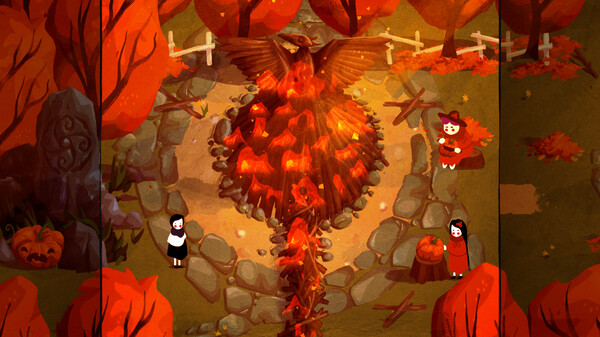 An autumnal red forest, a bonfire shaped like a flaming bird at its centre, a red-hatted character to the right — Steam store screenshot
Sources
Written by reading the Steam user review pool as of 2026-07-31. No review text is quoted directly; typical claims are reconstructed.
- Steam: Paper Trail (Overwhelmingly Positive — 95% of 644 Steam-purchaser reviews positive; across all 875 reviews, 833 positive and 42 negative; 93% of the last 15 in 30 days)
- Read: the top 10 helpful positives (all time), the top 10 helpful negatives, and the 10 most recent, including English, Chinese, Russian, Korean and Spanish reviews
- SteamDB: Paper Trail (release date and developer)
- The score of 80 is the Metacritic figure shown on the Steam store page; no individual press reviews were consulted
Closing
Against Steam's 95% I give it 7.5 on design grounds, and the gap is easy to explain from the pool. Most positive votes are cast for something the game genuinely delivers: a few pleasant hours, lovely art and music, no punishment for being wrong. My deduction lands elsewhere. Having committed to a single verb, the game pays its remaining difficulty in sokoban machinery rather than mining the fold itself to the bottom.
Who it fits is clear enough. If the moment when reversed terrain clicks together in your head is the point, and you can tolerate the execution time around it, this lasts. If you cannot forgive a search space where brute force beats understanding, it will not. That is scope, not quality — and putting Cozy and Relaxing at the front of the store page already declares the scope.
Completion times mentioned in reviews cluster around five to eight hours, stretching to fifteen or twenty if you collect every origami. Voices on both sides suggest waiting for a sale against the $19.99 price. I know of no other game that narrows itself to folding a single sheet this thoroughly; if that one thing is worth paying for, the price argument need not concern you.
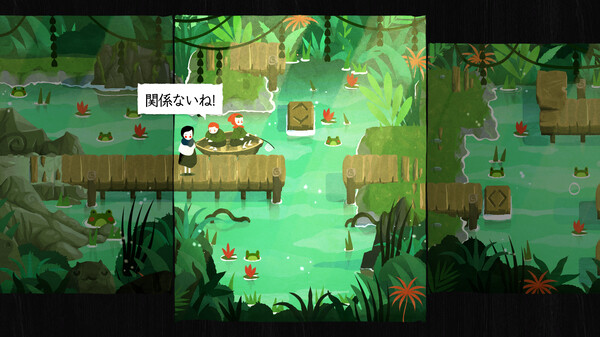 The protagonist on a swamp jetty, talking with a character in a small boat — Steam store screenshot
Where are you with this game?
Press one and the game goes on your shelf. You can see it on your account page.
Reactions (no login)
Anonymous • one of each per visitor per day
Read next
Related reviews
Sokobond Express
A grid puzzle in which you draw one unbroken path for a single atom, bonding it to the atoms it passes until the target molecule is assembled — a minimalist crossbreed of Sokobond and Cosmic Express, published by Draknek & Friends.
Wilmot Works It Out
A puzzle-building game: open the weekly package, pull out square pieces, assemble the pictures, and hang the finished ones on your walls. Each package mixes pieces from several pictures, so sorting comes before building. The sequel to Wilmot’s Warehouse, from Hollow Ponds and Richard Hogg.
Arranger
A grid puzzle-adventure where taking one step moves everything sharing your row or column, and the board loops at its edges. No sword or keys — you shove the things on the floor to open the way. The debut from Furniture & Mattress, folding movement, combat, and exploration into a single verb.


