REVIEW · 2022-09-06
Railbound
Lay the rails; let the engine gather its cars
First Impressions
Two dogs travel the world. You reconnect broken track so a moving locomotive picks up its carriages in order and carries everyone home — that is Railbound, developed and published by Afterburn, the studio behind Golf Peaks and inbento, and released on September 6, 2022. I wrote this by reading the Steam user reviews stacked up as of 2026-07-11: Very Positive, 94% of 1,785.
Line up the helpful positive reviews and the words rhyme: comfy, cozy, relaxing, wholesome, and always 'adorable dogs.' No timer, instant undo, a soundtrack you end up humming — those sit at the center of most recommendations. The tightest praise is simply that laying track with an empty head feels good.
But one of the most-upvoted reviews qualifies the praise: 'Comfy? There are some gnarly puzzles here — don't be misled,' and then, 'getting to 100% is not a comfy stroll.' The store's 'relaxing' banner and the helpful reviews plainly disagree. I read that split not as a fight but as a question of design range.
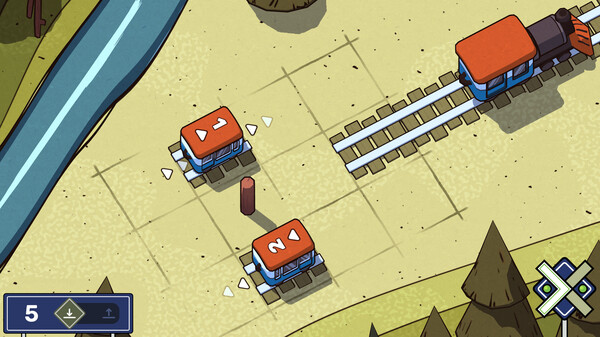 Two dogs and a locomotive touring the world — Steam store
Putting the Mechanics into Words
The loop reviewers describe: a board holds a locomotive and carriages waiting to be collected. You lay and peel a limited number of track pieces to build the route; press GO and everything moves at once. Link the cars in the right order, avoid any collision, and you're done. The verb set is startlingly small — lay track, remove track — which in Puzzlebyrinth's terms is pure subtraction of verbs. The 'clean, minimal' praise is just another name for it.
The grammar lives in time. After GO the cars run, so what you solve is order and timing, not placement — which car to grab first, which switch to flip, which tunnel closes the distance. Barriers, switches and tunnels arrive one at a time, and a few pieces explode into timing permutations. Where Cosmic Express found its combinatorial blow-up in space, Railbound stages it in time.
Reviewers also praise, without naming it, the teaching curve and the tight rail budget. Each world introduces one new piece on a gentle board before twisting it, and the exact number of tracks squeezes the solution toward one. The recurring 'not enough rails' complaint is that subtractive constraint doing its job.
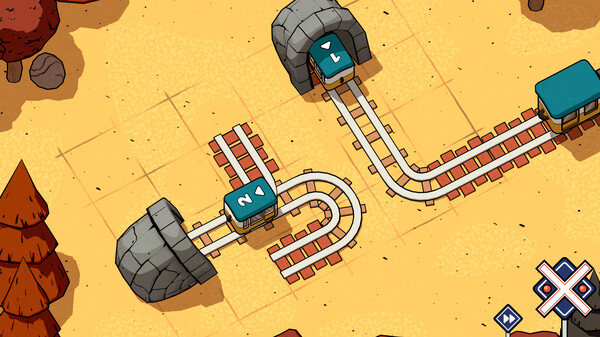 The engine gathering its carriages in sequence — Steam store
The Texture of Difficulty
On difficulty the split speaks the same fact with opposite signs. Critics call the opening 'too easy'; a player laughs that the game 'makes me doubt my IQ.' The trick is that difficulty is bimodal — the main line is a gentle tutorial road, and only the optional forks hold the hard boards. Ride the main line and it's cozy or slight; chase every fork and it turns gnarly.
The sharpest reservation is about the texture of that hardness: 'when I solved it I didn't feel clever, just like I'd done work.' With the rail budget pinned to a single answer, the hardest boards edge toward running the trains in your head by brute force. This isn't the observational load of The Witness; it's a working-memory load, simulating time.
So the split isn't better-versus-worse. By keeping the main line loose and the forks strict, the design lets the relaxed player and the hungry one share one track. If 'relaxing' misleads anyone, it's because the banner points only at the main line — and you get to choose how far down the forks you ride.
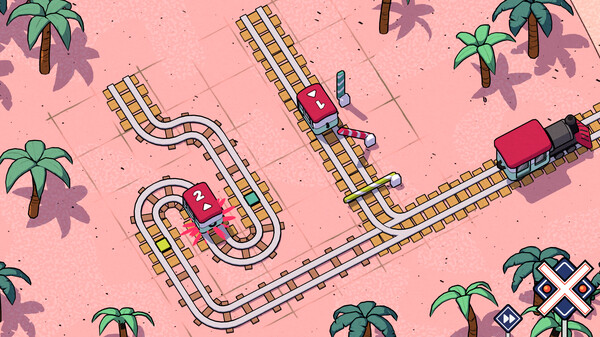 'Not enough tracks' — the constraint biting — Steam store
Place in the Lineage
Reviews keep reaching for neighbors. The idea of guiding cars along track descends from Cosmic Express (Steam even bundles the two together), and the patient one-verb teaching is continuous with Afterburn's own Golf Peaks. What is Railbound's own is solving the route in time rather than space.
The critic–user gap is telling. Launch reviews granted the charm but dinged it as 'too easy early, about three hours, no replay' — back when it held roughly 150 levels. Since then the team added worlds in free updates, shipped a level editor and Steam Workshop, and pushed the count past 240. That recent reviews still hold at 94% reads as the audience pricing in what the game became.
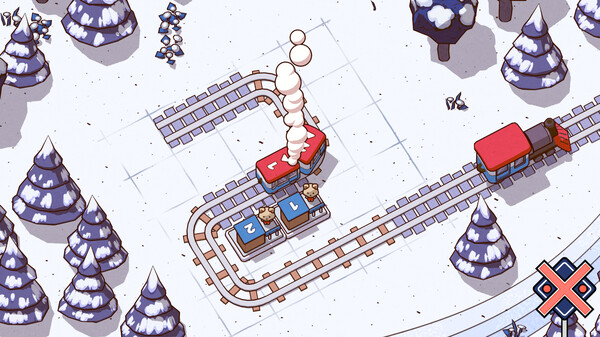 A stage that crosses the world, and a level count that kept growing — Steam store
Sources
I wrote this by reading the Steam store's user reviews as of 2026-07-11, reconstructing typical claims rather than quoting review text directly.
・Steam: Railbound (Very Positive, 94% of 1,785; across all reviews 1,799 of 1,900 positive)
・Read the most-helpful positive and negative reviews (all-time), several recent ones, and the community hub's discussions and screenshot posts via WebFetch
・Critic summaries from MyGamer, Tech-Gaming and Finger Guns, plus the game's 2023 Apple Design Award (Interaction) win
Closing
What comes through the review pool is a clean, well-swept track puzzle that solves one verb in time. Onto 'lay track' pile order, timing and a rail budget, and it quietly deepens. Cozy and gnarly aren't a contradiction; they're the names of two layers, main line and fork.
Steam's overall sits at 94% (1,785). From a design view I'd put it at 8.0 — nearly on top of the aggregate. The credit is for the subtracted verb, the careful teaching, and a team that kept patching its weak spots for free; the reservation is that the hardest boards sometimes lean on brute force over insight, and the postcard-thin story says less than 'travel the world' promises.
So the audience is clear. If you want to lay track on boards that ramp gently while dogs and a soft soundtrack keep you company, it is a fine companion. If you want the tension of deducing a truth, it's outside the range — head to Cosmic Express for a harder cousin, or Golf Peaks for the same studio's gentler hand. Choosing how far down the forks you ride is this little trip's best feature.
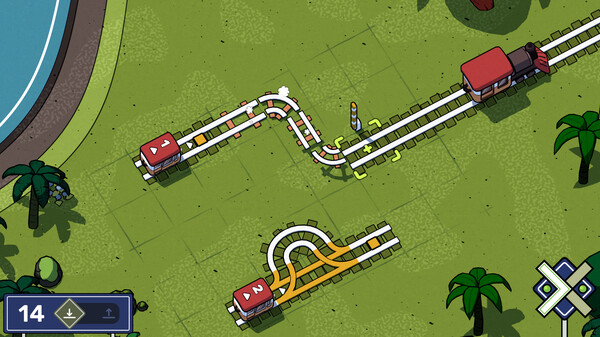 One verb that deepens over time — Steam store
Where are you with this game?
Press one and the game goes on your shelf. You can see it on your account page.
Reactions (no login)
Anonymous • one of each per visitor per day
Read next
Related reviews
inbento
A pattern-matching puzzle played inside a 3×3 lunchbox. You don't place the food directly: you play a small hand of operation cards that move, swap, copy or lift tiles, and you must spend every card exactly. 127 levels, wordless, with a short story about a cat mother and her kitten. By Afterburn, who also made Golf Peaks.
Dorfromantik
A hand-painted tile-placement puzzler: draw one hexagonal tile at a time and rotate it so its forests, fields, houses, rivers and rails line up with their neighbours. Complete quests to win tiles back and keep the village landscape growing, in Berlin studio Toukana Interactive's debut.
Sokobond Express
A grid puzzle in which you draw one unbroken path for a single atom, bonding it to the atoms it passes until the target molecule is assembled — a minimalist crossbreed of Sokobond and Cosmic Express, published by Draknek & Friends.


