REVIEW · 2022-09-08
Isle of Arrows
The store page already says "beat the RNG" — and across 1,100 reviews, nearly every complaint asks for one more lever against the draw
First Impressions
Start with the numbers. The store page shows 80% of 936 reviews positive, labelled "Very Positive"; SteamDB counts 1,000 across all languages at 75.6% (both as of 2026-09-04). Counted in every language the label drops a band, to "Mostly Positive." There are too few recent posts for a 30-day figure to appear at all.
The helpful column did not look like those numbers. Seven of the top ten positive reviews carry a request or a complaint inside them: give me an undo, show me the next tile, let me hold one, the towers never come. The recommend side is working largely as a wish list.
The negative side converges instead. Eight of its top ten name the same cause, the draw. The most-helpful one (13.4 hours) calls the RNG "quite unforgiving" and reports six hours without clearing level one. The second (6.9 hours) says the game is gorgeous and rock-solid, and also the most unsatisfying tower defense they have played. Neither side asks for weaker enemies; both ask for something to do about the tile in hand.
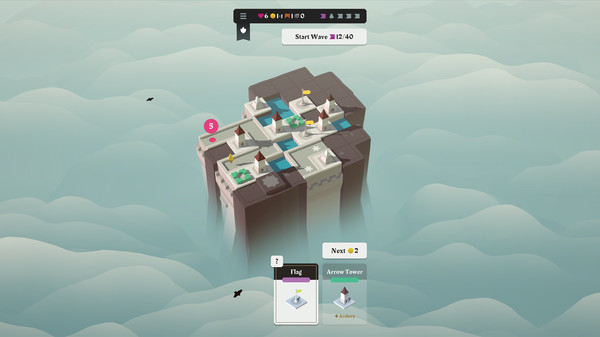 Isle of Arrows in play — the first image listed on the Steam store page — Steam store screenshot
Putting the Mechanics into Words
There looks to be one verb, place, but there are two: place and skip. Exactly one tile is offered each turn, and an unwanted one can be skipped for coins. Towers attack, roads carry the invaders, flags extend the isle, gardens produce coins, taverns strengthen adjacent archery towers. The store page names all five.
The most precise account of that structure comes from a Japanese review (48.5 hours): one card offered, skip the only alternative, buildable room only via flags and expansion, water tiles doubling as obstacle and condition, bombs to overwrite, income scaling with savings. It reads more exactly than the store copy.
The English pool points at the same thing in other words. "I'm playing against highly restricted resources and pure chance" rather than enemies (25.3 hours). "You will unlock a ton of cards, but only see the same handful" (18.0 hours). The first names the narrowness of the input; the second, the skew of the distribution.
In Puzzlebyrinth terms the game cut its verbs to two and put a price tag on one of them. The subtraction is clean; what is thin is that only one valve remains. Dorfromantik asks only where a tile goes. This one makes you pay for placement and for a redraw out of the same purse.
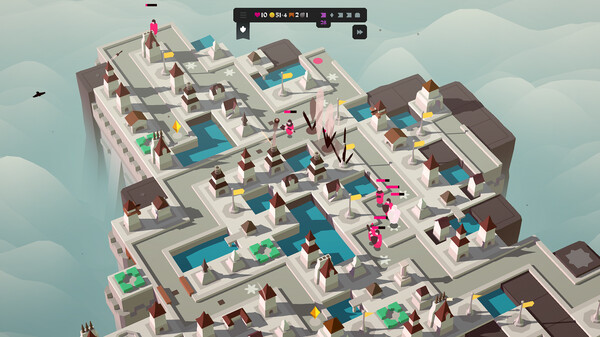 Isle of Arrows in play — the second image listed on the Steam store page — Steam store screenshot
The Texture of Difficulty
The negative pool sorts the difficulty into three kinds. Drought: "weapon tower droughts lasting seven or eight rounds are common" (13.4 hours). Dispersal: extra invader paths opening mid-run and splitting resources that were already short. And absence of foresight.
A Japanese negative review (15.5 hours) states the third most plainly — the freedom is apparent rather than real, tiles must be placed without seeing ahead, and the ways to recover are few. That is the English side's "let me see the next piece" with the sign flipped.
A 90-hour negative review even gives a distribution: 15% get lucky and cruise, 15% barely scrape through, the other 70% get run over. No source is offered, so read it as a felt shape rather than data — but it does say the difficulty is experienced as variance. It is the question I worked through in Is a win by luck your own win?, arriving here as a complaint.
Against it, a 53-hour positive argues that the variance is the point: the design deliberately offers mostly bad options, so the critics have misread the premise. I think that reading is right. A correct premise still does not prove that one valve is enough.
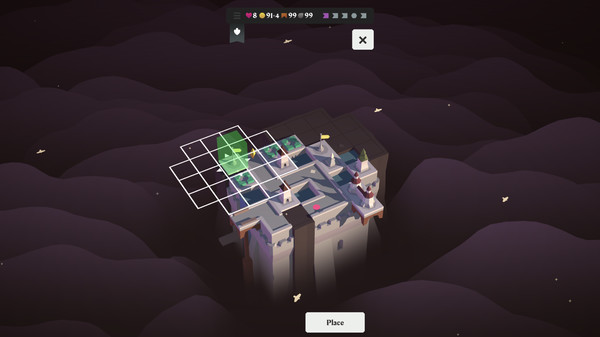 Isle of Arrows in play — the third image listed on the Steam store page — Steam store screenshot
Design Craft
The developer hides none of this. The store page asks whether you can "beat the RNG," advertises "brutally difficult challenges," and then spells out the dealing rule: order and type are random, but a set number of towers, paths and buildings is guaranteed every X tiles, in imitation of the luck of the draw in board games.
So the relief is built in from the start. This is capped randomness, not unbounded bad luck. There is no gap between the sign and the implementation — what the negative side is angry about is exactly what the sign says. The dissatisfaction survives because of the one thing the sign never promises.
What is not promised is how many tools you get against the randomness. Skip is a single valve that costs coins; coins need gardens; gardens compete with towers for space. Trading intervention against resources is coherent design, but with one valve the only move in an unlucky spot is to pay.
The requests on the recommend side name that empty seat precisely: undo, hold one, see the next. In the terms of Designing hint systems they are asking for observational resolution, not for an easier game. And as Does choice mean anything when you can undo? argues, refusing undo needs a reason — here the reason sits on the resource side, consistently.
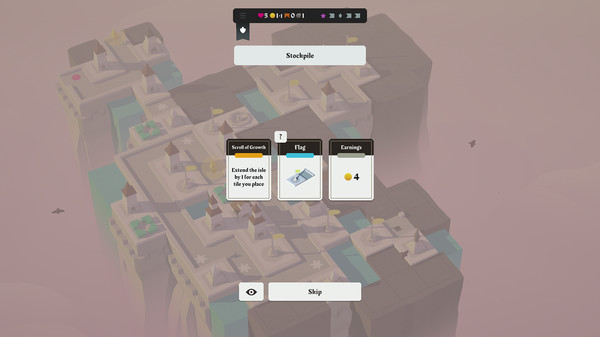 Isle of Arrows in play — the fourth image listed on the Steam store page — Steam store screenshot
Place in the Lineage
Set beside its neighbours the position gets clear. Dorfromantik ends when the deck runs out; ISLANDERS ends when the score falls short. Neither has an enemy. Losing is written as a meter running down, not as a verdict.
Isle of Arrows moved the verdict outside. A wave arrives, and if it walks through, you lose. A misplaced tile comes back as a plain failure rather than a slow shortfall, which sharpens both the sting and the shape of a success — and wires the draw straight to the result.
Against a full-information puzzle the contrast is sharper still. Into the Breach shows everything that is about to happen before you choose; on a board just as small, nothing is hidden. Isle of Arrows inverts that: the board is fully visible and only your hand is not.
Recent reviews sit calmer than the aggregate suggests. One at 428.8 hours calls it replayable, strategic, minimal and chill; one at 52.4 hours calls it good clean tower defense whose controls could use a little work. The long-hours voices are quieter than the split in the numbers.
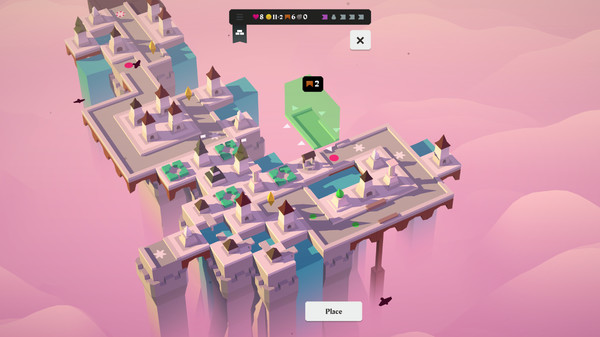 Isle of Arrows in play — the fifth image listed on the Steam store page — Steam store screenshot
Reviews I Read
This piece was written from the Steam user reviews as they stood on 2026-09-04.
・Steam: Isle of Arrows (80% positive of 936, "Very Positive"; too few recent posts for a 30-day figure to be shown)
・SteamDB counts 1,000 reviews across all languages at 75.6%; the store figure is English-weighted, so both are given.
・Read in full: top 10 helpful positive, top 10 helpful negative, 8 most recent, and top 10 Japanese-language reviews (38 in total).
・Critic coverage is thin. OpenCritic lists one review (GameBlast, 7/10, faulting an overreliance on random elements). Metacritic has the iOS version only, with two critics at 80 and no score yet for want of a fourth.
・All images are screenshots listed on the Steam store page and their URLs were checked as live. The image files themselves could not be downloaded from this run's environment, so the captions state only the store listing order and make no claim about what is depicted.
Closing
I give it 7.2 — a little below the store's 80%, a little above SteamDB's 75.6%. As a crossbreed it is well made, and the idea of importing a board game's luck of the draw into tower defense is coherent right down to the capped dealing rule.
One thing costs it. Having chosen the draw as the currency of difficulty, the game gives you exactly one move against that currency. Measured by the conditions I set out in Is hard the same as unkind?, bad luck is bearable; a shortage of answers to bad luck is harder to accept.
Who it suits divides cleanly. If a run reads as a dividend of chance, there is a lot of game here. If a run reads as your own answer sheet, the paper arrives different every time. That is a matter of taste, not of merit.
One review reports 100% completion at 25 hours, and campaign plus challenge modes look like roughly twenty. It sells for $12.99 — and almost everything above was written by the developer first, on the store page. You can read before you decide.
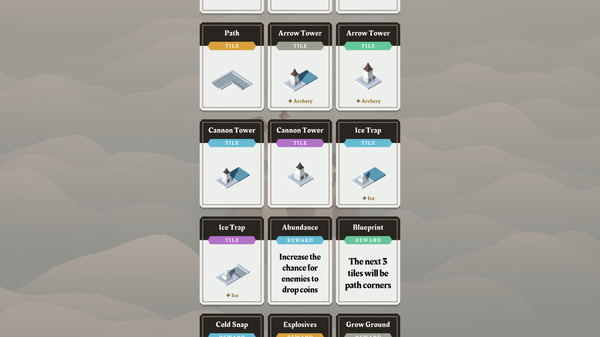 Isle of Arrows in play — the sixth image listed on the Steam store page — Steam store screenshot
Where are you with this game?
Press one and the game goes on your shelf. You can see it on your account page.
Reactions (no login)
Anonymous • one of each per visitor per day
Read next
Related reviews
Desktop Dungeons: Rewind
A turn-based puzzle-roguelike on a single screen of dungeon, where revealing unexplored tiles is what heals you, so every fight is a resource problem. QCF Design's 3D remake of their 2013 Desktop Dungeons, with a rewind for taking moves back and the kingdom-building layer carried over.
Dorfromantik
A hand-painted tile-placement puzzler: draw one hexagonal tile at a time and rotate it so its forests, fields, houses, rivers and rails line up with their neighbours. Complete quests to win tiles back and keep the village landscape growing, in Berlin studio Toukana Interactive's debut.
Mini Motorways
A minimalist 2D puzzle game in which you draw roads, one at a time, through a city that keeps sprouting colour-coded houses and destinations. Each week you are handed a motorway, a roundabout or a traffic light to spend, and you keep redrawing the network until the traffic finally seizes up. From Dinosaur Polo Club, the New Zealand studio behind Mini Metro.


