REVIEW · 2019-04-04
ISLANDERS
The calm is only at the entrance — across 10,218 reviews at 95%, what both sides agree on is the pressure of the score gate
First Impressions
The numbers first. The store page shows 95% positive out of 10,218 reviews — "Overwhelmingly Positive" — with the last 30 days at 93% of 16 (snapshot 2026-09-03). SteamDB's all-language count is about 16,000 at 92.1%. On Metacritic the PC version sits at 82 from 6 critics, with a user score of 8.4 from 41 ratings. The top user tag is not Puzzle or Strategy. It is Relaxing.
And yet the single most-voted review I read (418 helpful, June 2020, 1.0 hours) is a negative one. It calls the game charming and toy-like, then says it was over after an hour. The top positive (412 helpful) says you can play it with a dog on your lap. Neither says anything about how hard the board is.
Reading two dozen of them, what surfaces is that the calm is a property of the entrance. People who stayed longer say something else. A Japanese-language recommendation with 58 hours on record (March 2025) recommends the game and then writes that once you play for score, the calm is entirely gone.
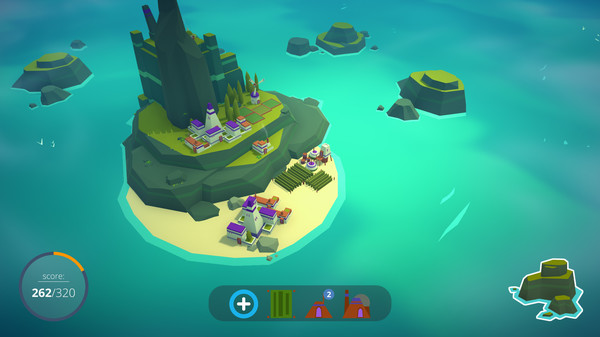 ISLANDERS in play — the first image listed on the Steam store page — Steam store screenshot
Putting the Mechanics into Words
There is exactly one verb: place. You drop a building from your inventory onto the island, points come from whatever sits near it, and enough points hand you the next set of buildings and eventually the next island. That is the whole input.
The review pool renames this structure in its own words rather than the store's. Across the helpful positives the recurring phrases are "SimCity plus Tetris" and "turn-based Tetris." The Japanese pool independently reaches for the same image: fill the gaps like Tetris; this is more puzzle than city building.
Translated into design terms, the rename means this: the buildings do not run. No citizens, no production, no clock. A building exists only as a coefficient on adjacency. The observational resolution is tuned to distance on a board, not to a town. One Japanese reviewer calls it a dowsing game, which is exact — the work is locating the single best spot.
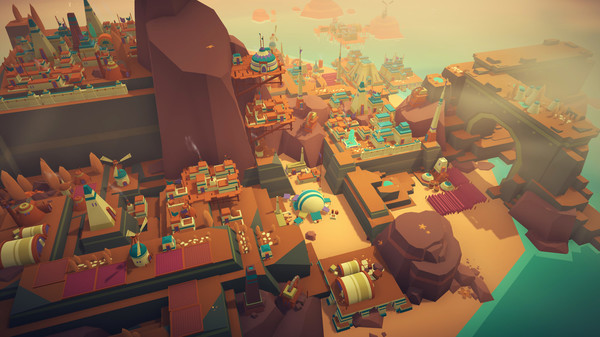 ISLANDERS in play — the second image listed on the Steam store page — Steam store screenshot
Subtraction
The store's own About text introduces the game by what is absent: no resource management, no loot boxes, no microtransactions, no multiplayer, no cinematic story. The three-person team hands you the list of removals before you play.
The review vocabulary is built from the same list. The positive side writes that there is no failure so it is easy on you, no objective so you are free, no undo so you are released from perfectionism. A games-press piece made the same point: because you cannot take it back, you get to live with your choices. The negative side writes that there is no depth, no citizens, no purpose, and no way to revisit the islands you made.
So the two sides agree on the inventory of absences and differ only in sign. The missing undo is the clearest case: one side reads it as weight added to each move, the other as being unable to recover when the draw goes wrong (The Ethics of Undo — Forgiveness or Punishment). Subtraction is never neutral. What decides the verdict is not the removal but what gets poured into the hole. Here what gets poured in is score.
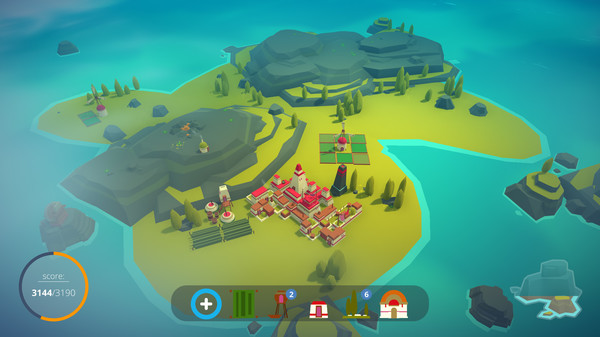 ISLANDERS in play — the third image listed on the Steam store page — Steam store screenshot
The Texture of Difficulty
There is no dead end here. There is running out. If you fail to reach the next threshold before your inventory is spent, the run ends there. The board never tells you a move was wrong; your hand simply empties first.
Both sides agree the mechanism exists and only disagree on what to call it. A top negative (November 2020, 2.6 hours) writes that the low-stress marketing is inaccurate — that this is turn-based strategy with score gates, and falling behind soft-locks the run. A long-playing recommendation describes the same thing from the other side, saying the calm disappears once score is on your mind, and another Japanese review puts it flatly: ignore the rules and it is game over.
As design, the difficulty has been moved off the board and onto the condition for continuing. Instead of a right and wrong move each turn, you manage a meter so it does not run dry. That is why the complaint is not "too hard" but "no room to rest." It is also where the illegible-failure grumbling comes from (Legible Failure — Making the Dead End Readable in Puzzles). The end arrives as quiet exhaustion rather than a warning.
Islands and building sets are generated, so mismatched draws happen. A negative review with 21.2 hours (December 2025) says the pack simply does not fit the island's resources and ends the run, and adds that you cannot zoom in and that placement demands pixel precision (Handcrafted or Generated — A Design Theory of Procedural Puzzle Levels). Generated variance blurs the question of whether the loss was yours.
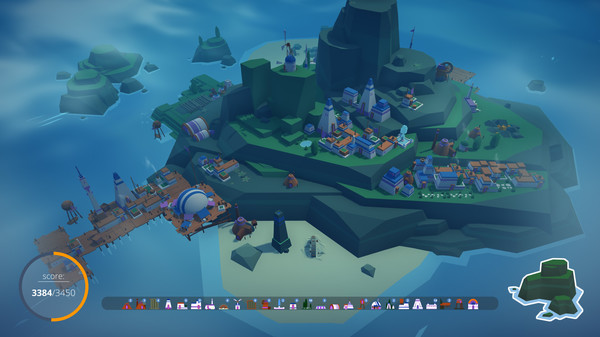 ISLANDERS in play — the fourth image listed on the Steam store page — Steam store screenshot
Place in the Lineage
Put it in the city-builder lineage and it looks like an act of aggressive subtraction. Put it in the score-attack puzzle lineage and it looks plain and classical. The tag list carries that doubleness openly: Relaxing first, then City Builder and Strategy, with Puzzle only fifth.
The clearest neighbour is Dorfromantik. Scoring by where a single tile lands is the same idea, but its ending is far gentler. Mini Metro is the opposite: collapse arrives as a visible pile-up. ISLANDERS ends as neither — the board stays calm and your hand runs out. Lined up, the three show how much choice a score-attack puzzle has in the shape of its losing state.
For the record, a sequel, ISLANDERS: New Shores, arrived on 2025-07-10. It landed long after this game's reception had settled, and what I read here is the review pool of the original only.
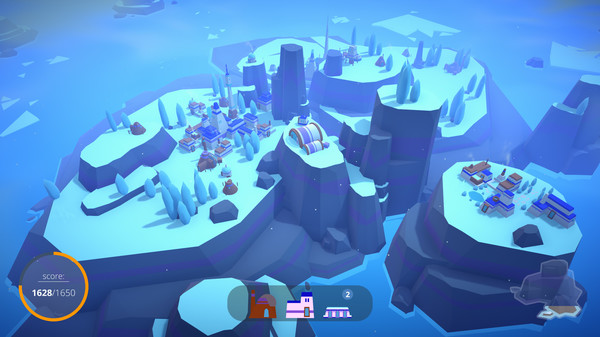 ISLANDERS in play — the fifth image listed on the Steam store page — Steam store screenshot
Reviews I Read
This piece was written from the Steam user reviews as they stood on 2026-09-03.
・Steam: ISLANDERS (95% positive of 10,218, "Overwhelmingly Positive"; last 30 days 93% of 16)
・SteamDB counts roughly 16,000 reviews across all languages at 92.1%; the store figure is English-weighted, so both are given.
・Read in full: top 10 helpful positive, top 10 helpful negative, 10 most recent, and top 10 Japanese-language reviews (40 in total).
・Metacritic (PC): 82 from 6 critics, user score 8.4 from 41 ratings.
・All images are screenshots listed on the Steam store page and their URLs were checked as live. The image files themselves could not be downloaded from this run's environment, so the captions state only the store listing order and make no claim about what is depicted.
Closing
I give it 7.6. That sits under Steam's 95% because the aggregate is grading the entrance while I am looking at the condition for continuing. The helpful top reviews cluster between 0.4 and 11.2 hours on record; the people with 80 or 380 hours barely collect votes. What is being counted is how the first few hours felt.
Who it suits is clear enough. If you want twenty minutes at the end of a day, or you enjoy squeezing adjacency for points, it suits you well. If you want to watch a town run, or to think by taking moves back, it does not. The Relaxing tag is not a lie, but it needs a footnote: the deeper you go, the less it holds.
As an act of subtraction it is admirable, because the one verb left standing afterwards is simply "place." The limit is that the only reward waiting behind that verb is a number, so the bottom shows up somewhere between five and ten hours. That most of the reviews were written at exactly that mark is unlikely to be a coincidence.
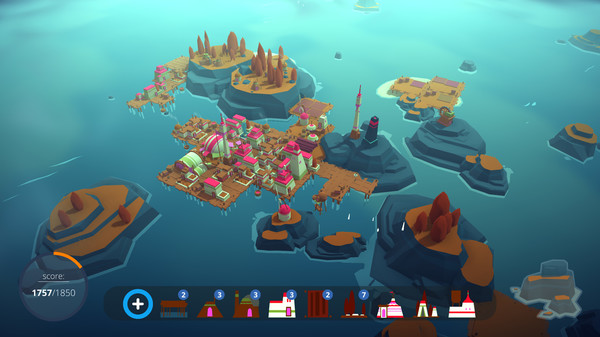 ISLANDERS in play — the sixth image listed on the Steam store page — Steam store screenshot
Reactions (no login)
Anonymous • one of each per visitor per day
Read next
Related reviews
Mini Motorways
A minimalist 2D puzzle game in which you draw roads, one at a time, through a city that keeps sprouting colour-coded houses and destinations. Each week you are handed a motorway, a roundabout or a traffic light to spend, and you keep redrawing the network until the traffic finally seizes up. From Dinosaur Polo Club, the New Zealand studio behind Mini Metro.
Wilmot's Warehouse
A 2D organisation puzzle: push the delivered goods into your warehouse and file them however you decide. No rule governs the shelves, and when the service hatch opens you retrieve orders from memory alone. By Richard Hogg and Ricky Haggett, who previously made Hohokum, with 200 kinds of pictorial tile piling up.
Autonauts
An automation puzzle in which you land on an empty planet, chop and quarry by hand, and then teach robots the steps you just performed so they can do them for you. With short Scratch-style scripts and one small memory allowance per bot, you grow a production line from farming to industry. Made by Denki, in Scotland.


