REVIEW · 2023-04-18
Desktop Dungeons: Rewind
The remake that gave up reading the board at a glance
First Impressions
From the Steam review pool, the split here sits in an unusual place. Almost nobody doubts the quality of the puzzle itself. What divides people is whether the board can be read on screen. As of 2026-09-08 the tally is 500 positive out of 652 across all languages — 76.7%, "Mostly Positive". The 2013 original sits at 83.7% of 2,358, so the remake scores lower than the thing it remade.
The positive side writes about the game. "Don't be fooled by the look, this is a puzzle" and "a roguelike puzzler dressed as an RPG" recur across the helpful positives. The negative side writes about the screen: you cannot see the whole board at once, your head moves like you are watching tennis, it is unreadable. The two camps point their words at different objects.
Line up the playtimes and the asymmetry sharpens. The top helpful negatives sit at 10, 25, 26, 33 and 65 minutes — under an hour, most of them. The positives sit at 998, 3,247, 8,351 and 11,325 minutes. The negative side is not made of people who did not play. It is made of people who knew the 2013 version and got off inside the first hour of this one.
 Official screenshot of Desktop Dungeons: Rewind (1 of 6) — Steam store screenshot
Putting the Mechanics into Words
The one rule every reviewer wants to explain is the healing. Revealing an unexplored tile restores health and mana. Exploration is therefore not movement here; it is a resource. The shorthand the positive side keeps reaching for is "reveal to heal", and it turns up again and again in the helpful positives.
In Puzzlebyrinth's terms, this folds the verb and the resource into a single action. Taking one step spends one unit of healing. The wish to save steps and the wish to save health collide inside the same input. The number of unexplored tiles left on the board is, in effect, the amount of health you still have.
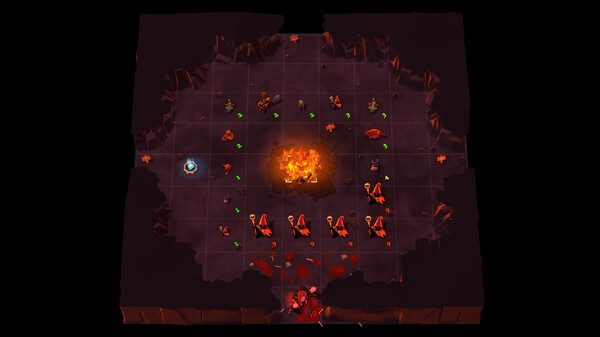
There is a second compression. The dungeon is one screen, and the monsters are placed and do not move. Only the deal is random; once dealt, the board is perfect information. Like the 8×8 of Into the Breach, the combinatorial explosion has been cut down to a size a person can finish reading. That perfect information is what the positive side means when it insists this is a puzzle.
 Official screenshot of Desktop Dungeons: Rewind (2 of 6) — Steam store screenshot
Feel of the Controls
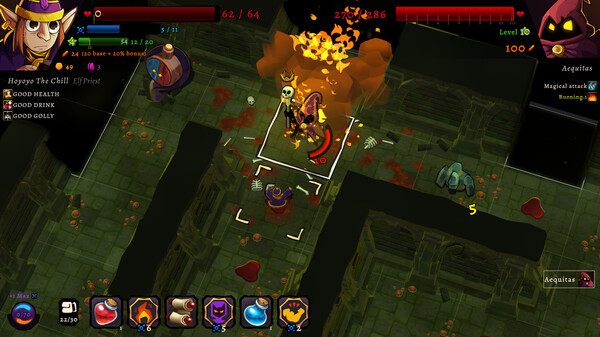
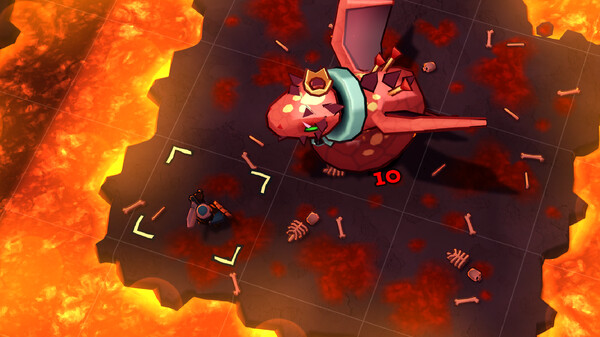
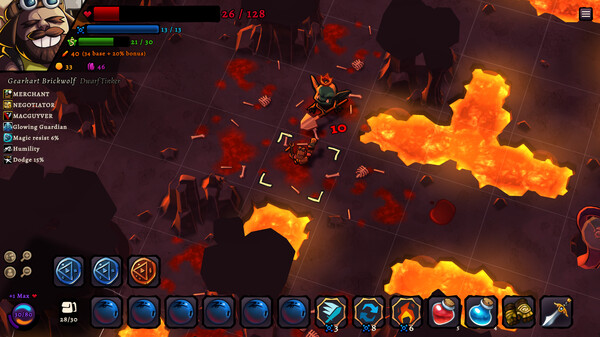
The negative case is startlingly unified. It comes down to one complaint: you cannot take in the whole board at once. The view is now an angled three-dimensional one, and the edges need scrolling. Zoom out and the text is illegible; zoom in and the board is gone. That pairing shows up over and over.
This is not a matter of taste. As the previous section had it, the thing you reason with here is how many unexplored tiles remain. If the board does not fit in one glance, neither does your remaining resource. What the presentation cuts into is what Puzzlebyrinth calls observation resolution.
The same complaint extends to where information sits. Health readouts and enemy data are scattered across the screen, and the eye has to travel. One reviewer wrote that the time goes to fighting the camera rather than to the arithmetic on the board. The puzzle underneath is unchanged; only the cost of reading it has gone up.
 Official screenshot of Desktop Dungeons: Rewind (3 of 6) — Steam store screenshot
Place in the Lineage
The most frequent proper noun in the pool is not a monster or a god. It is the 2013 Desktop Dungeons. Praise and complaint both rest on that reference line.
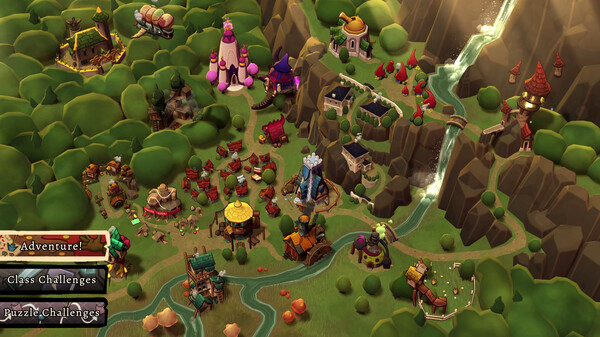
The positive side reads the changes as an expansion rather than a replacement: more dungeons, a rewind for taking moves back, and a play structure left alone. The negative side reads the same changes as a substitution. The flat pixel art of 2013 let the board read as a single tile of paper, and that way of seeing was the function, not the wrapper.
Remakes are usually judged on what was added. That is how the pool around The Talos Principle: Reawakened reads. What makes this one unusual is that the argument is not about the additions — the rewind, the extra dungeons — but about the change of presentation. And the numbers back the argument up: the older version scores higher.
 Official screenshot of Desktop Dungeons: Rewind (4 of 6) — Steam store screenshot
The Texture of Difficulty
When the subject turns to difficulty, the reviews change register. One wrong move can spoil a whole run; without skill there is no progress at all. What gets blamed here is not the display but the amount of arithmetic being asked for.
A recent review said the game is ruined by having to calculate every single action. That is a complaint, but it is also an accurate description. In designs that rule out guessing — Tametsi is the clean example — working the position out is the play. On a day when you do not want to work it out, it looks like labour.
The rewind divides people too. One positive reviewer calls it a kind move that lowers the difficulty; another positive reviewer says that because moves can be taken back, solving cleanly became the baseline. Critics land on this axis rather than the other one. God is a Geek never mentions readability and writes only about difficulty, about unimaginable pain hidden under a cute surface. Users argue about the screen; the press argues about the bite.
 Official screenshot of Desktop Dungeons: Rewind (5 of 6) — Steam store screenshot
Sources
Written by reading the Steam user review pool as of 2026-09-08. No review text is quoted directly; recurring claims are reconstructed.
- Steam: Desktop Dungeons: Rewind (Mostly Positive — 500 positive of 652 across all languages, 76.7%; 75% of 501 with the English filter)
- For comparison: Steam: Desktop Dungeons (2013) (Very Positive — 1,974 positive of 2,358 across all languages, 83.7%)
- Read via WebFetch: the top 10 helpful positives, the top 10 helpful negatives, and the 8 most recent reviews — 28 in total
- God is a Geek: Desktop Dungeons: Rewind review (Mick Fraser, 2023-04-26)
- The images here are official screenshots returned by Steam's appdetails API. This run could not open the image files themselves, so the captions are kept generic rather than describing specific contents.
Closing
Judged as design, what is inside this game is good. One screen; perfect information once the deal is made; healing and exploration folded into a single verb. Those three were already finished in 2013 and have not aged.
I still put it at 7.2, which sits close to Steam's 76.7%. The reason is simple. The puzzle here is made of reading the board, and this edition raised the cost of reading the board. A change meant to touch only the surface can end up cutting into the thing itself.
Who it suits is clear: someone who never met the 2013 version and can pour dozens of hours into learning one board. Who it does not suit is equally clear: someone who remembers that flat board. The distribution of reviews is really a distribution of which shelf each reader arrived from.
 Official screenshot of Desktop Dungeons: Rewind (6 of 6) — Steam store screenshot
Where are you with this game?
Press one and the game goes on your shelf. You can see it on your account page.
Reactions (no login)
Anonymous • one of each per visitor per day
Read next
Related reviews
Isle of Arrows
A puzzle-leaning tower defense: place randomly drawn tiles onto a floating island, grow the paths yourself, and line up towers against the waves. Unwanted tiles can be skipped, one at a time, for coins. Gridpop's crossbreed of board game and tower defense.
Tactical Breach Wizards
A turn-based tactical puzzle in which a squad of wizards in body armour clears a building one room at a time. Every shot lands, nothing is random, and you can rewind as many turns as you like. From Suspicious Developments, the studio behind Gunpoint.
Bombe
A logic puzzle where you do not clear the Minesweeper board yourself: you write rules that act on the numbered regions, and a checker verifies them. Rules that pass are applied automatically to every board from then on, leaving only the situations no rule has reached. A solo project by Charlie Brej.


