REVIEW · 2023-06-04
Bombe
95% Very Positive is not unanimous — the reviewers who left early name the UI, and the ones who stayed name being made to write the same rule again
First Impressions
The store's one-line pitch is unusually exact here: "Minesweeper, but you only solve each situation once." Across the 385 Steam reviews I read, the verb the positive side reaches for when paraphrasing that line is not "solve." It is "teach."
One of the top helpful reviews reads almost like an incantation: teach your computer to play Minesweeper, teach it better, teach it better still. Another states it flatly — this is not a game about solving puzzles, it is a game about teaching your own robot exactly how to solve them.
The aggregate is 385 reviews across all languages, 368 of them positive, 95%, labelled Very Positive (snapshot 2026-09-05). But 95% does not mean unanimous. There are only 17 negative reviews, and those 17 are strikingly consistent — and they split cleanly into two groups.
The ones who left early all produce the same word: UI. "Absolutely the worst UI for a game I've ever seen." "Nothing is explained properly." What is interesting is that the positive side says it too: "Once you get your head around the not-great UI, what's within is an amazing game."
So both sides agree on the facts. What separates the signs is not their judgement of the work but whether the reviewer made it through the entrance. This piece rereads the 385 from that starting point.
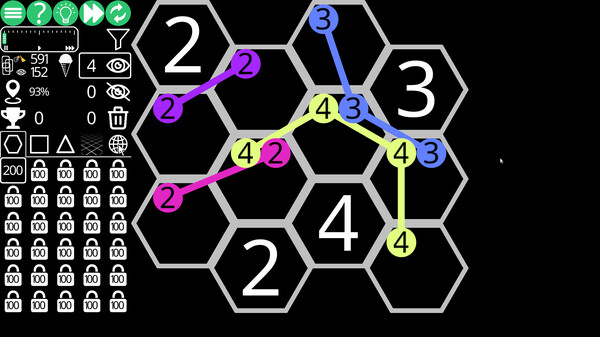 Bombe in play — the first image listed on the Steam store page — Steam store screenshot
Putting the Mechanics into Words
The board is Minesweeper. Numbers, and lines connecting those numbers into "regions." But the player's verb is not "open a square." It is: write a rule that acts on regions, and register it. The store copy lays this out in six sentences, without hiding anything.
A built-in checker tells you whether the rule you wrote is formally correct. Once it passes, it is applied automatically to every board from then on. A Japanese review's headline says it in one breath: build your own fully automatic bomb-disposal machine.
In Puzzlebyrinth's terms, this is a game where the verb has moved. In an ordinary puzzle the verb touches the board. Here the verb touches the solver, and the solver is what touches the board. It is close to the instruction-writing of 7 Billion Humans, except that what you write is a logical statement rather than a list of commands.
Luck is handled just as plainly. The store guarantees every level is solvable without guessing. A Japanese reviewer compresses it: Minesweeper with no careless slips and no coin-flips. The luck was not diluted by probability — it was declared out of the design. Of the lineage I traced in Designing Luck Out, this is the most thorough case I have seen.
So a shape you have solved never returns. What remains in front of you is only the situations your rules have not yet reached. This is subtraction: the author went straight for the repetition that made up most of Minesweeper and cut it out.
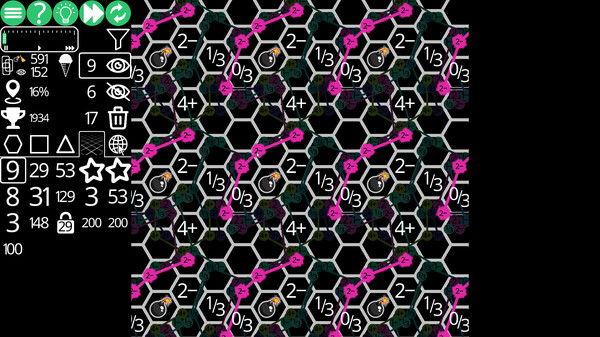 Bombe in play — the second image listed on the Steam store page — Steam store screenshot
Teaching
Sort the 17 negative reviews by the reviewer's playtime and the picture snaps into focus. Eight minutes, forty, fifty-nine, one hundred and twelve, five hundred and forty-one. Every negative in that band names the UI. Pressing the same button seems to do different things; it is not clear from the outset how to create a rule at all.
Above about seven hundred minutes, the negatives barely mention the interface. They are angry about something else entirely, which the next section takes up. The content of the complaint splits into two layers by playtime — that was the clearest shape to emerge from the 385.
What that distribution means is that the 95% is not measuring the quality of the work. It is the score written by the people who got through the entrance. The verdict of everyone who turned back is largely absent from the record.
The top Japanese reviews are telling here. One of them declines to explain the game — other reviews cover it, the author says — and instead lists, stage by stage, the symptoms of playing it. The review column is functioning as the tutorial. It is the opposite of 14 Minesweeper Variants, which walks its board rules out one at a time.
To be clear, the logic is not taught badly. Holding the hard situations back until later is close to an ideal learning curve. What goes untaught is not the logic but the handling, and the whole gate sits on a single point: how you get a rule into the screen.
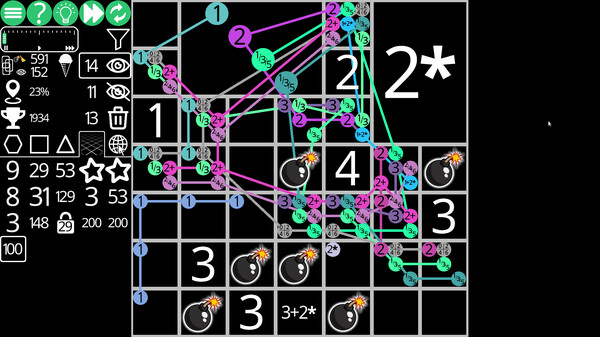 Bombe in play — the third image listed on the Steam store page — Steam store screenshot
Design Craft
The negatives from long-time players converge on one thing: being made to write near-identical rules over and over. "I found myself copy-pasting the same rule way too many times." A needlessly restrictive, draining experience that forces duplicate rules. Tautological workarounds written just to get past the checker.
What makes this interesting is that the positive side praises the same number. One writes that repeatedly reducing the count of active rules is extremely satisfying. The rule count is a score for one player and a bill for the other.
This is the most interesting place in the design. The counter on screen never declares which of the two it is. When the rule grammar cannot generalise over a shape, the count rises for reasons that are not the player's fault — and the counter goes on ticking with the same face. That is where it differs from the tally sheets in Opus Magnum, which announce plainly that they are a competitive score.
And it is, ironically, the one repetition the game did not subtract. To borrow a Japanese reviewer's image, Bombe cut a great deal of repetition away in order to leave only the fatty, prized cut of Minesweeper. A smaller repetition then reappeared, one level up, at the desk where you write the rules.
The hint system, by contrast, is placed well. It marks the squares that are determinable and clears regions that are no longer needed. It raises observation resolution rather than handing over an answer, and the work of writing the rule stays with the player. As subtraction, it is consistent.
 Bombe in play — the fourth image listed on the Steam store page — Steam store screenshot
Place in the Lineage
Reviewers reach for two lineages. One is automation and programming puzzles — if you like those, buy this. The other is Minesweeper variants, usually phrased as a unique take that might start a genre of its own.
The sharpest of them says that Bombe refreshes Minesweeper to the same extreme that Patrick's Parabox refreshes Sokoban. That correspondence is more exact than it first looks. Parabox did not add a verb to Sokoban. It moved what the box refers to.
Bombe does the same kind of thing. It adds no verb to Minesweeper. It moves who holds the verb. The player stops being the one who opens squares and becomes the one who writes the opener. Neither game is an addition; both are a change of hands.
Set against Hexcells Infinite the difference gets even clearer. That game multiplied the rules the board obeys, and changed the character of the deduction that way. Bombe leaves the board's rules entirely alone and multiplies only the rules the player writes. Same phrase, opposite side of the table.
Is the genre-starting claim right? A genre needs a second work. Three years after release I have not found a clear successor in this shape. For now it sits as an isolated point rather than a line.
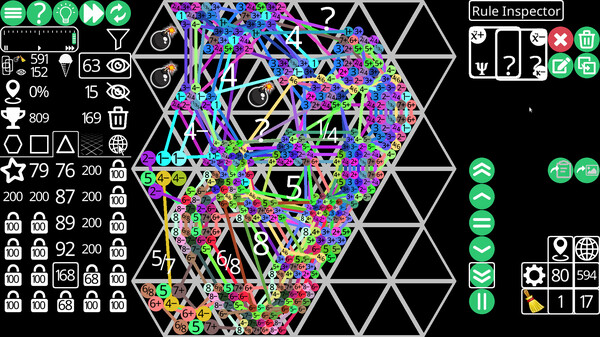 Bombe in play — the fifth image listed on the Steam store page — Steam store screenshot
The Reviews I Read
This piece was written from the Steam store page's user reviews as of 2026-09-05.
・Steam: Bombe (368 positive of 385 across all languages, 95%, Very Positive; the store page itself displays 379 reviews at 95%)
・Read: the top 12 positive by helpfulness, the top 10 negative (out of all 17 negative reviews), the 10 most recent, and 10 Japanese-language reviews — 42 in total.
・The account of the mechanics was checked against the store page's own description as primary source: the checker, the permanent auto-application of rules, the hint system, and the no-guessing guarantee.
・I found no professional press coverage. This is a low-budget solo project, and outside the review pool there is almost no other evaluative material — worth stating plainly.
・All images are screenshots published on the Steam store page and their URLs were verified to resolve. The image files themselves could not be downloaded from this run's environment, so the captions record only their order on the store page and make no claim about what they depict.
Closing
I give it 8.3. That is below Steam's 95%, but the gap is not a deduction. It is a statement that the two numbers measure different things: theirs is the score of the people who got through, mine is the score of the design including the part before that.
The achievement itself is unambiguous. The author saw precisely which part of Minesweeper is the substance and which part is padding, and removed only the padding. The whole of that judgement is contained in a single line of spec: you never solve the same situation twice.
The deduction sits on one point, the entrance. The game declares that everything is solvable without guessing — and then asks the player to guess how to enter a rule. Having driven guessing off the board only to leave it in the controls is, to me, an inconsistency in the design.
I rate the difficulty 5, the highest band. But the difficulty has moved somewhere unusual. It is not that individual boards are hard; it is that generalising the one case in front of you into a form that will hold forever is hard. In the reviewers' words, what burns out is not the board but the rule.
Who is it for? Anyone who enjoys the act of generalising a piece of logic, and who is willing to push through an unhelpful first hour unaided. It is not for people who would rather learn by playing. That narrow reach reads less like a flaw than like the shape the author chose from the start.
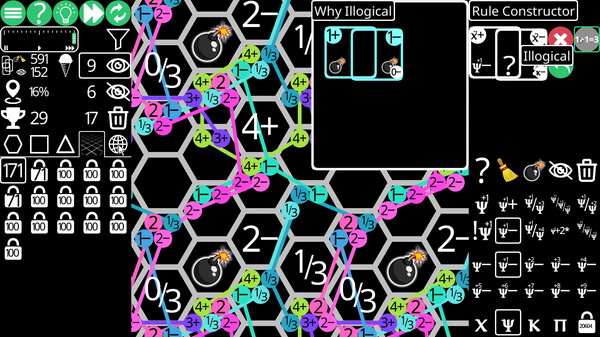 Bombe in play — the sixth image listed on the Steam store page — Steam store screenshot
Where are you with this game?
Press one and the game goes on your shelf. You can see it on your account page.
Reactions (no login)
Anonymous • one of each per visitor per day
Read next
Related reviews
Paquerette Down the Bunburrows
A 2D puzzle game about cornering rabbits down in a warren. The bunnies flee by fixed rules, so you close their escape routes in advance with traps, a pickaxe and carrots. Five themed depths, over a hundred bunnies and a stack of secrets underneath, made by Bunstack.
Desktop Dungeons: Rewind
A turn-based puzzle-roguelike on a single screen of dungeon, where revealing unexplored tiles is what heals you, so every fight is a resource problem. QCF Design's 3D remake of their 2013 Desktop Dungeons, with a rewind for taking moves back and the kingdom-building layer carried over.
The Signal State
A 2D logic puzzler where you slot modules — AND, NOT, attenuators, sample-and-hold — into a rack and patch them with cables carrying voltages from -100 to 100 until the output waveform matches the spec. Reckoner Industries builds it on modular synthesis, framed as repairing the irrigation of a ruined farm.


