REVIEW · 2022-11-14
14 Minesweeper Variants
Reading the Steam verdict on a no-guess deduction toybox
Introduction
A pure-logic puzzle collection that rewrites Minesweeper — the old flag-the-mines-by-numbers staple — in fourteen ways, and really more. Made by Alith Games and Artless Games (Godot) and released in 2022, it wears a startlingly bare screen: grids and numbers, nothing else.
I write this from the Steam review pool — over a thousand of them. The label is 'Overwhelmingly Positive,' 97% of 1,556 reviews (snapshot 2026-07-16), and the last 30 days sit at 100% of 26. Nearly four years on, the verdict hasn't slipped.
So this isn't a piece that referees a split. When 97% face the same way, the work is to translate what reviewers call 'satisfying' — and what the other 3% trip over — into design terms, and to read what happens beneath the plain surface.
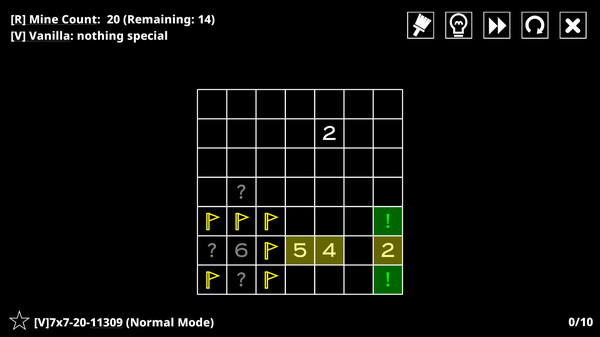 The variant-select menu — Steam store
First Impressions
Line up the helpful positives and the words rhyme: satisfying, tough-but-fair, and 'a steal for the price.' One reviewer logged 1,900 hours and called it their GOTY; another spent 1,100 reaching the hidden mode and wrote 'life-changing.' The playtimes alone tell the story.
The caveats keep returning to two things: uneven difficulty from procedural generation, and a screen stripped too bare — 'a white highlight on a white square.' The 'Artless' banner sometimes tips into hard-to-read. Even so, only 45 of 1,556 reviews are negative.
What's odd is how many recommend it hard while warning 'it's not for everyone.' Those who stall blame themselves — 'skill issue.' When the complaint points at the player and not the game, it's worth unpacking in design terms.
 A board partway through a solve — Steam store
Putting the Mechanics into Words
Reviewers state the core in one breath: 'every board is solvable by logic; no guessing.' In Puzzlebyrinth terms this is design-by-guarantee — luck subtracted to zero, every board closed under deduction. It's the ideal I discussed in guessing-free logic puzzle design, mass-produced.
So what do the fourteen variants change? Per Thinky Games, along two axes. One adds a constraint — Connected requires every mine to touch another. The other rewrites what a clue means — in Liar, each number is always off by one. The verbs (open, flag) stay; only the grammar is swapped, one rule at a time.
That looks opposite to the rule-editing of Baba Is You, but the root is the same. There you rewrite the board; here the author swaps one line and you read 'which grammar is it this time' before solving. Fourteen is a catalogue of grammars grafted onto a single verb.
 Each variant swaps the rules — Steam store
Design Craft
What positives admire most concretely is default Expert mode: make an unguaranteed move — a guess — and the mines rearrange so you fail. Several call it the feature that impressed them most. It doesn't punish guessing; it makes guessing impossible — a quiet, strong way to pin the learning curve in place.
The scaffolding is careful too. Hints don't give the answer; they only light up which clue to look at. And only hint-free solves unlock new variants and sizes, so the help pushes you away from the reward the more you lean on it. Grids grow 5x5 to 8x8, and drawing tools — inherited from Tametsi — externalise your reasoning.
That same reviewer's 'white highlight on a white square' is the flip side. Cutting visuals to raise logical purity occasionally cuts observation resolution too. Subtraction as a design creed goes a shade too far on legibility — 'Artless' holds its virtue and its flaw in one word.
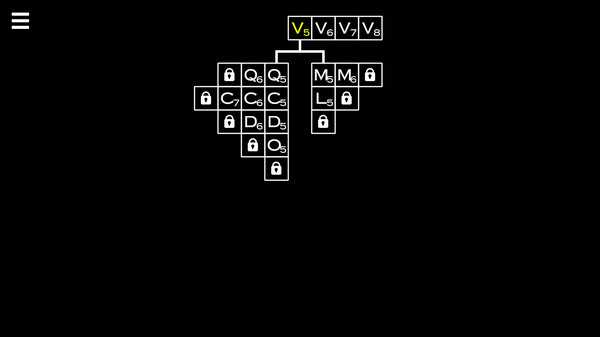 Drawing tools and gradually larger grids — Steam store
The Texture of Difficulty
The difficulty talk splits on kind, not amount. Two stuck-points recur. One is the variant logic itself, which nearly everyone accepts as 'tough but fair.' The other is unevenness from generation: 'a trivial board, then a brutal one.' A step a handmade set would smooth, the algorithm leaves in.
The same system reads two ways. Some hail the sheer volume as a 'bottomless treasure'; others note 'a machine measures difficulty differently than a human.' Both are right. 100,000-plus boards buy richness at the cost of even texture — the author chose an inexhaustible practice ground over a few polished rooms.
To me the difficulty isn't high so much as non-monotonic. The floor is guarded by 5x5 grids and hints; the ceiling runs open-ended into the hidden Ultimate mode's optimisation constraints. Expect the calm of Hexcells Infinite and you'll blink — but that's reach, not a flaw.
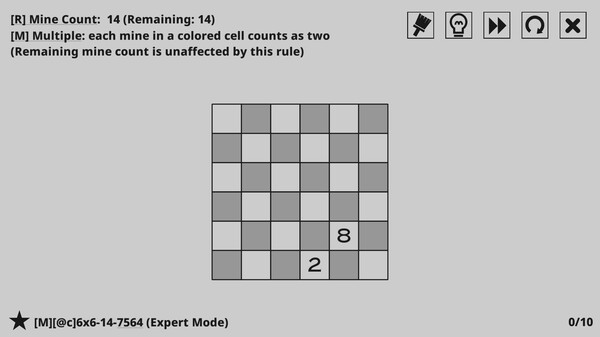 A larger grid from the later game — Steam store
Sources
This piece was written by reading the user reviews on the Steam store page as of 2026-07-16. No review text is quoted directly; typical claims are reconstructed.
- Steam: 14 Minesweeper Variants (Overwhelmingly Positive, 97% of 1,556 reviews)
- Read via WebFetch: top helpful positives, representative negatives, and several recent reviews (last 30 days: 100% of 26)
- Editorial: Thinky Games — 14 Minesweeper Variants (Oriane Tury)
Closing
Steam reads 97% positive; my design-critique score is 9.0, and they nearly coincide. A single subtracted verb, one swapped rule per variant, fourteen grammars grafted on — as logic-puzzle design it's about as clean as it gets, and the teaching (guess-proof Expert, self-limiting hints, ramping grids) is just as considered.
Two reasons I hold back from full marks: an artless UI that shaves a little observation resolution, and generation that won't smooth the difficulty steps. Both are the underside of the design creed, not quite flaws. The pool's refrain — 'not for everyone, but life-changing for the right person' — names that uncompromised purity exactly.
If the lineage of Understand or Nikoli — the joy of banishing the guess and reading the rule — rings a bell, seven dollars is too cheap. Behind the grid-and-numbers screen is a bottomless well of deduction; the only question is whether the bareness lets you take the first step down.
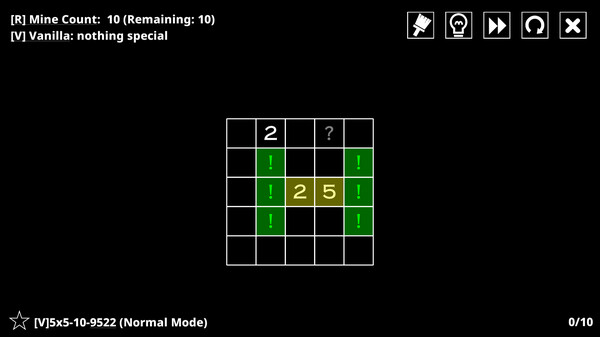 A board that closes on rules and numbers alone — Steam store
Reactions (no login)
Anonymous • one of each per visitor per day
Read next
Related reviews
Last Call BBS
Boot a fictional '90s PC, dial into a BBS, and download eight thinking puzzles one at a time - the last game from Zachtronics. From the logic puzzle Dungeons & Diagrams to circuit design in ChipWizard and the falling-block HACK*MATCH, it is a catalogue of small games with very different verbs on a single retro machine.
Dorfromantik
A hand-painted tile-placement puzzler: draw one hexagonal tile at a time and rotate it so its forests, fields, houses, rivers and rails line up with their neighbours. Complete quests to win tiles back and keep the village landscape growing, in Berlin studio Toukana Interactive's debut.
Railbound
An overhead track-laying puzzle where you place a limited number of rails so a moving locomotive links its carriages in the right order, avoids collisions, and brings everyone home. Tunnels, barriers and switches blow the board up into timing permutations, all solved with a single verb: lay track. From Afterburn, the studio behind Golf Peaks.


