REVIEW · 2020-07-16
SUPERHOT: MIND CONTROL DELETE
Adding MORE removed the hand-placed board
First Impressions
From the Steam review pool, the split here cannot be explained by how much people played. Usually the negative side is made of people who got off early. Not here. The ten most helpful negatives sit at 69, 103, 187, 473, 613, 675, 706, 875, 1012 and 1189 minutes — a median near eleven hours. The positive median is about fourteen. Both camps stayed.
As of 2026-09-08 the tally is 10,704 positive out of 12,768 across all languages: 83.8%, labelled "Very Positive". On the numbers alone this is a well-received game. But the first SUPERHOT sits at 91.5% of 40,732, so the sequel gives up nearly eight points. Where those points went is what this piece is about.
The interesting part is that both sides agree on the facts. The stages are no longer hand-built; they are dealt fresh each time. A run structure with abilities you collect has been added. There is more of everything than before. Everyone writes this. What divides them is whether to call that change "more" or "thinner".
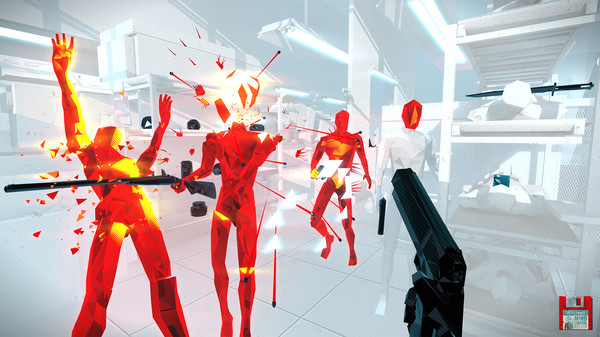 Official screenshot of SUPERHOT: MIND CONTROL DELETE (1 of 6) — Steam store screenshot
Putting the Mechanics into Words
The verb has not changed from the first game. Time moves only when you move. So despite the first-person view, this is not a game about reflexes. It is about counting bullet lines and enemy positions in a frozen world and deciding what order to solve them in. As I wrote in the SUPERHOT piece, the quickest way in is the vocabulary of time manipulation.
What MCD adds is verbs. Reviewers keep naming the throwing knives, and the swappable abilities. The positive side writes that the hacks widen your options. In Puzzlebyrinth's terms, that is verb addition: more hands means more solutions can be pulled out of one board.
The trouble is that the board those verbs act on has become disposable. In the first game each stage was placed by hand, and failure returned you to the same arrangement. Reading it through was always rewarded. MCD's rooms are re-dealt, so reading one through buys you nothing next time. The combinatorial explosion grew; the payoff for folding it up disappeared.
The signature negative sentence points straight at this. Part of what made the original great, they write, was that each level was a fresh puzzle. They are not saying verbs were taken away. They are saying the author of the board has left.
 Official screenshot of SUPERHOT: MIND CONTROL DELETE (2 of 6) — Steam store screenshot
Teaching
A hand-ordered set of stages carries information in its order. Teach it here, twist it next, combine it after that. The first game was good at that ordering. Deal the stages at random and the order is gone.
When the negative side keeps saying the game feels like a chore, I do not read that as a synonym for boring. It is a report that nothing is being taught. The same hard spot gets dealt again and again, and what you learned last run does not carry. Hours accumulate without a curve.
Random ability pickups pull in the same direction. If what you hold is decided by the draw, the first question stops being "how do I use this tool" and becomes "what did I get this time". Authorship moves from the designer to the dealer.
The positive side reads it from the other end. Many write that they enjoy testing the same verb against a different hand each run. You could say the object of study moved from "the answer to this stage" to "the reach of this verb". Both readings describe the game correctly. They differ only in what the player wanted to learn.
 Official screenshot of SUPERHOT: MIND CONTROL DELETE (3 of 6) — Steam store screenshot
What Makes It Great
So what is the positive side praising? The most common word across the helpful positives is simply MORE. More shooting, more slashing, more of it. Short recommendations pile up: if you liked the first one, buy this. Many also mention that owners of the original were given it for free.
The concrete praise clusters on the tools. Throwing knives, swappable abilities, new enemy types. The felt experience is that there are more ways to arrange the clearing of a room than before. For players who enjoy designs where the toolkit itself changes each time — Mosa Lina is the clearest case — this format lands well.
And there is something I am not willing to dismiss: duration. One positive review shows 14,639 minutes, over 240 hours. The first game was finished in an afternoon. In trading away the pleasure of solving a fixed board, this one became a place you can come back to. As an exchange, that is coherent.
 Official screenshot of SUPERHOT: MIND CONTROL DELETE (4 of 6) — Steam store screenshot
Design Craft
There is one more device nearly every reviewer mentions: late in the game you are made to wait, unable to act, for roughly two and a half hours. It cannot be skipped. The positive side writes it up as a joke; the negative side cites it as the reason they withhold a recommendation. Once again the facts are not in dispute.
The story is about the appetite for MORE. So the wait can be read as a design that charges the irony to the player's time rather than stating it in words. The intent is legible, and it is bold.
As design, though, the cost lands in an awkward place. The critique aims at the habit of wanting more, but the only people who actually pay are the ones who stayed to the end. One negative reviewer argued the move works against the very point it wants to make. I read it much the same way.
This is the one issue where the split has a different shape. Elsewhere the two camps call the same fact by different names. Here they call it by the same name and divide over whether they are willing to pay it.
 Official screenshot of SUPERHOT: MIND CONTROL DELETE (5 of 6) — Steam store screenshot
Sources
This piece was written from the user reviews on the Steam store page as of 2026-09-08.
・Steam: SUPERHOT: MIND CONTROL DELETE (10,704 positive of 12,768 across all languages = 83.8%, labelled "Very Positive")
・For comparison I also pulled the tally for Steam: SUPERHOT (37,285 of 40,732 = 91.5%, "Very Positive").
・Read via WebFetch: the top 10 helpful positive, the top 10 helpful negative and the 8 most recent reviews — 28 in total. The playtime figures come from those 28.
・Press: GameRevolution, Michael Leri, 2020-07-09 (7/10)
・Note: from this writing environment the Steam image servers were unreachable, so I could not open the images to confirm their contents. Every URL was verified to exist and all are files Steam itself serves as screenshots, but the captions are deliberately kept generic.
Closing
Read the eight most recent reviews and the argument has not moved by 2025. Among the short cheers, one line still turns up: not worth a two-and-a-half-hour brick wall. A game whose terms of debate stayed fixed for five years is itself unusual.
The press comes in from another angle. Michael Leri gave it 7/10 at GameRevolution and wrote that randomisation cannot hide the length, and that a two-hit-point design encourages hiding and waiting. His line lands: you do not have to get better, you just have to have more patience. Users argued about who placed the board; the press argued about how long it was. Two faces of the same thing.
I give it 7.4. Converted from Steam's 83.8% that would sit in the eights, so mine is low. The reason is single: what this game gave up was the centre of the first one. As games like Patrick's Parabox show, the value of a thinking puzzle lives in the ordering of its stages, not in their count.
That is not the same as calling it a failure. The verb is intact, and reading a frozen room is still a pleasure. It is wrong for people who loved the first game one stage at a time, and right for people who wanted to keep using that verb for a long while. The reach is cleanly divided. And since Into the Breach managed randomisation and full readability at once, the format itself is not a dead end.
 Official screenshot of SUPERHOT: MIND CONTROL DELETE (6 of 6) — Steam store screenshot
Where are you with this game?
Press one and the game goes on your shelf. You can see it on your account page.
Reactions (no login)
Anonymous • one of each per visitor per day
Read next
Related reviews
SUPERHOT
A first-person shooter built from white rooms and red figures, where the world's time advances only as far as you move. You take your weapons from the enemies who drop them, and a single hit ends the level. Grown by SUPERHOT Team out of a game-jam prototype.
shapez
A 2D automation puzzler where you mine simple shapes, carry them on belts, and combine cutting, rotating, stacking and painting to build whatever each level orders, growing a factory across an endlessly expanding blank map. tobspr Games' Steam build of what began as a free browser game.
ISLANDERS
A minimalist placement puzzle: drop buildings onto procedurally generated islands and score them by whatever sits nearby. No resource management, no citizens — one verb, "place." A small release from Grizzly Games.


