REVIEW · 2016-02-25
SUPERHOT
Time Moves When You Move: Reading a Puzzle in a Shooter's Clothes Through 40,000 Reviews
First Impressions
Time moves when you move. That single line is almost the whole pitch for SUPERHOT. White rooms, red figures, black guns. SUPERHOT Team released and published it themselves on 25 February 2016; the store says it grew from a small game-jam prototype over thirty months.
What I read is the ten years of Steam reviews stacked on top of that. The pool holds 40,317 reviews; across the 16,130 English ones, 90% are positive, labelled Very Positive. The last 30 days sit higher still, at 95% of 169 (snapshot 2026-08-22).
The first thing you notice is that both columns write the same sentence: this is a puzzle game wearing a shooter's clothes. GamesRadar+ says it as praise, at 4.5 out of 5. A Japanese Not Recommended review says it as a complaint.
So the split here is not about whether the game is good. It is about which sign to put in front of one shared observation. That sign is what this piece is about.
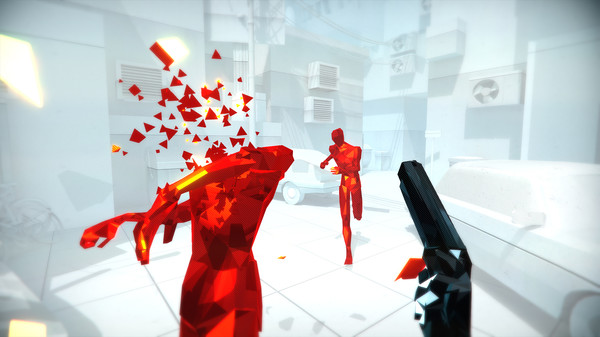 Key art for SUPERHOT — Steam store key art
Putting the Mechanics into Words
The verb list is short: walk, shoot, throw, punch. No regenerating health. Every weapon is taken from someone who dropped it. One hit ends you. That much is ordinary subtraction for a hard-edged shooter. What is unusual is that those verbs are also the tap that lets time out.
Stop moving and the bullets in the air very nearly stop too. The board becomes readable. When the positive column keeps reaching for the word innovative, I think this readable state is what it means. Every trajectory is visible; the hard part is choosing, not seeing.
In our terms it is a device for pushing observation resolution as high as it will go. The number of enemies and bullets never grows, but the weight of a single move does. There is no combinatorial explosion. Into the Breach, which shows you every enemy's next move up front, is after something similar.
The vessel is what differs. That game hands you turns on a board. This one keeps the first-person view and ties the speed of time to your input instead: turn-based reading, run through a real-time body.
 Move and the world's clock runs; wait and it barely does. The same four inputs, and the bullet (red) covers very different ground — diagram
The Feel of the Controls
So what is the negative column angry about? Lay the complaints out and almost none of them are about reading the board. Hitboxes feel off. You fall during the parkour in the fourth level. Enemies spawn out of unmarked walls. These are complaints about hands.
It helps to see the game as two layers: a reading layer while you stand still, and a real-time layer that runs only in the instant you move. You can read the room correctly and still die because your hands were late. One review claims the hitboxes grew and the game got harder than the free browser version; I could not verify that.
The positive column writes about the same seam with the opposite sign. A 13.9-hour Recommended review calls the moments it produces John Woo moments. That shot only appears when the reading and the hands land together. Flip it over and every slip of the hand becomes the complaint.
The Texture of Difficulty
The difficulty in the pool separates into three kinds. First, the difficulty of reading: finding the best move on a frozen board. Second, the difficulty of memorising: dying until you know where they spawn. Third, the difficulty of execution: aim and footing slipping away from you.
Not Recommended reviews almost always name the second and third. One writer, at 3.2 hours, calls it die-and-retry and says it measures memory rather than skill. Another, at 1.4 hours, says it turned into learning enemy placements.
Praise for the first kind clusters among the long hours. The Recommended reviews at 28, 31 and 34.5 hours are talking about the challenges and endless modes that open after the campaign — the same rooms re-solved under changed rules, where reading matters more than memory.
That is why I scored the difficulty a 3. Finishing the campaign is not heavy. It gets heavy once you add constraints yourself. Stephen's Sausage Roll is hard from the first room; this one keeps its hardness somewhere else.
Pacing
The loudest complaint is length and price. The campaign runs roughly two to three hours; the list price is $24.99. Across the twenty Steam reviews I read, the median hours logged was about five.
The interesting part is that the complaint stands in the positive column, not the negative one. A Recommended review with 268 helpful votes says it is good but $25 is steep, wait for a sale. Another with 109 votes says the same. The thumb points up while the text argues about money.
The top Recommended review, at 631 votes, offers a different frame: the campaign is a prelude, and the body of the game is the challenge and endless modes that unlock after it. As design that holds together. As a thing you can see before buying, it barely exists.
So the length complaint is probably about order rather than amount. The part where reading pays off is placed last. Anyone who stepped off at three hours never reached the puzzle underneath.
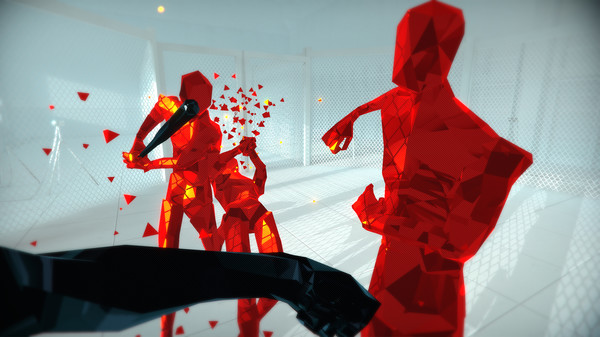
 The key art used on SUPERHOT's store capsule — Steam store key art
Sources
Written from the Steam user review pool and the aggregates around it as of 2026-08-22. No review text is quoted directly; recurring claims are reconstructed.
- Steam: SUPERHOT (Very Positive — 40,317 reviews in total, 90% positive across 16,130 English ones; 95% of 169 in the last 30 days)
- Read in full from the Steam review lists: 10 top-rated Recommended reviews, 10 top-rated Japanese Not Recommended reviews, and the 10 most recent — 30 in all.
- About 50 individual Metacritic user reviews (7.6 from 1,060 ratings: 676 positive, 312 mixed, 72 negative), for scored versions of the same arguments.
- Critics: OpenCritic (82 from 121 reviews, 76% recommend). PC Gamer 84, Polygon 90, GameSpot 80, Game Informer 78, IGN 75, GamesRadar+ 4.5/5.
- On images: Steam's image CDN was unreachable from this run, so nothing could be inspected by eye. Only two official key-art files, confirmed to exist on the store page and SteamDB, are used, with captions limited to the asset type. No in-game screenshot (ss_) was retrievable for this app. The diagram is mine and was checked.
Closing
I settled on 8.2 — below Steam's 90%, above the 7.6 from Metacritic users. OpenCritic collects 121 critics at 82, with 76% recommending. The reason for the upper half is plain: tying the verbs and the clock into one move works as a mechanism, not as atmosphere.
The reason for holding back sits in the control layer. This is a game you solve by reading, yet the last step of every solution can still fail on execution. Because that seam is not resolved, it is often unclear what to fix after a death. Nearly all of the negative column grows out of that one point.
Who it suits is clear. Anyone who likes reading a frozen board slowly. Anyone who likes pulling time onto their own side of the table, as in Timelie. What Portal did by handing you a puzzle inside a first-person shell, this game does inside a gunfight.
It does not suit anyone buying the pleasure of the shootout itself. Order matters more than aim here. And if you stop after finishing the two-hour campaign, you leave before the puzzle proper begins. The store's one line is true, but it is still not an explanation.
Where are you with this game?
Press one and the game goes on your shelf. You can see it on your account page.
Reactions (no login)
Anonymous • one of each per visitor per day
Read next
Related reviews
SUPERHOT: MIND CONTROL DELETE
The sequel to SUPERHOT, the first-person action puzzle where time only moves when you move. It drops the hand-built one-screen levels for randomly dealt rooms fought in runs, and adds abilities you pick up along the way. The third game from SUPERHOT Team.
ChromaGun
A first-person puzzle where you fire colored paint at walls and roving droids, mixing primary colors to lure each droid onto a matching panel — a Portal-style test-chamber game built on a single verb: painting.
Hue
A 2D puzzle-platformer where one button swaps the world's background between eight colours, making anything of that colour vanish. Walls, boxes and lasers are all handled through colour as you restore hue to a grey world and search for a missing mother. From Fiddlesticks Games.


