REVIEW · 2020-05-20
Timelie
Scrub time back and forth like a media player
Introduction
You drag time back and forth like a media player's timeline—that is the headline. Pull the bar right and the future plays out; you see the robot patrols and your own mistakes in advance. Pull it left and time rewinds so you can redo the past. A third-person time-manipulation stealth puzzle in which you steer a girl and a cat at once. Released in 2020 by Thailand's Urnique Studio.
I write this from the Steam review pool. The label is 'Overwhelmingly Positive,' 95% of 1,776 reviews (snapshot 2026-07-17). Metacritic sits at 77—lower than the user warmth would suggest. That gap is itself the first clue.
The helpful positive reviews converge on one praise: 'the handling of time feels new.' The negative side converges just as tightly: 'it's short, and the endgame turns into brute force.' I want to lay both voices against Puzzlebyrinth's design vocabulary.
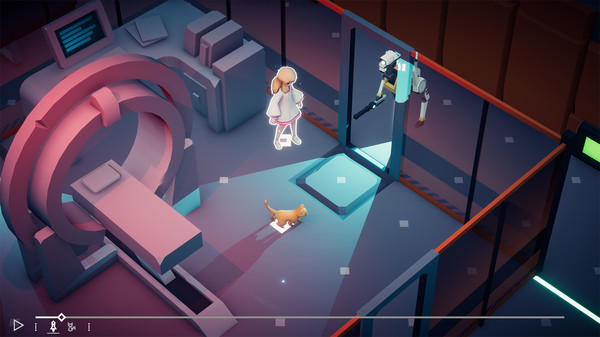 The girl, the cat, and a watching robot — Steam store
First Impressions
The first surprise in the pool is how little anyone spends explaining the controls. Many players just write 'you get it by touching it.' Grabbing and dragging the timeline rides on a metaphor everyone already knows—a video scrubber. The learning cost is outsourced to existing bodily knowledge.
The recurring positive words are 'relaxing,' 'atmospheric,' and 'clever.' Quiet music, a palette pared to a few colors, a wordless girl and cat. That calm cushions the tension of the puzzles—that seems to be the shared first impression.
The developer's store page says 'control time like a media player,' and the reviews barely contradict it. The gap between the pitch and the experience is small. I read that as a rare and honest piece of design.
 Slipping past a patrolling robot's sightline — Steam store
Putting the Mechanics into Words
When positive reviews say 'new,' I think they are pointing at the verb structure. Timelie has two core verbs: 'move time back and forth (watch the future / redo the past)' and 'move two bodies at once.' The first is observation resolution itself—play the future forward to gather information, then return to the past and act on it. Observation and execution are split along the time axis.
The second—steering girl and cat together—the developer calls 'co-op for a single player.' Reviewers say it 'takes two brains.' In design terms it folds combinatorial explosion onto the time axis. Two bodies times time is enormous, but because you can play the timeline to check, brute force becomes visible brute force.
Rewind-as-verb has precedent: Braid is famous for it, and The Entropy Centre rewinds objects. Timelie's twist is to make rewind a tool of observation rather than editing. 'Watch the future first' is a surprisingly rare verb in this genre.
 Manipulating time to plot a safe route — Steam store
The World
In both helpful and recent reviews, the thing many players mention last is the story. There are no words at all—a girl, a cat, pursuing robots, white abstract space. From that alone, plenty write 'the ending got me a little' or 'I like that it's open to interpretation.'
Part of the negative side treats exactly this as the flaw: 'too vague,' 'I couldn't tell what actually happened.' The same blank space reads as interpretive freedom to one camp and under-explanation to the other. Not better or worse—just how far the author subtracted explanation.
My read: by subtracting words, Timelie lets the time mechanic carry the story. Watching the future and changing the past becomes a metaphor for wanting to reclaim something lost. When mechanic and theme align, you don't need words.
 An isometric world pared to a few colors — Steam store
The Texture of Difficulty
Difficulty is where opinion splits hardest. The store tags hold both 'Relaxing' and 'Difficult.' Gather the reviews and the sticking points fall into three kinds: the early 'I don't get the system' wall, the mid-game 'I can't sequence this' wall, and the late 'I know the answer but can't thread it' wall.
The negative core is the third. 'It becomes brute force,' 'endless one-tile tweaks.' Late levels crowd the guards' sightlines and narrow the correct path. What they ask for is not insight but the patience to scrub the timeline until a gap appears. Observation resolution climbs so high that thought thins into fine-tuning.
Yet the positive side calls the same tweaking painless—'the cost of a try is tiny,' because rewinding is instant. One camp calls it busywork, the other comfort. Whether you enjoy the late shift from 'insight' to 'dexterity' is the fork in the reception.
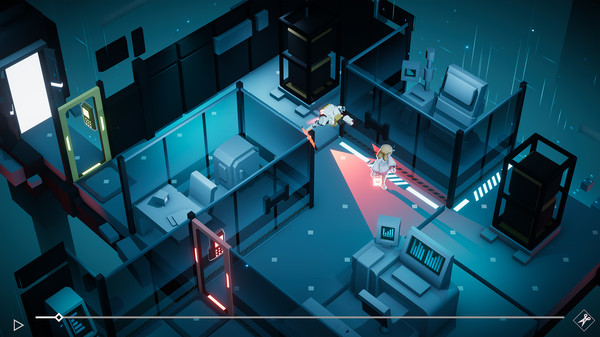 Moving the girl and the cat at once — Steam store
Sources
This piece was written by reading the Steam store page's user reviews as of 2026-07-17.
・Steam: Timelie (Overwhelmingly Positive, 95% of 1,776 reviews, snapshot 2026-07-17)
・Read via WebFetch: top 10 helpful positive, top 7 helpful negative, and 5 recent reviews
・(reference) PC Gamer: Timelie review (Tyler Wilde, 2020), and a Metacritic score of 77
Closing
Steam's overall is 95%, but from a design view I give it 8.2. The deduction is almost entirely one thing: the late shift where difficulty slides from 'insight' to 'dexterity.' The central invention—time as a media player, a verb for watching the future and editing the past—is faultlessly executed. But it is not carried all the way through as a tool of ideas.
The median completion time cited in the reviews is around six hours, with a free pack (Hell Loop) adding a few levels. 'Too short' is a fair complaint, yet I read the length as a virtue. It folds one verb up just before it wears thin—short and dense over long and diluted.
What I want to steal: the nerve to bolt a verb onto a metaphor everyone already knows (a scrub bar), skipping the tutorial almost entirely. Saying less and letting the blank space speak echoes Cocoon, but Timelie is its own thing—into that blank it slips the single move of 'watching time.' The review pool quietly, firmly agrees.
 Heading for the exit through white space — Steam store
Reactions (no login)
Anonymous • one of each per visitor per day
Read next
Related reviews
Untitled Goose Game
A sandbox stealth-puzzle in which you steer one goose through a quiet English village, working down a to-do list of pranks that sits in the corner of the screen. The goose can honk and it can carry things; the board is the villagers reacting. Made by House House, a four-person studio in Melbourne.
shapez
A 2D automation puzzler where you mine simple shapes, carry them on belts, and combine cutting, rotating, stacking and painting to build whatever each level orders, growing a factory across an endlessly expanding blank map. tobspr Games' Steam build of what began as a free browser game.
Creaks
A hand-drawn 2D puzzle-platformer in which you descend a dim mansion, shine light to turn mechanical monsters into furniture, and use that furniture as footing. No dialogue, no combat, no inventory — solved through a single rule called light, from Amanita Design, makers of Machinarium.


