REVIEW · 2020-10-15
Lucifer Within Us
Scrub the testimony, expose the contradiction
First Impressions
Lucifer Within Us sits right on the fence: Mostly Positive, 73% of 619 reviews as of 2026-07-10. What struck me is that positive and negative reviewers, for all their split, describe the core the same way — you don't act like a detective, you become one. Kitfox Games says as much on the store page, and the review pool largely agrees.
Across the helpful positive reviews, the recurring praise is how intuitive it feels to scrub a testimony timeline and jab at contradictions. The negative side keeps coming back to length: three cases, roughly two hours. Same screen — one calls it purity, the other calls it thin.
 Key art for the daemon-hunt premise — Steam store
The Feel of the Story
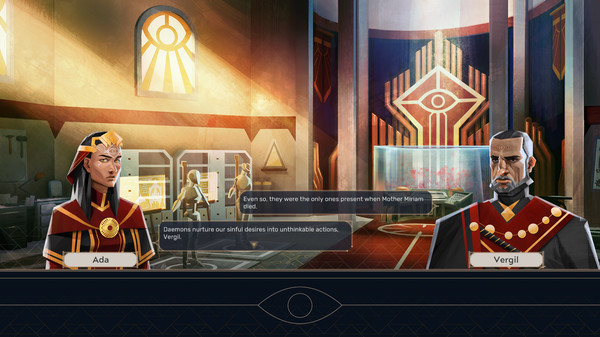
The setting — a last human city wired into a consciousness network, a church hunting digital daemons, and you as its digital exorcist — is something the review pool almost unanimously calls compelling. The isometric noir art and the theocracy-meets-technology mood draw real love from the positive side.
But the same world fuels the loudest complaint: why close it after three cases? It hints at history and culture, then draws the curtain before most of it is told. Compared with how Return of the Obra Dinn spends every corner of one ship, here the world's breadth and the runtime don't match.
 The isometric theocratic city — Steam store
Putting the Mechanics into Words
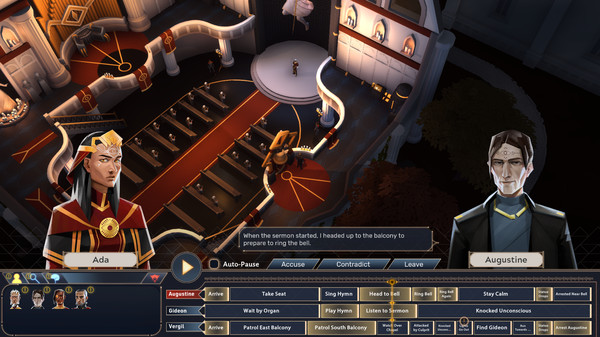
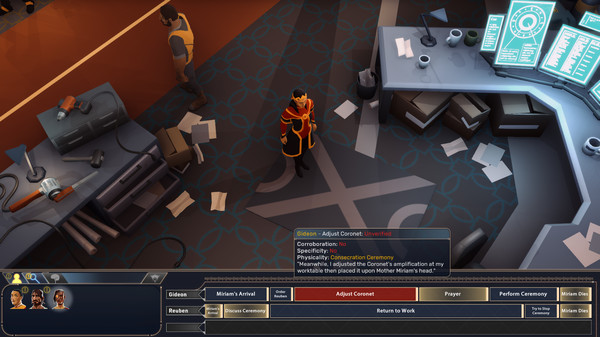
Reconstructed from reviewers' words, the loop is: gather up to three testimonies, lay them on a single timeline, scrub back and forth, and find where they disagree. When a real contradiction lands, a 'Lies Unmasked' screen fires — the moment the positive reviews keep calling satisfying.
In Puzzlebyrinth terms, there are only three verbs here: observe, rewind, contradict. That scarcity — what I keep calling verb subtraction — is exactly what the positive side means by 'intuitive.' You spend your attention on the testimony, not on the controls.
 The testimony timeline in play — Steam store
Design Craft
The most interesting design note is one the negative side points at precisely: each daemon carries a trait-name like 'the Vengeful' or 'the Proud.' So once you learn the motive, the target nearly picks itself — the deduction, they argue, is pre-solved by the naming.
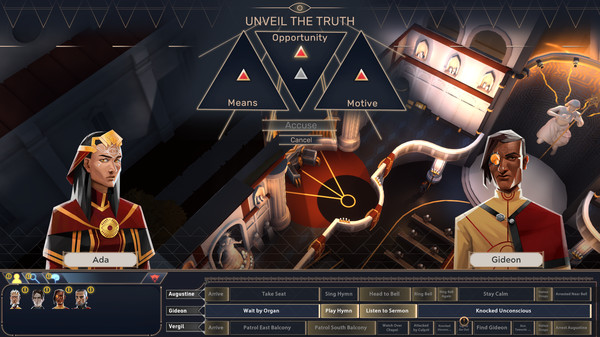
That is a leak in the grammar. Of the three layers — motive, means, opportunity — the motive shows through the name, so the combination space thins out. Where The Case of the Golden Idol keeps its combinations open to the end, here the deduction sometimes slides toward matching. The positive side doesn't mind, because it prizes the smoothness of the procedure.
Kitfox says it's 'just you and the information.' Mostly true — but taken strictly, a name that whispers the motive sits a little at odds with that claim. I read it less as a flaw than as a call toward accessibility.
 The interrogation and contradiction interface — Steam store
Sources
This piece was written by reading the user reviews on the Steam store page as of 2026-07-10. No review text is quoted directly; typical claims are reconstructed.
- Steam: Lucifer Within Us (Mostly Positive, 73% of 619 reviews, Kitfox Games)
- Read via WebFetch: the top ~10 helpful positive reviews, representative negative complaints, and several recent reviews
- Press: Metacritic 76, a PC outlet's 'one of the best detective games on PC,' plus scores from Finger Guns and Hey Poor Player
Closing
What splits the reviews is how you weight length and price. Metacritic 76, and PC outlets praise the procedural innovation; Steam users weigh three cases, about two hours, and a $20 list price, and settle at 73%. Pros measure the mechanism; users measure the portion.
My design-critique score is 7.5, a little above Steam's 73%. The timeline-and-contradiction verb set is complete within this runtime. I dock it for the naming leak that pre-solves the motive, and for ending before those verbs reach a combinatorial bloom.
Since the price fell to a low of $2.99 in late 2025, the recent reviews' 'buy it on sale' has become the default advice. For a short, pure hit of deduction it's an easy recommendation; for living in the world, the runtime falls short. Few games telegraph who they're for this clearly — and that clarity is what the 73% is really made of.
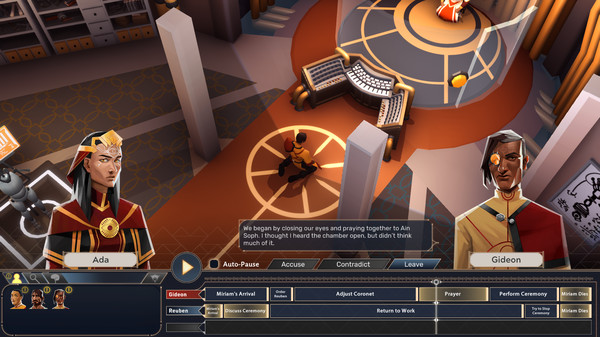 The digital exorcist at work — Steam store
Where are you with this game?
Press one and the game goes on your shelf. You can see it on your account page.
Reactions (no login)
Anonymous • one of each per visitor per day
Read next

Related reviews
Evan's Remains
A 2D puzzle adventure built from single-screen block puzzles — platforms that vanish once you step off them, blocks that switch other blocks on and off — carrying the story of Dysis, a girl searching for a missing boy named Evan. A game by maitan69.
In Other Waters
A non-violent sci-fi adventure in which you play the AI aboard a stranded xenobiologist's diving suit, scanning an alien ocean from a panel of contour lines and cataloguing the life you find. From Jump Over The Age, built so the ocean is never rendered — only described.
Unheard - Voices of Crime
A deduction adventure played over a top-down floor plan: you move between rooms and scrub a recording of the day back and forth, listening. There are no subtitles — you name the figures and answer the case questions using only what you heard. From NExT Studios.


