REVIEW · 2019-08-23
Telling Lies
Unraveling four lives with a single verb: search
First Impressions
I'm writing this by reading the Steam review pool for Telling Lies. You search a stolen NSA database of secretly recorded video by the words spoken in it, pulling clips to reconstruct four lives and one big lie — an FMV mystery from Sam Barlow, released by Annapurna in August 2019 as a successor to Her Story.
The numbers split cleanly. Steam sits at Mixed: 62% of 1,230 reviews positive (820 up, 482 down; 1,302 across all purchase types, 2026-06-30 snapshot). Yet press scored it high — IGN 9, PC Gamer 87, Metacritic 84 — while the Metacritic user score sank to 5.9. Critics raved; players are cut in half. That gap is the first clue.
Read the pool in order and both sides point at the same facts; they just measure them on different axes. So this piece doesn't pit them against each other — it asks which part of one design lands for whom. Her Story is drawn as a baseline in nearly every review.
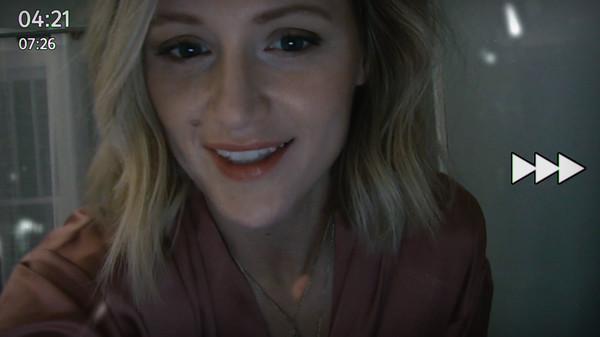 An FMV mystery built on searching a stolen NSA database — Steam store
The Feel of the Story
Across the positive reviews the recurring praise is the acting and the afterglow. Logan Marshall-Green, Alexandra Shipp, Kerry Bishé and Angela Sarafyan carry two years that assemble out of fragments; more than a few say it stuck with them, and some rate it above Her Story.
The negative side aims one word at the same story: aimless. One review jabs that Hitchcock called drama 'life with the dull parts cut out,' and that Barlow seems to disagree. The complaint repeats: you watch without knowing why.
My read: they describe observation resolution placed differently, not story quality. The game never hands you events — you rebuild the timeline and the feelings in your head. Take that as 'I get to be the editor' and it sings; take it as 'raw footage dumped on me' and it drags. As deduction-as-storytelling, Return of the Obra Dinn is a useful contrast.
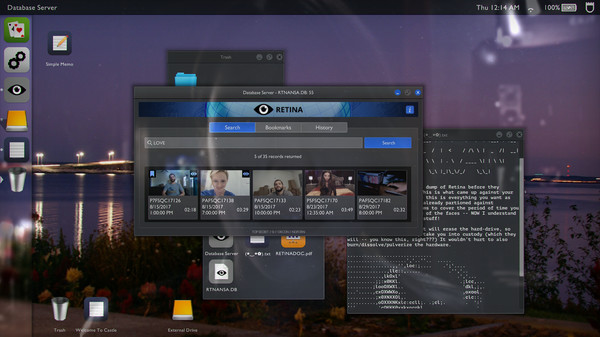 Two years across four lives, assembled from fragments — Steam store
Putting the Mechanics into Words
Positive or negative, the reviews describe the same loop: a word spoken in one clip becomes the search term that surfaces another. There is essentially one verb — search. In Puzzlebyrinth terms that's an extreme subtraction of verbs, a grammar inherited straight from Her Story.
The careful reviews note what the sequel adds. Conversations are mostly recorded from one side, so you must find the other half elsewhere and stitch them together. Many call this 'a real step forward from Her Story.'
Everyone also mentions the limit: only the top five results by date appear. The positive side reads it as 'forcing you to hunt more specific words'; the negative side reads it as 'hiding matches that exist.' The same constraint is both a teaching device for observation resolution and an arbitrary wall.
 Words spoken in a clip become the search terms for the next — Steam store
Pacing and Length
The sharpest clash is over length and pace. Detractors keep citing long one-sided monologues and roughly ten hours of footage that isn't all engaging. 'Her Story's short clips traded for a long, monotonous one-way street' shows up again and again.
The other recurring gripe is feel: you can only rewind a seven-minute clip, can't jump to its start, can't watch two side by side — one review quips the NSA's tradecraft can't be much of a threat. Early on there were fast-forward bugs, too.
This too is subtraction by design. Fast-forward, a goal marker, a second screen — Barlow cut them on purpose. Some take the friction as 'the discipline of really watching'; others call it plain inconvenience. Whether friction converts into pleasure is what splits the experience. Against the dense brevity of Her Story, this game's bet on length carries a heavier load.
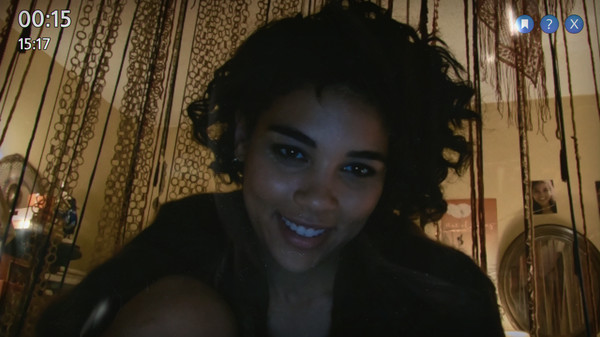 No fast-forward, no jump-to-start — the friction is left in on purpose — Steam store
The Reach of the Design
The pool also explains the press-vs-player gap. Critics scored the acting, structure and themes on their own. Players score the hours of hands-on navigation along with them. One review bluntly wishes they'd 'waited for Steam reviews instead of trusting the critics.' The medium of judgment drives the gap.
But I'd read it as reach, not failure. The thin hinting, the long takes, the awkward playback — Barlow built them for one audience: the viewer willing to sit and observe. Who it's for and who it isn't is unusually stark. He declined to sand it down for everyone.
That authorship sharpens further in Immortality (2022). From 2015's Her Story onward, this is the lineage that takes stories apart with a single verb — search — and Telling Lies stands at its midpoint. The very split is the width of the experiment.
 A design unusually clear about who it is and isn't for — Steam store
Sources
This piece was written by reading the user reviews on the Steam store page and related sites as of 2026-06-30. No review text is quoted directly; typical claims are reconstructed.
- Steam: Telling Lies (Mixed — 62% of 1,230 positive; 820 up / 482 down; 1,302 across all purchase types; 2026-06-30 snapshot)
- Read via WebFetch: helpful and recent user reviews, plus Metacritic user reviews (user score 5.9)
- Press: Metacritic (84), IGN (9/10), PC Gamer (87)
Closing
Steam's 62% doesn't mean the game is broken. It's an honest readout of a design whose reach is narrow and deep. If you'll sit and watch the material, it hits hard; if you want game-like goals and comfortable controls, it mostly won't.
From a design standpoint I give it 7.5 — higher than Steam's 62% because I read most of the friction as intent, not accident. But the fact that four in ten feel only the inconvenience is part of the design too: good subtraction sharpens who it's for as much as what it removes.
If you want to watch the experiment of solving a story with one verb, this is essential. As an entry point, though, Her Story is lighter; Telling Lies is the door you open next, on purpose.
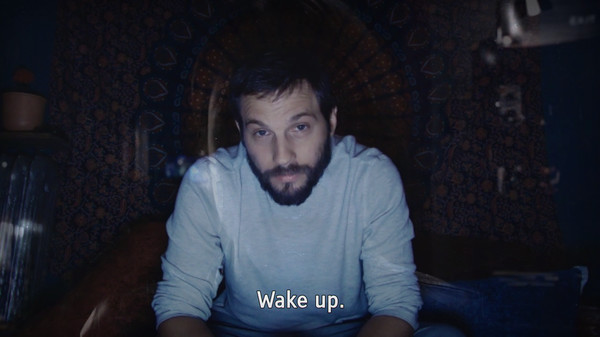 The midpoint of an experiment in solving a story with one verb — Steam store
Where are you with this game?
Press one and the game goes on your shelf. You can see it on your account page.
Reactions (no login)
Anonymous • one of each per visitor per day
Read next

Related reviews
IMMORTALITY
An FMV adventure built from the unreleased films of vanished actress Marissa Marcel. Pause the footage, click a face or an object to match-cut into another clip, and assemble the fragments to chase her disappearance. From Her Story's Sam Barlow, who reworks the verb 'search' from text into the visual.
Unheard - Voices of Crime
A deduction adventure played over a top-down floor plan: you move between rooms and scrub a recording of the day back and forth, listening. There are no subtitles — you name the figures and answer the case questions using only what you heard. From NExT Studios.
The Occupation
A first-person thriller set in North West England on 24 October 1987, in which you play a journalist slipping into restricted areas and interviewing people to gather evidence. The in-game clock runs at real-world speed and the cast moves on a timetable, in this game from White Paper Games.


