REVIEW · 2020-03-06
Murder by Numbers
Reading the Steam reviews of a picross-and-murder-mystery hybrid, and the question of who actually deduces
First Impressions
Los Angeles, 1996. Honor Mizrahi, an actress just fired from a TV detective show, is pulled into a murder when her boss suddenly dies, and teams up with SCOUT, a discarded reconnaissance robot, to clear her name. That is Murder by Numbers, developed by Mediatonic and published by The Irregular Corporation on March 6, 2020, with all clue-hunting handled through picross (nonogram) puzzles. I wrote this by reading the user reviews stacked up on Steam as of 2026-07-11: Very Positive, 85% of 1,142.
Line up the helpful positive reviews and the words rhyme: charming, gorgeous art, an amazing soundtrack, and again and again, "Phoenix Wright plus picross." The music is by Ace Attorney composer Masakazu Sugimori and the character art by Hato Moa of Hatoful Boyfriend, and most recommendations put those two names at the center. The tightest praise is a formula: "Like picross? Like visual novels? Buy it."
The single most-upvoted review, though, isn't praise but a structural observation: if you want an Ace Attorney-style novel there are too many puzzles killing the pacing; if you want straight picross there's too much plot and busywork between them. Needs polish, no real agency, missable puzzles — the qualified and negative reviews all circle this one point. I read the split not as a fight but as a question of design range.
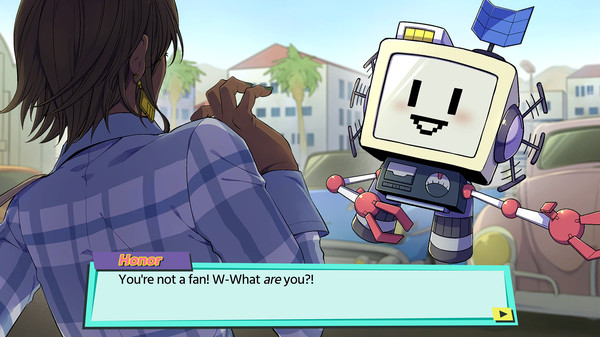 Los Angeles, 1996: Honor and SCOUT — Steam store
Putting the Mechanics into Words
The loop reviewers describe: scan a room for something off, solve one picross grid, and a clue-picture appears; press that clue on a witness in conversation, then move on. The verbs are few — fill a cell, mark a blank, pick a clue in dialogue. In Puzzlebyrinth's terms, a self-contained picross grammar bolted onto an investigation frame.
Here many reviewers name the same unease: "you never actually solve anything." The grid logic is pure, but the case logic is filled in by the protagonist's leaps. The coloring puzzle and the mystery puzzle are decoupled. Unlike Return of the Obra Dinn or The Case of the Golden Idol, where you raise your own observation resolution to close in on the truth, here the thinking happens on the board, not on the case.
The input grammar draws its own complaints: it's easy to stray into an adjacent row while dragging and ruin a grid, you can't clear the board, there's no dialogue backlog — friction points that recur from launch reviews to recent ones. The picross itself is called "top notch," which is exactly why these misses sting. Clean subtraction of verbs, undercut by an input layer left unpolished.
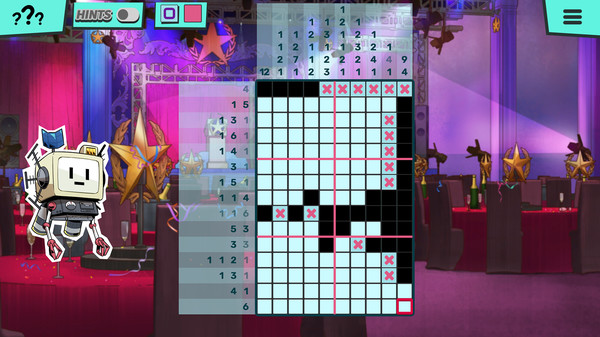 A picross grid that unearths the next clue — Steam store
The Feel of the Story
When positive reviews talk about the story, the two-hander is always at the center: the fired actress and the amnesiac robot. Comedy and drama in equal measure, moving from TV studios to drag clubs to award shows across 1996 Los Angeles. Hato Moa's portraits and Sugimori's upbeat score keep pulling out the same word: heartwarming.
The negative side keeps questioning the scaffolding: characters act foolishly to manufacture drama, the protagonist accuses people without evidence and then reverses herself — padding to stretch each case. It's a kinetic novel with no meaningful choices; nothing you decide changes the ending. Character charm carries it more than mystery coherence.
Tellingly, the store description says "use clues to interrogate witnesses, work your way to the truth" — as if you deduce. The review pool reads closer to "you are carried to the truth." I take that not as deceit but as a statement of audience: ideal for someone who wants a warm novel with picross between beats, wrong for someone who wants to build the deduction themselves.
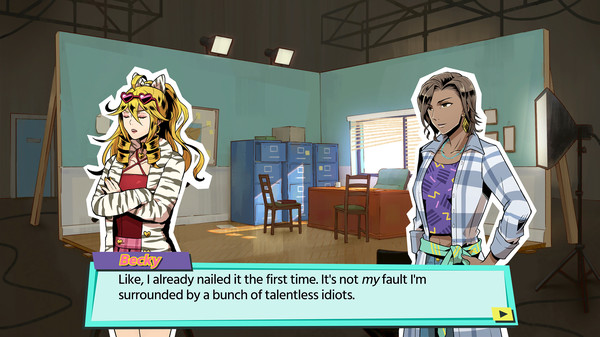
 The cast, designed by Hato Moa — Steam store
The Texture of Difficulty
On the picross, praise and complaint report the same fact with opposite signs. Grids rarely exceed 15x15; later chapters raise the challenge by chopping the clue numbers finer rather than enlarging the board. Picross veterans call it small and unambitious; newcomers say the later ones were harder than expected and yielded after a break. One design, read as a low ceiling or as a gentle climb.
The exception is the timed "hacking" puzzle each chapter: small 5x5 grids against a clock, unpausable and unskippable. Reviews asking for reaction-time relief or accessibility options run unbroken from the 2020 launch to 2022 recent posts. A reflex gate wedged into a game that is otherwise about logic.
Dissected, the difficulty has three layers: logic difficulty, gentle and deliberately capped; input friction, straying marks and no clear-board; and a reflex gate, the timed hacking. Only the first is something you savor as thinking; the other two are texture the design left unrefined. Add missable puzzles that block 100% completion, and completionists carry a small, needless tension.
 Grids grow trickier, not larger — Steam store
Sources
This piece was written by reading the user reviews on the Steam store page as of 2026-07-11. No review text is quoted directly; typical claims are reconstructed.
- Steam: Murder by Numbers (Very Positive, 85% of 1,142; across all languages 1,407 of 1,675 positive)
- Read via WebFetch: top All-Time helpful positive and negative reviews, several recent ones, and community screenshot posts
- Press: Metacritic 79; review takeaways from Eurogamer, God is a Geek (9/10), Nintendo Times and others
Closing
Across the review pool, one picture emerges: a hybrid that chose warmth over deductive rigor. Picross and murder mystery run in parallel more than they interlock. The coloring logic is tight while the case logic proceeds out of the player's hands. The split, to the end, is two views of that single structure.
Steam sits high at 85% of 1,142. From a design standpoint I land at 7.5. The gap is clear: full marks for the polish of art, music, and character drama, but on the question this site weighs most — who does the thinking — the game answers "the board," not "the case." That the press (Metacritic 79) runs a notch warmer than users fits, too: they measure the novelty of the fusion, users the daily friction.
So the audience is clear. If you like picross and want the Ace Attorney mood with a 90s drag-club backdrop, it's about as good a partner as you'll find. If you want to assemble the truth from your own observation, head instead to games where logic itself is the lead, like Return of the Obra Dinn or Hexcells Infinite. For either reader, the shape of the split says best what this game chose to be.
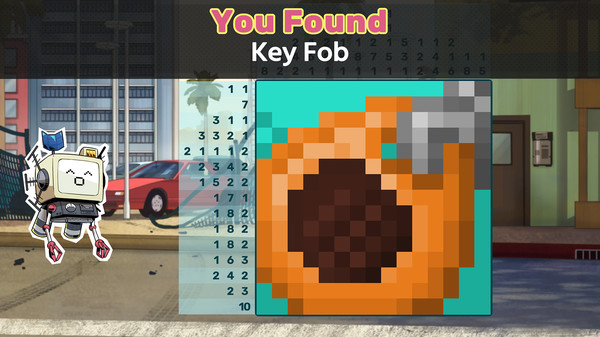 Where picross and mystery run in parallel — Steam store
Where are you with this game?
Press one and the game goes on your shelf. You can see it on your account page.
Reactions (no login)
Anonymous • one of each per visitor per day
Read next
Related reviews
Phoenix Wright: Ace Attorney Trilogy
A courtroom adventure in which you play defense attorney Phoenix Wright, matching one line of testimony against one piece of evidence to break a lie. Capcom's collection gathers all fourteen episodes of the three games first released between 2001 and 2004, with the art redrawn frame by frame.
Lucifer Within Us
An isometric detective game where you scrub testimony timelines and jab at contradictions to solve murders, piecing together motive, means, and opportunity in a daemon-haunted theocracy — from Kitfox Games.
Lightmatter
A first-person puzzler where touching a shadow kills you instantly. Light your way out of a collapsed research facility using only portable lamps and light-relaying pylons, turning a floor of darkness into a safe path. Tunnel Vision Games' open love letter to Portal, built on the single paired verb of light and shadow.


