REVIEW · 2023-10-17
Mosa Lina
How the Steam review pool received a puzzle game that admits some boards can't be solved
Introduction
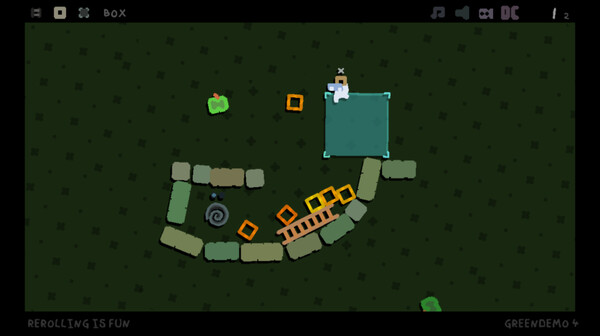
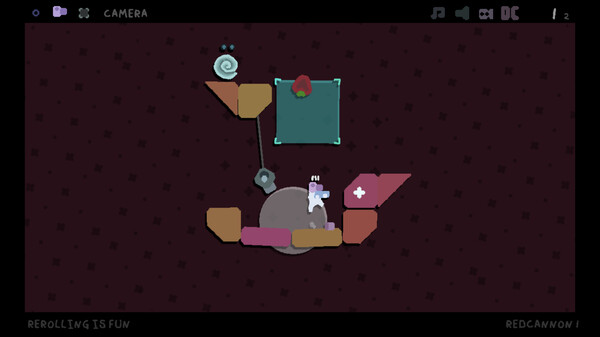
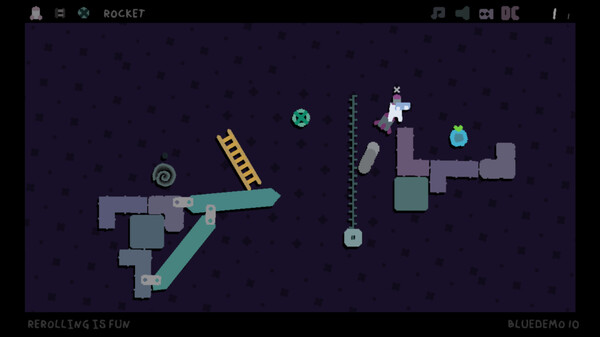
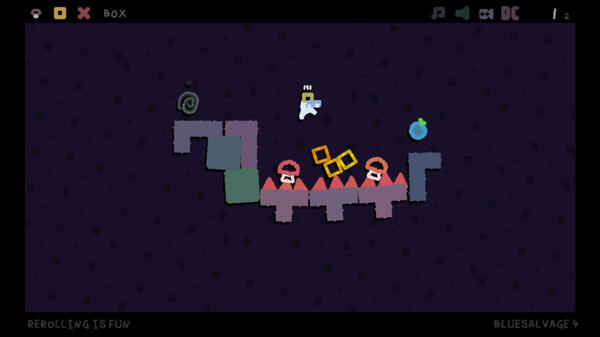
Collect the fruit scattered around a stage, return to the exit. That is the whole rule, and it is handed over entirely to a physics engine. You yourself can only walk and jump; everything else comes from three tools dealt at random for each attempt. Released 17 October 2023 by Stuffed Wombat, credited alongside Silkersoft, Lukke and Rollin'Barrel. The store page introduces it as a hostile interpretation of the immersive sim.
I am writing this from the Steam review pool. The aggregate reads 95% positive across 1,987 reviews, labelled Overwhelmingly Positive (snapshot 2026-08-04), with the last 30 days at 89% of 19. By the numbers, this looks like a settled question.
And yet the same store page says the developer cannot verify that every level is beatable with every tool combination. A puzzle game that refuses to guarantee a solution, sitting at 95%. Reading which words the pool chose for praise explains how that works.
 Mosa Lina store header key art — Steam store key art
First Impressions
The first thing I notice in the helpful positive reviews is that the praise is not aimed at polish but at a sense of not being allowed. Reviewers keep saying it feels like constantly getting away with something, or that every death lands like the punchline to a joke they didn't know they were writing. Several one-line recommendations reach for other games played wrongly on purpose: mashing jump up a mountain, clearing a shrine by a route nobody intended.
The negative side names the same property differently: an un-game, no winning, no progress, no design, with RNG generating more slop than play. The sharpest version of the complaint is that the game means to break conventions and instead confirms why conventions exist.
So both camps agree on what the game is — random, rough, unguaranteed. The disagreement is only whether that reads as the endpoint of a design or the abandonment of one. That agreement is precisely why a 95% game is still worth reading.
 Mosa Lina store capsule key art — Steam store key art
Putting the Mechanics into Words
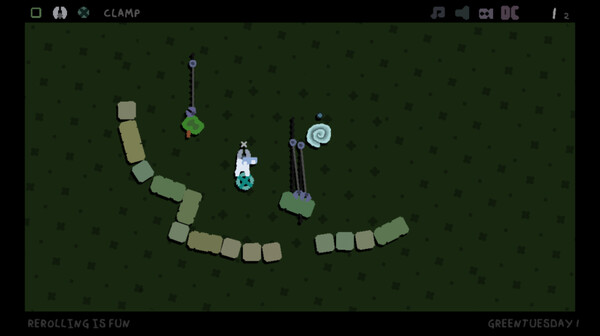
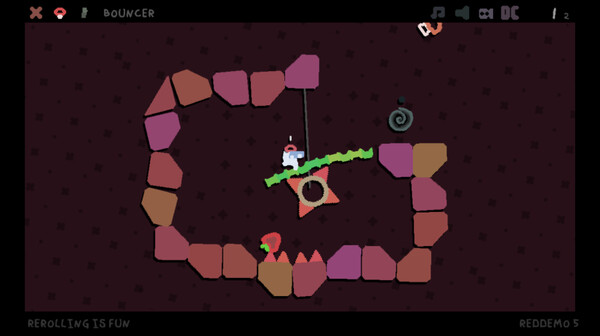
Cross-referencing the reviews, the structure is this. A run picks nine stages and nine tools from the pool. Each attempt at a stage hands you only three of those nine. Uses per tool are fixed and reset on retry. Dying moves you to another stage, with unfinished ones returning later. Only the final stage is an expanded version of a normal one, seeded with boxes that swap your tools.
What the positive reviews enjoy pointing out most is that the player character can only walk and jump. That is subtraction of verbs in the Puzzlebyrinth sense: strip the player's own verbs to the bone and move all expressive power out into the tools. Change three tools and the same board becomes a different problem — the widely reported feeling that solutions change completely on the same stage is a by-product of fixing the verbs and swapping the grammar.
What makes it unusual is the open refusal to verify the combinatorial explosion. The tool set is reported to have doubled from 24 to 48 in a 2025 update. Forty-eight down to nine, nine down to three, multiplied by handmade stages: too wide for one author to check. Ordinary puzzle design prunes that explosion to guarantee a grammar in which solutions exist — that guarantee is what Stephen's Sausage Roll and Patrick's Parabox are built on. Mosa Lina sells the space that opens up when you remove it.
 Mosa Lina in play — Steam store screenshot
The Texture of Difficulty
Collecting where reviewers got stuck, the difficulty splits three ways: coming up with an idea from the three tools in hand; executing that idea through twitchy physics and loose character control; and the draw itself, when the three tools simply don't meet the board.
The third is where the two camps use one word for different things. Positive reviewers treat a bad draw as a cue to die quickly and move on — because impossibility is stated up front, they can let go instead of filing it as personal failure. Negative reviewers describe the same moment as time invalidated by design. Both reports are accurate; only the attribution of failure differs.
The final stage draws complaints from outside both camps. One specialist piece (Electron Dance) singles out the structure of taking the stage you are struggling with most and expanding it into the finale, and calls rerolling there galling. I agree that the switch in the quality of difficulty at the end is a weak point: nine stages train you to let go cheaply, then one stage is placed where letting go is expensive.
 Mosa Lina hero capsule key art — Steam store key art
Place in the Lineage
Line up the proper nouns in the pool and the coordinates appear. The most common is the physics-as-harassment lineage, the work of Bennett Foddy. Then a roguelite sold on material interaction (Noita), a sandbox that conjures objects from words (Scribblenauts), and the shrines of big open-world action games that promise free solutions. The specialist reading lands nearby: Electron Dance calls it a portal into a Foddy-shaped reality while invoking Miguel Sicart's notion of abusive game design.
Users and critics look at the same spot with different weight, though. Users centre their recommendation on a growing vocabulary of tools — the item you wrote off becomes your first pick, and you feel like a craftsman. That is a learning curve relocated out of stage order and into the player's tool literacy. Critics focus on the fact that this learning is never stored as progress: there is no reward structure. The number of reviews logged at very high playtimes suggests the first reading holds up in practice.
My own placement: Mosa Lina is a game about observational resolution wearing the costume of a physics sandbox. Getting better means learning to re-read bouncy objects and coarse collisions as things usable on this specific board. Where Baba Is You does that by re-reading rule text, this does it by re-reading physical behaviour — and because the object of re-reading is matter rather than language, the same discovery comes out as a laugh.
 Mosa Lina library hero key art — Steam store key art
Reviews I Read
This piece was written from the Steam user reviews as they stood on 2026-08-04.
・Steam: Mosa Lina (Overall 95% positive, 1,987 reviews, Overwhelmingly Positive; last 30 days 89% of 19)
・Read via WebFetch: the top 11 English and top 8 Japanese reviews by all-time helpfulness (posted between October 2023 and June 2025). Coverage of the negative side is limited to the recurring claims I could confirm through review search: un-game, RNG slop, conventions re-confirmed
・Steambase: Mosa Lina Reviews (month-by-month positive/negative counts; negatives grow from 37 in February 2024 to 84 in January 2026, with the ratio roughly flat)
・Electron Dance, "King Mosa" (Joel Goodwin, 2023-11-26)
・SteamDB: Mosa Lina (release date, developer credits, supported languages, asset URLs)
Closing
Steam reads 95% positive; from a design standpoint I put it at 8.0. The gap sits in the third kind of difficulty, the draw. The freedom created by dropping the guarantee of a solution is real, and pairing subtraction of verbs with re-readable physics is unusually sharp at this price. But that freedom is only issued to players who can let a bad draw go cheaply, and the finale hands back the expensive kind of letting go.
On who it suits, one Japanese review puts it most economically: not for people who want a game where a solution definitely exists. That is not a fault, it is a statement of design reach. Positive reviewers call the same property clean; negative reviewers call it careless. Both words come from a single choice.
Playtimes cited in reviews range from a little over two hours to more than three hundred, clustering around five to ten. With an endless mode, a level editor and Workshop support, the ceiling is a matter of stubbornness. Reviews also report that a 2025 update doubled the tool count and added Japanese text, and recent reviews often read as thanks for that change: the reach is a little wider than it was.
 Mosa Lina library capsule key art — Steam store key art
Where are you with this game?
Press one and the game goes on your shelf. You can see it on your account page.
Reactions (no login)
Anonymous • one of each per visitor per day
Read next
Related reviews
Desktop Dungeons: Rewind
A turn-based puzzle-roguelike on a single screen of dungeon, where revealing unexplored tiles is what heals you, so every fight is a resource problem. QCF Design's 3D remake of their 2013 Desktop Dungeons, with a rewind for taking moves back and the kingdom-building layer carried over.
Can of Wormholes
A grid-based sokoban where you steer a worm that crawls Snake-style-head forward, tail shrinking-to fill target holes with a body of the exact right shape and length. A handful of verbs (push, grow, slice) hide layers of interactions that fire only under precise conditions. By munted finger.
Teslagrad 2
A 2D puzzle-platformer that climbs an abandoned tower above a northern fjord by flipping magnetic poles and carrying momentum. Rain Games keeps the wordless storytelling and painted backdrops of the original, but steers from stop-and-think puzzles toward sliding and flow.


