REVIEW · 2025-07-14
Kaizen: A Factory Story
Praised for getting kinder, faulted for the same
Introduction
Japan, 1986. An American new hire is put to work designing automated assembly lines at a factory on the edge of Tokyo. On a green grid you place arms and tracks, program a timeline of commands, and build calculators, camcorders and arcade cabinets. Made by Coincidence, published by Astra Logical and Klei Publishing on July 14, 2025.
I write this not as a play diary but from the Steam review pool. The store label is 'Very Positive' — 92% of 674 reviews (snapshot 2026-08-02), and 84% of 13 in the last 30 days. Metacritic sits at 80. By the numbers, a solid game.
Read the text, though, and praise and complaint keep landing on the same feature. What one side calls 'finally playable,' the other calls 'the challenge removed.' What follows is an attempt to translate that argument into design terms.
 Kaizen: A Factory Story — Steam store key art
First Impressions
Line up the helpful positive reviews and the vocabulary rhymes: polished, breezy, 'clean and tactile,' snappy. The UI, the soundtrack and the voiced dialogue scenes draw most of the praise, and more than one reviewer calls this the most refined presentation the team has produced.
The negative side rhymes too: short, shallow, repetitive, fiddly, under-baked. Reviewers keep volunteering their clear times — seven story chapters in eight to ten hours — which tells you the running length itself is the argument.
What's striking is that both camps agree on the opening. The first rooms are easy for everyone. The fork comes later: whether you read that ease as where the game stopped, or as what let you reach the end. It's rare for a game's problem to be that its first impression is too smooth.
 Building a camcorder: two arms and a handful of commands — Steam store screenshot
Putting the Mechanics into Words
The pool counts the verbs, and there aren't many: grab and release, push and pull, flip, then weld, rivet, cut and drill. Tracks carry an arm in a straight line, but only one way and only so far. When negative reviews complain that rotation is gone entirely and tracks were 'nerfed,' they are describing, in Puzzlebyrinth terms, a deeper subtraction of verbs than the studio's earlier work.
What moved forward instead is observation resolution. You can edit the layout while it runs, and the change plays back from the exact tick you're on; collisions are flagged on the timeline before you press start. The positives call this fast iteration, and say they no longer have to hold the whole factory in their head. The load shifted from memory to observation.
The negatives dock points for precisely that shift — the mental bookkeeping, they argue, was the pleasure. Neither side is misreading. The author simply relocated the difficulty from memory load to spatial assembly, and that is a decision, not an accident.
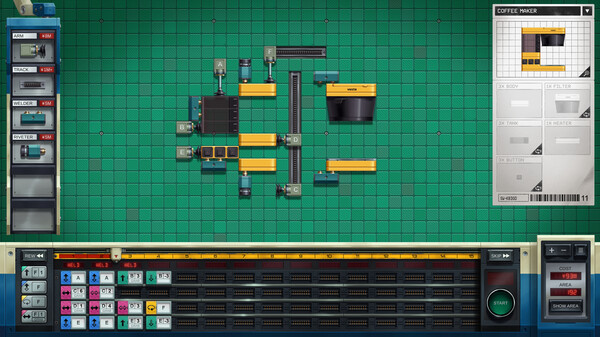 A coffee-maker board: arm, track, welder and riveter on the shelf, the cutter and drill slots still empty — Steam store screenshot
The Texture of Difficulty
The most frequent word in this pool is probably 'easy,' used as praise and as complaint. The positives write that the older games were simply too hard, and that this one is where you start. The negatives write that the campaign is one long tutorial and that only the final puzzle behaves like a puzzle.
Sort the stuck points and there are three kinds: reading orientation when a part arrives flipped; scheduling several arms so they don't collide; and shaving cost, area and cycles on the histograms. The first two hit their ceiling by the middle chapters. The third is entirely optional. The curve flattens before it has finished rising, then steps once at the end.
To me this is placement, not quantity. Space and part counts are barely limited here, so no combinatorial explosion ever forces your hand. Tighten your solution and it becomes beautiful; don't, and it still passes. Elegance has been moved from requirement to prize. 'You can brute-force it' names that relocation exactly — the difficulty didn't vanish, it emigrated to the optional layer.
 An arcade-cabinet board: many arms and tracks, and a command timeline stretched wide — Steam store screenshot
Place in the Lineage
The most frequent proper nouns in the pool are not the studio's name but Opus Magnum and Infinifactory. 'The two of them mashed together' shows up on both sides of the split, and some reviewers rank the whole back catalogue mid-review. This game is measured on a shelf from the first sentence.
The sharpest gap between the store text and the reviewers is one word. The page calls it an 'open-ended puzzle automation game'; a negative review answers that there is no sandbox and no community puzzles, so what exactly is open-ended? Open-ended here means 'more than one valid solution,' not 'endless.' That mismatch does a lot of the damage to expectations.
The customary card game belongs to the lineage too — a pachinko-flavoured solitaire called Commuter Rush. Positives enjoy the theming; negatives call the luck weighting too heavy. Given that the earlier bonus games were built on the same design logic as their campaigns, a side game leaning on chance points the same way the main game does when it makes optimisation optional.
 Commuter Rush, the pachinko-styled solitaire, with its win counter and handle on the right — Steam store screenshot
Sources
This piece was written by reading the user reviews on the Steam store page as of 2026-08-02. No review text is quoted directly; typical claims are reconstructed.
- Steam: Kaizen: A Factory Story (Very Positive, 92% of 674 reviews; 84% of 13 in the last 30 days)
- Read: the top 10 helpful positive reviews, the top 10 helpful negative reviews, and several recent ones (English-language)
- SteamDB: app 2275490 (cross-checking release date, developer and the Metacritic score of 80)
Closing
Steam reads 92% of 674 positive; my design-critique score is 7.8. The gap is wide enough to explain. The feel of laying out a process, the small verb set, the raised observation resolution — those are good calls. The marks come off because almost no new call arrives after the middle: the grammar is complete early, and the rest of the game asks bigger questions in the same grammar.
Clear times reported in the pool cluster around eight to ten hours, and most players finish inside a week. Easy is not itself a flaw. What I miss is not difficulty but a second grammar waiting on the far side of the easy stretch. The single puzzle in the last chapter points at where this game could have gone.
Who is it for? Anyone new to automation puzzles, or anyone tired of holding a whole factory in their head, will find a good door here. Anyone who came to buy the hours of being stuck is outside its reach. Read end to end, the split is not about quality — it is about whether you welcome that change of aim.
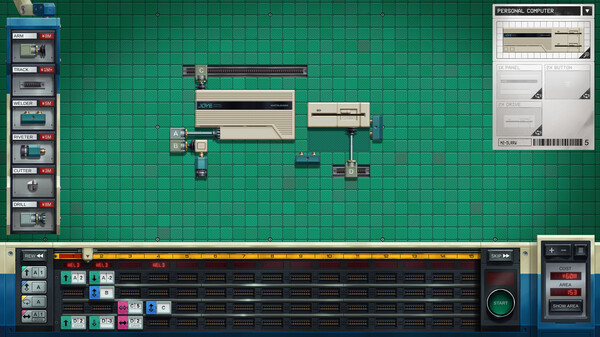 A personal-computer board with plenty of empty space and only four arms placed — Steam store screenshot
Where are you with this game?
Press one and the game goes on your shelf. You can see it on your account page.
Reactions (no login)
Anonymous • one of each per visitor per day
Read next
Related reviews
shapez 2
A 3D factory-building puzzle: mine geometric shapes, carry them on belts, and combine cutting, rotating, stacking and painting until they match the order. No enemies, no time limits and no building costs — just platforms scattered across three layers of space, in tobspr Games' sequel to shapez.
Bombe
A logic puzzle where you do not clear the Minesweeper board yourself: you write rules that act on the numbered regions, and a checker verifies them. Rules that pass are applied automatically to every board from then on, leaving only the situations no rule has reached. A solo project by Charlie Brej.
World of Goo 2
A sequel to the physics-building puzzler: grab black goo balls, link them into bridges and towers, and route them to the exit pipe. New goo species that stretch, shrink and explode join liquid that runs downhill and pools, across five chapters and sixty-plus levels. From 2D BOY and Tomorrow Corporation.


