REVIEW · 2025-04-25
World of Goo 2
When the recommend column stops recommending
First Impressions
World of Goo 2 is a sequel to the physics-building puzzler; the Steam version arrived on 25 April 2025, developed and published by 2D BOY and Tomorrow Corporation. The verbs are unchanged: grab a goo ball, attach it to what is already standing, extend a bridge or tower toward the exit pipe. Five chapters, sixty-plus levels. Critic reviews were all in by August 2024, some eight months before Steam got it.
The 2026-08-12 snapshot reads 761 recommended against 109 not recommended out of 870 in all languages — 87%, labelled Very Positive. English alone (388) sits at 85%; Simplified Chinese (192) and Russian (178) both at 90%. OpenCritic aggregates 19 critics at 82, Metacritic at 83. By the numbers, an unremarkable good sequel.
Sort the recommending reviews by helpfulness, though, and praise is scarce. One near the top wishes Steam offered a middling option; another says it would leave a “meh” score if it could. The thumb points up and the body text is a list of complaints. What stands out first here is not a split between camps but a twist inside the positive column itself.
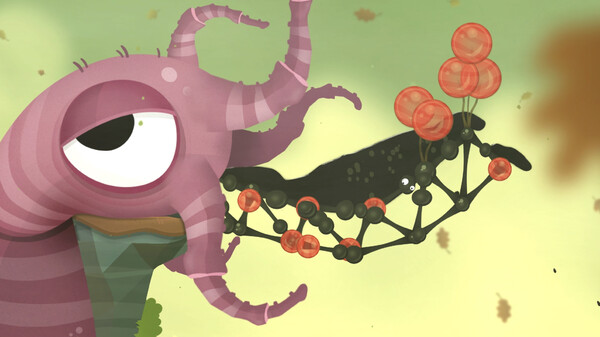 A huge one-eyed creature with striped tentacles against a yellow-green sky, a black goo framework extending to the right while translucent red goo pulls the structure upward — Steam store screenshot
Putting the Mechanics into Words
Two additions come up on both sides of the pool: new goo species (stretching, shrinking, exploding, bouncing) and liquid that flows and pools. The liquid is a continuous quantity the first game did not have — it runs downhill, collects in hollows, and shifts where the weight of a structure sits. Even the most-upvoted negative review grants that the new fluid adds a fun twist to a lot of levels.
The same review then adds that the new goo types are underutilised. In this site's vocabulary: the verb count went up, the grammar did not. Adding kinds adds options, but combinatorial explosion comes from the rules by which kinds interfere with each other, not from the kinds themselves — the point of the subtractive lineage, where verb count and design depth never track one another.
One verb was also removed. A top positive review reports that the whistle for calling goo balls back is gone, and that this makes the game far more tedious. Recall functions as a soft undo; without it, a single misplaced ball becomes an unrecoverable loss. Subtraction can be the right move, but what got thinner here was legible failure.
 A cutaway of green and brown strata, an arrow sign pointing right at the centre, funnel-shaped one-eyed devices on tripods to either side, and black liquid running down the yellow-rimmed slopes — Steam store screenshot
The Texture of Difficulty
Every level carries three optional targets — time, moves, and balls collected. The first game had one: get more than a set number of goo balls into the pipe. One positive review calls the three-way version the only straight upgrade over the original; one negative review calls the challenges unrewarding and too numerous. The same feature, filed in opposite places.
The split comes from what the extra targets do to the kind of difficulty on offer. With one goal, a player only asks whether the level is solved. With three, an optimisation problem remains after the level is beaten. Given that the store files this under Casual and Family Friendly, the expectation that no such problem is coming is the natural one — which is what a positive review means by calling the challenges too difficult for this type of game, and unrewarding with it.
The physics itself divides opinion too. A recent negative review states specifically that structures are tuned softer than in the first game, collapsing under slightly more weight, and that the maximum distance between balls is shorter. If that matches the build, part of the difficulty moves from thinking to handling — the perennial question for the Poly Bridge lineage, where the fun of collapse and the unfairness of collapse sit on either side of one parameter.
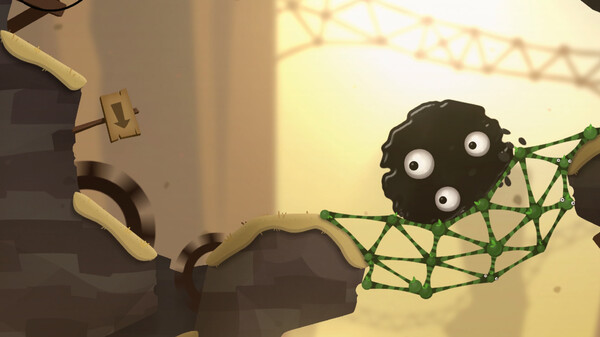 A backlit sand-coloured canyon, a triangulated green goo framework projecting rightward from the rock, a black mass with three floating eyes hanging off its end — Steam store screenshot
Place in the Lineage
The single most-discussed topic in the pool is Chapter 4, a stretch that leans hard into story and experimental staging. The negative side calls it overlong and not what they came for, and reports using the skip button for the first time. Positive reviewers say much the same — that it was a drag, that the physics puzzler abruptly turns into something to read. The chapter is not the boundary between camps; it is a snag both camps hit.
Critics went the other way. Nintendo Life wrote that the utterly bizarre fourth chapter elevates the experience to one of considerable excellence; Checkpoint Gaming saw the chapter as where the sequel's new direction actually lives; GamingTrend registered a section that runs against the story's own themes. Either way, critics read the detour as the work making an argument. Users read it as an interruption of the thing they bought.
The unit of evaluation differs. A critic reads the game as one continuous structure. A Steam review is written as a ledger of how the reviewer's hours were spent — how many of the sixty levels were physics puzzles. The minimum bone, maximum skin principle still holds, except that in Chapter 4 the skin got thicker. Whether you welcome that thickness or want the bone back decides which way the chapter reads.
 A blue-violet interior: tall glass tubes lined up inside a metal gantry with black liquid hanging inside them, and two white one-eyed goo balls floating in the air — Steam store screenshot
Sources
This piece was written from the Steam user reviews as they stood on 2026-08-12.
· Steam: World of Goo 2 (761 recommended / 109 not recommended out of 870 in all languages, 87%, labelled Very Positive; English 388 at 85%, Simplified Chinese 192 and Russian 178 at 90% each)
· Read: the top 12 positive and top 12 negative English reviews by all-time helpfulness, plus the 8 most recent in all languages — 32 reviews in total.
· On the critic side, the round-up at OpenCritic (19 reviews, average 82); Chapter 4 quotations are from Nintendo Life, Checkpoint Gaming and GamingTrend.
Closing
On its standing as a sequel the pool speaks with one voice: no novelty left, feels like an expansion pack, Chapter 1 is close to a rerun of the first game. Self-reported playtimes for people who actually finished run from four to fifteen hours, with a median around eight. Once a 2025 game inherits the verb a 2008 game invented, the surprise cannot be restocked.
Even so, the weakness I read here is not that it is unoriginal. It is that the things it does add — the liquid and the new goo species — never get a level that meshes them together. The most accurate diagnosis in the pool comes from a positive review asking for more complex, harder levels combining all the new goos and mechanics. The ingredients are all present; the multiplication is missing.
Steam's overall is 87%; my score is 7.8. The gap from the 9 this site gave World of Goo is not about invention but about that missing multiplication. The $29.99 list price is worth noting too, since the negative reviews keep returning to it. Recommended to anyone who enjoyed the original — though if you are buying for a sequel to that soundtrack, read the pool's verdict of rehash first.
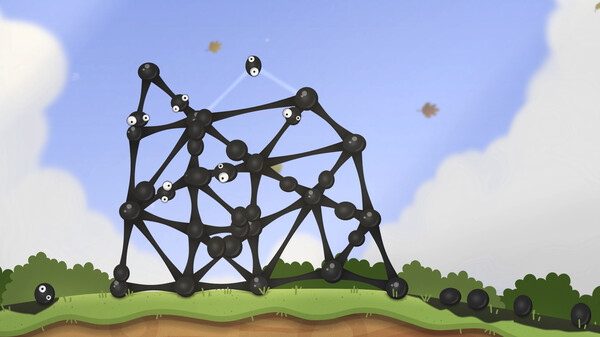 A blue sky with clouds over grassland, a large triangulated framework of black goo balls standing on the ground, more goo balls lined up on the grass in the foreground — Steam store screenshot
Where are you with this game?
Press one and the game goes on your shelf. You can see it on your account page.
Reactions (no login)
Anonymous • one of each per visitor per day
Read next
Related reviews
Strange Antiquities
A 2D identification-and-deduction puzzler in which you mind an occult antiques shop in the lakeside town of Undermere, probing unlabelled objects by colour, touch, scent and inner perception, cross-referencing illustrated tomes, and handing each customer the item their trouble calls for — where what you hand over decides the town's fate.
Kaizen: A Factory Story
A 2D automation puzzle set in 1986 Japan: lay arms and tracks across a green workbench, program a timeline of commands, and build assembly lines for calculators, camcorders and arcade cabinets. Made by the original Zachtronics team under their new studio Coincidence, with a pachinko-flavoured solitaire on the side.
Portal: Revolution
A free unofficial Portal 2 expansion set in the gap in that game's story, adding some forty new test chambers and hardware such as a laser-redirecting cube. It opens with only one portal available and walks you through the facility between the chambers.


