REVIEW · 2016-07-12
Poly Bridge
Less about building bridges than bargaining with physics
First Impressions
In Poly Bridge you span two banks within a budget and get cars across, placing wood, steel, cable, and hydraulic pistons into a structure that must survive its own stress. Dry Cactus released it in July 2016; it is the first of a series that now includes Poly Bridge 2 and 3.
I write this from the Steam review pool, not my own save file. English reviews sit at 89% of 6,794 ('Very Positive'); across all languages roughly 91% of 18,534 are positive (1,654 negative, snapshot 2026-07-02). The last 30 days soften slightly to 84% of 57.
But the score is not monolithic. The helpful positives praise 'brain candy' and hilarious failure GIFs, while the up-voted negatives point, almost in unison, at one thing: the physics are non-deterministic. The loudest praise and the loudest complaint share the same engine. That is my axis.
 Poly Bridge store header — Steam store
Putting the Mechanics into Words
Read the pool and the game's verbs are strikingly few: drop a node, join it with a part, pick a material, watch the budget and the stress meter. The recurring praise that it is 'simple and intuitive' is, in Puzzlebyrinth's terms, subtraction of verbs.
From those few verbs the space of bridges explodes. One reviewer notes a friend built a wildly different bridge on the same level — combinatorial explosion working as intended, and why the early worlds score highest. The red/green stress meter is a coarse observation resolution, yet players build real structural intuition from it.
Later, though, the lead verb shifts from 'build a bridge' to 'game the physics': ramps, loops, jumps, multi-phase hydraulics. This is where negatives bristle that 'these are not bridges,' and where the store's self-description as a 'bridge-building simulator' visibly drifts from what players report.
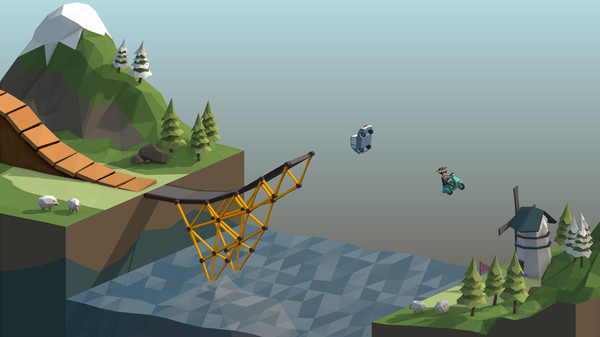 Spanning the banks with a few kinds of parts — Steam store
The Texture of Difficulty
On difficulty the testimony is unusually consistent: 'the first two worlds are fun, then it becomes a different game.' One reviewer cites achievement stats showing completion falling to roughly 3% past world two. A cliff sits in the middle of the learning curve.
Collect the sticking points and difficulty splits into three kinds: genuine structural puzzles of budget and stress; pixel-perfect nudging of a joint by a millimetre or a degree; and 'gimmick' levels built on jumps and timing. Positives love the first; negatives resent the second and third.
One line captures it: a reviewer says that finishing a level brings not a feeling of being clever but plain relief. I read that as the moment difficulty slid from the first kind to the second — when the payoff is release rather than discovery, the puzzle has shifted its weight from thinking to endurance.
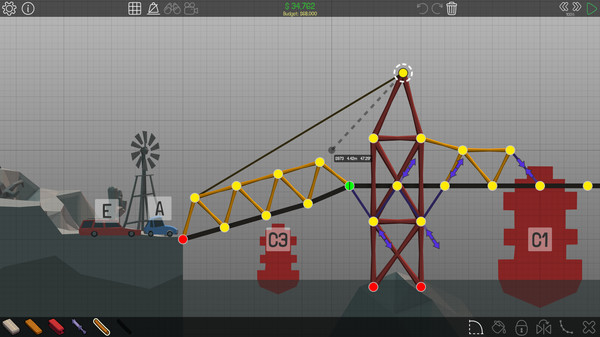 Budget and stress in a later level — Steam store
Design Craft
Here is the crux. The top negative (387 votes) and many others report running the same bridge twice and getting different outcomes. A physics puzzle promises a deterministic function from structure to result; make it stochastic and the puzzle degrades from an object of thought into a machine you re-roll for a win. Calling that 'a mortal sin for a game about incremental improvement' is fair criticism.
The other flashpoint is part-count limits that funnel you toward one intended solution. Players who 'came to build my bridge' resent 'guessing the designer's answer.' It is the side effect of two design philosophies — open sandbox and single-solution puzzle — living in one game. Next to an open-ended optimiser like Opus Magnum, Poly Bridge's reach wobbles level to level.
I will not write this off as mere neglect. Sharing GIFs of collapsing bridges and competing for the minimum budget demand different levels of determinism. The former turns non-determinism into comedy; the latter cannot forgive it. Loading two games onto one engine is exactly the wide reach that splits the reviews.
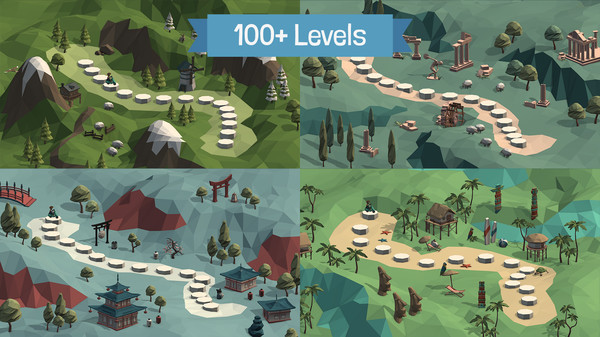 Assembling a moving bridge with hydraulics — Steam store
Place in the Lineage
Veteran reviewers place Poly Bridge in the line of Pontifex and Bridge Builder — 'the first fifteen levels are pure nostalgia.' The classic skeleton of solving load with stress is clearly that lineage. Much as World of Goo made structural wobble endearing, Poly Bridge knows how to turn collapse into a laugh.
Tellingly, many negatives end by saying 'buy the sequel.' Poly Bridge 2 and 3 are described as steadier in physics and controls, and both carry higher Steam labels (reported as 'Overwhelmingly Positive'). Read fairly, the first game is a first draft of a series correcting its own faults.
Recent reviews add a new complaint: an over-eager tutorial that 'kills the creative part.' A game once called unfriendly for having no tutorial now draws the opposite charge after a mobile-oriented rework. Raise the observation resolution and you see the same game's axis of evaluation flip over time.
 One of the campaign's many level types — Steam store
Sources
This article was written by reading the Steam store user reviews as of 2026-07-02. No review text is quoted directly; typical claims are reconstructed.
- Steam: Poly Bridge (English 'Very Positive' 89% of 6,794; across all languages 18,534 with 1,654 negative; last 30 days 84% of 57; snapshot 2026-07-02)
- The top 15 helpful English negatives (387 down to 11 votes), plus 10-plus each of filter=all positives and recent reviews, read via Steam's appreviews. The ~3% completion figure rests on several user posts citing achievement stats.
- Press reference: Metacritic: Poly Bridge (critic aggregate around 73 — generally more measured than the users' physics complaints)
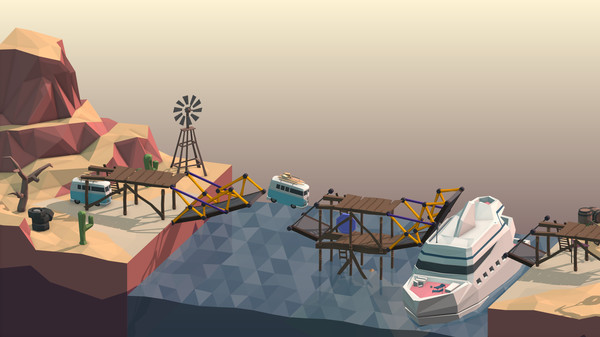 Sharing GIFs of collapse and success is a signature feature — Steam store
Closing
From a design standpoint I give it 7.5 of 10 — harsher than Steam's ~91%. The reason is plain: the non-deterministic physics breaks, in the back half, the core contract of the 'physics puzzle' it advertises. The skeleton of few verbs and combinatorial explosion is elegant, but if the result is stochastic there is no resolution of thought to sharpen.
Still, as a toy for laughing at collapsing bridges and overbuilding in the sandbox, it remains genuinely appealing. Reviewers report roughly 10-12 hours for the campaign and 40-95 for 100%. I would recommend the early worlds to the casual and point strict completionists to the sequels.
'Less about building bridges than bargaining with physics' is also my summary of the pool. Which of those you came to play decides whether this bridge holds.
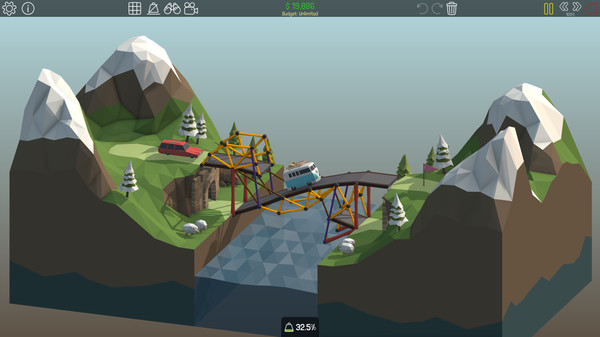
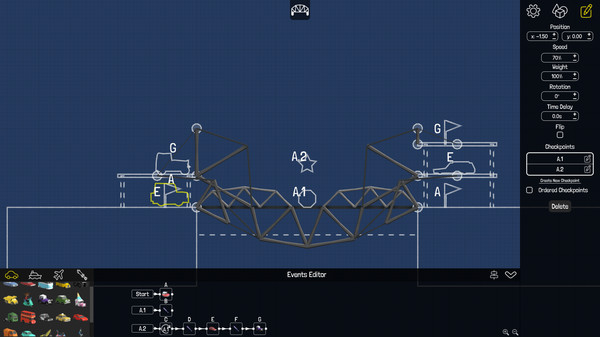 A finished crossing — the moment of payoff — Steam store
Where are you with this game?
Press one and the game goes on your shelf. You can see it on your account page.
Reactions (no login)
Anonymous • one of each per visitor per day
Read next
Related reviews
Duskers
You send drones into abandoned spacecraft, scavenge fuel and parts, and move on to the next hull. Every order is typed, and all you see is one camera feed plus a sensor blip that says something is there without saying what. A single-player game of planning in the dark from Misfits Attic.
Day of the Tentacle Remastered
Double Fine's redraw of the 1993 LucasArts game: a broken time machine scatters three friends into the past, present and future of the same motel, and you switch between them, mailing objects across the centuries to stop a purple tentacle from taking over the world.
Quern - Undying Thoughts
A first-person puzzle adventure: stranded on an island with no way back, you open some fifty doors by working gears, crystals and alchemy, and solved contraptions return, reused, so the whole island reads as one machine. A 2016 homage to Myst and Riven from the four-person studio Zadbox.


