REVIEW · 2025-09-17
Strange Antiquities
Reading the inside of a 95% Steam score, on a sequel that raised its observational resolution
Introduction
In the lakeside town of Undermere you take over, temporarily, a shop that deals in occult antiquities. The shelves are full of unlabelled objects; the customers who arrive each day bring only their problems — something to ward off nightmares, something to sharpen their hearing. You pick an object up, gather information through four channels (colour and composition, touch, scent and sound, inner perception), cross-reference a small library of illustrated tomes, and hand over whatever you decide it is. Released 17 September 2025, made by the UK's Bad Viking and published by Iceberg Interactive.
I wrote this by reading the Steam review pool rather than by reporting my own playthrough. As of the 2026-08-08 snapshot the game holds Overwhelmingly Positive across 3,177 reviews in all languages; the English score is 95% of 2,256, and the last 30 days sit at the same 95% of 122. Across all 3,443 reviews the split is 3,285 positive to 158 negative. Metacritic reads 81, PC Gamer gave it 80.
The inside of that 95% is noisier than the number suggests. I have already written about Strange Horticulture; this is less a sequel piece than an exercise in noticing what each camp calls the same design decision. Three points absorb almost all the argument: how vague the clues are, how many books you must consult, and how light the punishment is.
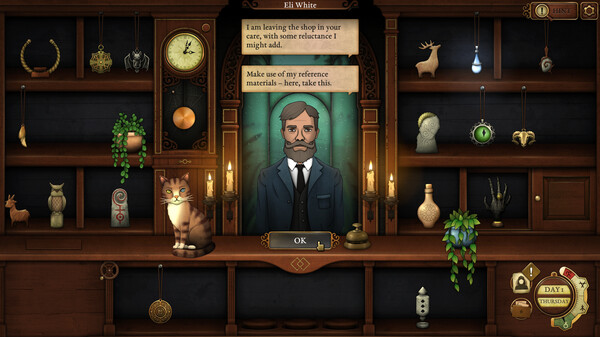 Eli White announces he is leaving the shop in your care; curios line the shelves and a cat sits on the counter — Steam store screenshot
First Impressions
Line up the most helpful positive reviews and the vocabulary rhymes. Cozy and gloomy sit in the same sentence; rain, candles, tea and Jupiter the cat recur. One English reviewer described the whole activity as a jeweller's work — alone at a table, magnifying glass in hand, throwing a small light on one small thing at a time. Japanese reviewers reach for a stock phrase meaning 'a proper evolution of the original', and cite concrete quality-of-life gains: an index at the back of the books, no more waiting timer on exploration.
The negative vocabulary is just as consistent: vague, nebulous, moon logic, tedious. In Japanese, 'brute force' and 'unhelpful'. The recurring formula is a confession — the game made me feel stupid. It comes hardest from people who loved the first game, often followed by a line about having bought this expecting something relaxing.
What interests me is that both camps are pointing at the same place. The books describe objects through myth and symbol rather than through shape and material. The positive side calls that the texture of real identification work; the negative side calls it a refusal to be guessable. The rest of this piece translates that fork into design terms.
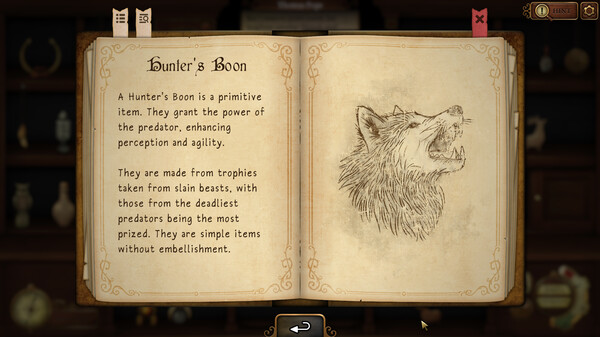 A two-page spread of a reference book: the entry text for 'Hunter's Boon' on the left, a pen drawing of a snarling wolf on the right — Steam store screenshot
Putting the Mechanics into Words
There are only two verbs: examine and hand over. But examine branches. Each part of an object can be probed for colour and composition, for touch, for scent and sound, for inner perception. One reviewer counted more than ten separate details available per item. A Japanese positive review put it in a phrase I would have used myself: the resolution of the object has gone up. That is exactly what this is — an expansion of observational resolution.
The trouble is that the resolution went up while the workbench did not. The most concrete complaint on the negative side is procedural: you cannot open two books at once, cannot set an object beside a book, cannot bookmark a page. With ten-plus details per item and several volumes to consult, the number of pairs to check multiplies. That is combinatorial explosion, and the only tools for offloading memory are a screenshot and a notepad beside the keyboard. So there are stretches where trying everything is simply faster than reasoning.
The lightness of the punishment compounds it. The dice minigame that interrupts a run of wrong answers is described warmly even by positive reviewers — and the same reviewers add that because it is enjoyable, failure costs nothing. The device meant to discourage brute force ends up licensing it. I read that less as a contradiction than as a kindness whose side effect landed somewhere else.
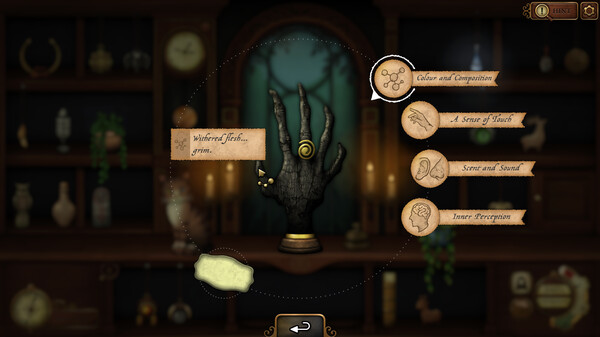 A blackened withered hand on a stand, ringed by examination options — Colour and Composition, A Sense of Touch, Scent and Sound, Inner Perception — Steam store screenshot
The Texture of Difficulty
The pool agrees on one thing: it is harder than the first game. It splits on whether that is good. The positive side reports more bite; the negative side reports losing the calm they came for. Curiously, some recent reviews call it easier than the original, crediting the new index — the impression of difficulty is not even stable.
Sort the stuck points and three kinds emerge. First, difficulty of labour: all the information is present, but the number of lookups wears you down. Second, difficulty of association: the entry speaks in myth and symbol, and you must leap from 'goddess of earth and rebirth' to the object with a snake on it. Third, difficulty from outside the system: the clue lives beyond the vocabulary the game taught you. The third is what the negative reviews resent most — being handed a book of symbols and then finding the symbols on the desk obey a different logic entirely. Teach a rule and then answer outside it, and players do not feel challenged, they feel misled.
The progressive hint system, by contrast, is praised on both sides: it starts by pointing and ends by telling. The one gap reviewers name is the hint for hidden mechanisms inside the shop, which stays generic no matter how often you ask. Taken together, the difficulty here is not a matter of amount but of which of the three kinds you happen to step on.
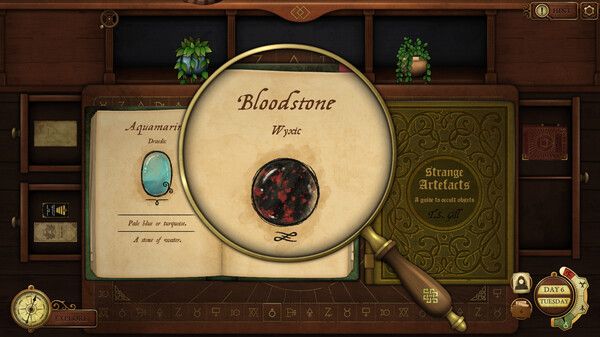 A gemstone book under the magnifying glass — Aquamarine on the left page, Bloodstone enlarged on the right — with the tome 'Strange Artefacts' beside it and a HINT button in the corner — Steam store screenshot
Place in the Lineage
Nearly every review measures this against its predecessor. The developers say plainly on the store page that it is not a direct sequel, and both camps open by comparing it to Strange Horticulture anyway. For the positive side, the same town and the same feel are reassurance; for the negative side, they are reuse. One Japanese negative review framed the friction well by asking where the border lies between a sequel and a large expansion. There is no external answer, but it is a real question about how much skeleton a follow-up may inherit.
My reading is that the first game worked by subtraction. Look at one plant, check one book, hand it over. Because that was all, reading the book became the game. This one moves the other way: four channels of examination, several volumes, more maps, and the desk itself turned into a puzzle. It is an addition built on a design that stood by subtraction. The addition raises resolution, and in the same motion gives up the quiet of a game that fit inside one book.
The shelf around it is crowded. Rock Paper Shotgun placed it near Blue Prince among the year's best puzzle games, and in the sense of assembling an answer out of written description it sits beside The Case of the Golden Idol. But there the answer has a fixed shape and a wrong guess breaks nothing. Here you commit by handing the object over. Same deduction, very different placement of the cost of being wrong.
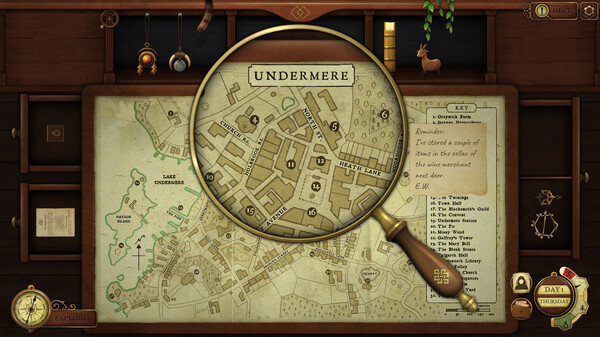 A hand-drawn town map labelled UNDERMERE, magnified under the glass, with a handwritten note pinned to its right — Steam store screenshot
Sources
This piece was written by reading the Steam user reviews as of 2026-08-08. Nothing is quoted directly; recurring claims are reconstructed.
- Steam: Strange Antiquities (Overwhelmingly Positive; 3,177 reviews across all languages; 95% of 2,256 English reviews; 95% of 122 in the last 30 days)
- Read: roughly the top 20 all-time helpful positive reviews (English and Japanese), the top 10 negative, and about 10 of the most recent
- Press: PC Gamer (80/100), Rock Paper Shotgun (Bestest Best), and the Metacritic aggregate of 81
Closing
Steam reads 95% positive; my design-critique score is 8.5. The gap is structural rather than qualitative. It comes off for raising observational resolution without widening the workbench where that information gets compared, and for teaching a system of books and then, in places, putting the answer outside that system. What holds up without qualification is the atmosphere, the voice, the progressive hints, and a story that branches on the simple act of choosing what to hand over.
Completion times cited in reviews run roughly six to twenty hours, with one press review putting it near twelve; people chasing multiple endings spend longer. Anyone who loved the first game as a quiet, forgiving afternoon with one book may sit down in the same chair and miss the step — that reader is outside its reach. Anyone who enjoys the act of deriving an object from a written description, and does not mind keeping notes outside the game, gets a deeper desk than before. The 95% is not unanimity; it is a fairly precise collective statement about who this is for.
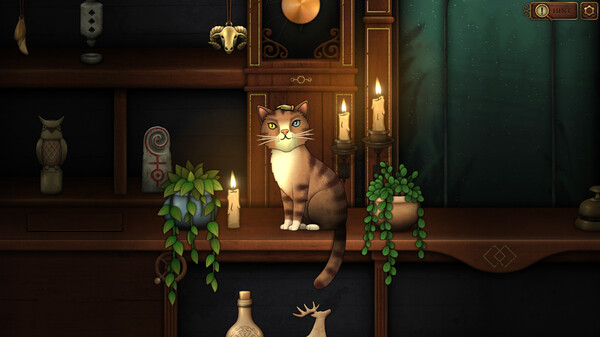 A cat sits on the shop counter between lit candles and trailing houseplants — Steam store screenshot
Where are you with this game?
Press one and the game goes on your shelf. You can see it on your account page.
Reactions (no login)
Anonymous • one of each per visitor per day
Read next
Related reviews
Strange Horticulture
A 2D occult deduction puzzle in which you identify each plant that arrives at your counter by matching it against an almanac and the clues you gather, then use its effects to answer customers and steer the story. Made by the UK’s Bad Viking, it unravels foggy Undermere’s mysteries with a cat and a single book.
World of Goo 2
A sequel to the physics-building puzzler: grab black goo balls, link them into bridges and towers, and route them to the exit pipe. New goo species that stretch, shrink and explode join liquid that runs downhill and pools, across five chapters and sixty-plus levels. From 2D BOY and Tomorrow Corporation.
Kaizen: A Factory Story
A 2D automation puzzle set in 1986 Japan: lay arms and tracks across a green workbench, program a timeline of commands, and build assembly lines for calculators, camcorders and arcade cabinets. Made by the original Zachtronics team under their new studio Coincidence, with a pachinko-flavoured solitaire on the side.


