REVIEW · 2026-04-23
shapez 2
Inside 97%, the 440 negative reviews land on a single point — a factory that hands difficulty to the player
First Impressions
shapez 2 left early access on 23 April 2026, a year and eight months after its August 2024 debut. tobspr Games develops it; tobspr Games and Gamirror Games publish it. You mine geometric shapes, carry them on belts, and cut, rotate, stack and paint them into whatever the hub has ordered. The grammar is the same as shapez. Only the board has moved, from a plane into three dimensions.
As of 9 September 2026 the Steam tally reads 15,017 reviews with 14,577 positive — 97%, labelled Overwhelmingly Positive. English-only reviews sit at 9,200 positive out of 9,472, the same ratio. The one slightly lower figure is the last thirty days: 92% of 142. Metacritic lists a critic score of 80.
On the numbers this looks settled. Read the 440 negative reviews, though, and something odd turns up: the complaints nearly all land on one point. 'Basically no problem solving, contemplation or planning.' 'It's an idle game.' 'A very stretched-out tutorial.' There is work, they say, but the thinking never arrives.
The awkward part is that the positive side is praising the same spot. Across the helpful positives one phrase keeps returning: pure brain exercise. One board, called a pure mental exercise by one group and an idle game by the other. This piece follows that split back to its source.
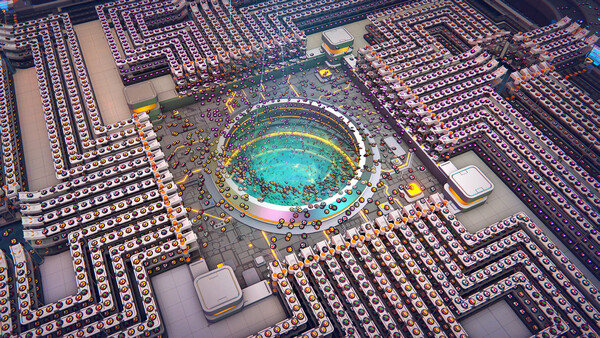 In-game view of shapez 2 — Steam store screenshot
Putting the Mechanics into Words
The verb list has barely grown since the first game. Cut, rotate, stack, paint — plus mine and carry. That is still the whole vocabulary. What grew is not the verbs but the room you have to put them in.
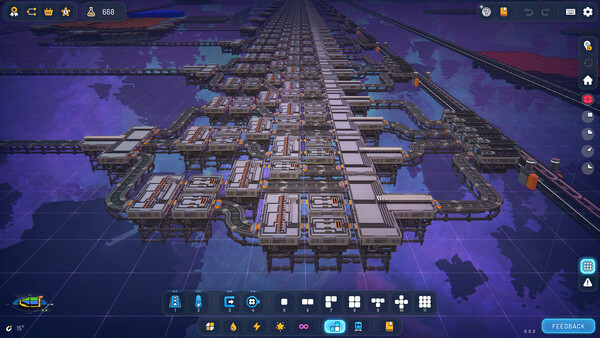
The released version splits the board into three layers and scatters buildable platforms through space, linked by trains, with saved blueprints for pasting a design again. When positive reviewers list what they like, they name those three things and the new 3D look. 'Simple ideas, done extremely well' recurs almost as a formula.
In design terms this is a revision that leaves the grammar alone and enlarges the paper. The combination rules carry over, so almost nothing has to be relearnt. What is asked instead is how far you can unfold a rule you already know. It runs in the opposite direction from Opus Magnum, which tightens the board to raise the density of a solution.
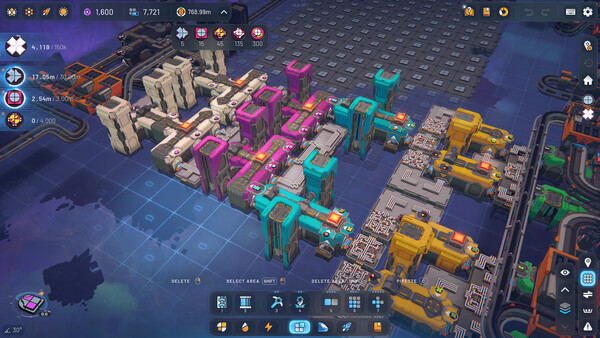 A shapez 2 gameplay view published on the Steam store — Steam store screenshot
Subtraction
The store page is candid about it. All buildings are free, resources never run out, there are no enemies or time limits, and you can delete and rebuild without penalties. That is a declaration of subtraction. Cost, enemies, time, failure — the four things factory games normally use to supply difficulty, removed together.
The positives welcome it: no combat bolted on, pure fun, attention free to sit on layout and flow. The negatives describe the identical facts as 'no currency or materials needed' and rebuilding that feels 'unrewarding.' Both sides agree about what is in the game. They disagree only about whether to call it a virtue.
Subtraction works, I think, on one condition: whatever remains has to gain resolution in proportion to what was taken away. In the first game the blank map promoted planar layout to the leading role. The same thing happens here, with the use of layers and the division of platforms as the new object of attention. So far this is simply the first game continued.
But removing all four has a price. No deadline and no failure means the game holds no constraint of its own. The only place left to keep one is the player. That is where the next section's fault line begins.
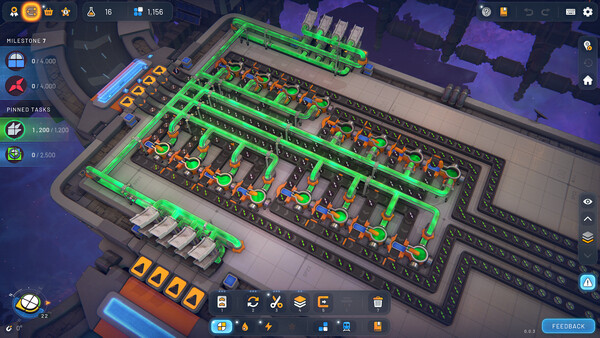 In-game view of shapez 2 — Steam store screenshot
The Texture of Difficulty
'Pure brain exercise' and 'basically no problem solving' are not split along playtime. In what I read, the logged hours run from a couple to several hundred, with a median around fifteen, and the negative side includes several writers well past thirty hours. These are not the opinions of people who bounced off in an evening.
Line up the negative phrasing and the shape of the complaint appears. 'When it's easy, it feels like work. When it's hard, it feels like jumping through hoops.' 'The difficulty spike is unreasonable and too sudden.' 'Set the shapes and watch — I had a video running the whole time.' The claim is not that difficulty is absent, but that it has turned into volume of work.
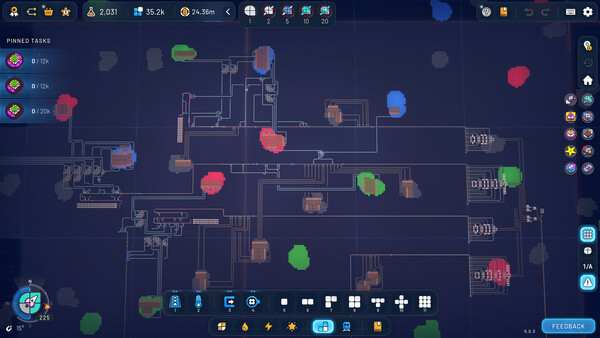
The game asks for throughput and nothing else. Throughput can be met by building a second copy of a design that already works. So the difficulty of procedure stays low, the difficulty of scale dissolves into labour, and only the third kind — faster, smaller, tidier, the constraints you impose on yourself — has no ceiling at all.
The location of difficulty therefore moves with the player. Set your own constraint and a real exercise appears; wait for the game to set one and an idle game appears instead. This is not a ranking. It is a question of reach: which of those two players the design was built for.
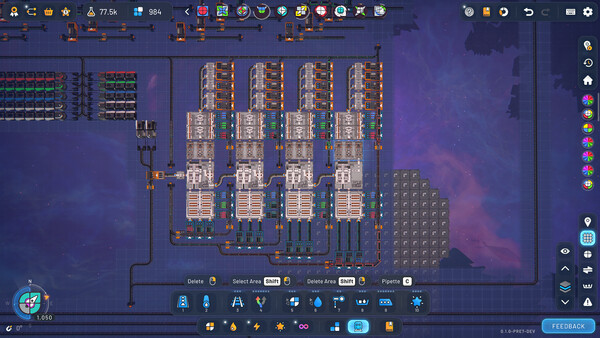 In-game view of shapez 2 — Steam store screenshot
Place in the Lineage
A stock phrase in the negatives is that it is 'not even close' to Factorio or Satisfactory. The same sentence filled the review pool for shapez six years ago. This series still gets measured against the big neighbours first.
The comparison is pointed the wrong way, though. In Factorio, raids impose a deadline and depleting ore forces you to move; optimisation means something because there is a clock. shapez 2 removed every clock, so holding up the same ruler will always report a shortfall. What falls short is the ruler.
Its place in the lineage reads better if you sort by how much constraint a game supplies. Infinifactory and Opus Magnum clamp the board and the move count from the start so that solutions can be compared. Kaizen: A Factory Story belongs with them. shapez 2 sits at the far opposite end, handing out floor space instead. Sorted that way, both camps fall neatly into place.
 In-game view of shapez 2 — Steam store screenshot
The Review Pool
This piece was written from the Steam user reviews as of 9 September 2026. Nothing is quoted from a review body directly; typical claims are reconstructed.
・Steam: shapez 2 (Overwhelmingly Positive — 14,577 of 15,017 reviews positive, 97%; English-only 9,200 of 9,472; last 30 days 92% of 142)
・Read: the top 12 helpful positive, the top 15 helpful negative and the top 8 recent. Negatives are only 3% of the pool, so they were collected across several pages.
・GamingOnLinux review (4/5), Wikipedia: Shapez 2 (history, Metacritic 80)
・Images come from Steam's official assets. In this run the environment could not open the image files themselves, so the captions are kept generic rather than describing specific contents.
Closing
Steam says 97%, Metacritic's critics say 80, my design-critique score is 8.5. The credit is for enlarging the board into three dimensions without adding verbs, and without breaking the legibility of the rules. The deduction is for keeping no external constraint at all.
The reach is clear. If you can set your own 'faster, smaller, tidier,' there is no more straightforward playground than this. If you want the game to hand you one problem at a time, the 1.0 release will still feel thin. The fault line has not moved since shapez.
The number worth reading is not the 97%. It is that the 440 negative reviews converge on almost a single claim. When dissent gathers at one point instead of scattering, the design has usually made a clear choice. Here the choice was to hand difficulty to the player.
 In-game view of shapez 2 — Steam store screenshot
Where are you with this game?
Press one and the game goes on your shelf. You can see it on your account page.
Reactions (no login)
Anonymous • one of each per visitor per day
Read next
Related reviews
shapez
A 2D automation puzzler where you mine simple shapes, carry them on belts, and combine cutting, rotating, stacking and painting to build whatever each level orders, growing a factory across an endlessly expanding blank map. tobspr Games' Steam build of what began as a free browser game.
Kaizen: A Factory Story
A 2D automation puzzle set in 1986 Japan: lay arms and tracks across a green workbench, program a timeline of commands, and build assembly lines for calculators, camcorders and arcade cabinets. Made by the original Zachtronics team under their new studio Coincidence, with a pachinko-flavoured solitaire on the side.
Tactical Breach Wizards
A turn-based tactical puzzle in which a squad of wizards in body armour clears a building one room at a time. Every shot lands, nothing is random, and you can rewind as many turns as you like. From Suspicious Developments, the studio behind Gunpoint.


