REVIEW · 2021-08-26
Myst
Rebuilding the island of 1993 — reading a review pool that argues whether it is still the same island
First Impressions
The first thing I notice in the Steam review pool is that this game is argued about less as a game than as a decision: what to do with the Myst of 1993. The helpful positive reviews say this is the best-looking Myst and the right one to start with. The top negative reviews say Ship of Theseus. One camp is counting how the island looks; the other is counting whether the island still has its personality.
The numbers first. As of 2026-07-28 the Steam overall is 88% positive out of 1,979, labelled Very Positive; counting all purchase types, 1,930 of 2,178 are positive. The last 30 days drop to 75% of 20, Mostly Positive. Metacritic sits at 78. This is not a clean split — a large majority recommends it while a minority recommends a different edition of the same game.
That last part is what makes this pool unusual. Most of the negative reviewers are not rejecting Myst; they point you to realMyst: Masterpiece Edition or the plain Masterpiece Edition instead. The dispute is not about quality but about what counts as the thing worth preserving.
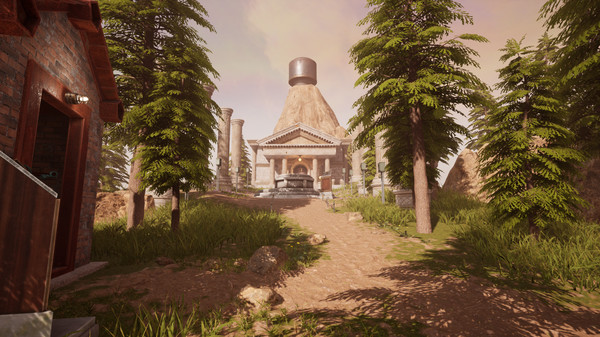 Myst store header image — Steam store key art
Putting the Mechanics into Words
Positive and negative reviews reach for the same nouns: buttons, levers, doors, journals. There are only three verbs — look, press, write down. When a VR review says, plainly, that it is full of buttons and doors, that is an accurate description: this is verb subtraction taken about as far as it goes, four Ages built out of three verbs.
The 2021 version tried to pull the third verb inside the game with a photo capture bound to the spacebar. That feature draws the most specific complaints in the pool: you cannot open the album while zoomed into a puzzle, you cannot cancel the camera without taking a shot, and the album is not reliably chronological. One VR reviewer describes bouncing in and out of the menu to enter three six-digit date-times. Taking a record-keeping step that players had externalized to pen and paper and folding it back into the UI raised the round-trip cost instead of lowering it.
The pool also registers the VR-driven relayout: interactables were levelled to roughly chest height so seated players can reach them. Reviewers note handles attached to handles and ladders sunk into stone where a door would do, and say some clues became harder to spot while others became too obvious. A reachability constraint has quietly rewritten the distribution of observation resolution.
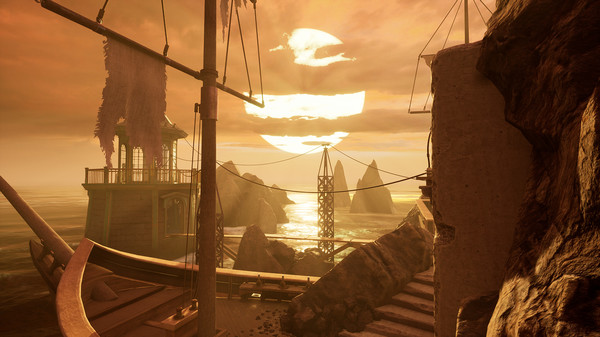 Myst main capsule image — Steam store key art
The Texture of Difficulty
The negative side's word is obtuse: puzzles that hinge on whether you happened to notice, and that turn into busywork once the trick is known. The positive side calls the same design fair and logical. One long 2025 review says the game felt very hard in the nineties and reads as scrupulously fair now, after dozens of other adventure games. The difficulty moved on the player's side of the ledger, not the game's.
Collecting where reviewers actually stall, three kinds separate out. Clues scattered across Ages. Record-keeping, since carrying number sets from one device to another all but requires paper. And the temptation of brute force, because there are few enough switches that you can just try them. Much of what gets called obtuse is really the third: a gap where your hands move before your reasoning does.
One report deserves separating out. Several top negative reviews describe levers that stop responding and a lighthouse wheel that locks up, leaving runs unfinishable. Puzzle games assume you can tell "my reasoning is wrong" apart from "the game is broken." When that assumption wobbles, observation itself stops working, and no account of difficulty survives it.
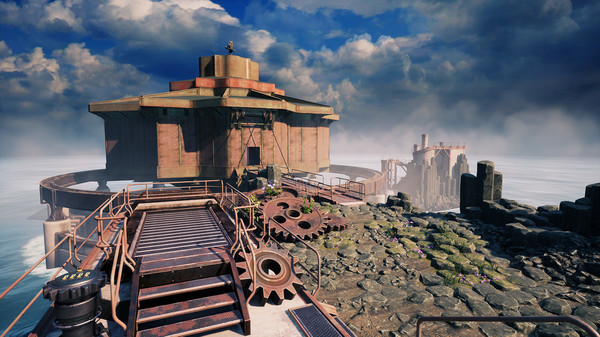 Myst hero capsule image — Steam store key art
Place in the Lineage
What makes this pool interesting is that players argue across three editions: the near-untouched Masterpiece Edition, 2014's realMyst: Masterpiece Edition, and this one. Negative reviewers often send you to the older two, citing the closeness of the sound, the darkness of the generator room, the density of pre-rendered stills. Positive reviewers read the same changes as a fair price for a space you can walk through and stand inside. The disagreement is really about what preservation is supposed to preserve.
Cyan's own 2024 Riven remake is nearly the same operation and runs distinctly warmer in its reviews — the original had the information density to survive 3D, and its assignment of verbs was already finished. Set beside Obduction, built new, a remake inherits the mesh of story and puzzle but shows every seam.
Its place in the lineage is not in dispute. What Myst III: Exile and Quern - Undying Thoughts inherited — a grammar of machines read without a manual — starts here. The recurring line that every environmental puzzle game is measured against this one is unmeasurable as criticism and accurate as design history.
 Myst library hero image — Steam store key art
Sources
This piece was written from the Steam store page's user reviews as of 2026-07-28. No review text is quoted directly; typical claims are reconstructed.
・Steam: Myst (Very Positive / 88% of 1,979; 1,930 of 2,178 across all purchase types; 75% of 20 in the last 30 days; snapshot 2026-07-28)
・Read: the ten most helpful positive reviews and the ten most helpful negative ones. A recency-sorted list was not reachable from this environment, so I substituted the 30-day aggregate, reviews posted or updated in 2024–2025, and 2025 forum threads on the price change and the Rime addition.
・For critic-versus-user emphasis: the Metacritic aggregate of 78 and PC Gamer's 2021 verdict, in essence that the modern rebuild still feels dated.
・SteamDB's asset listing was used to confirm developer, release date and the existence of the image URLs used here.
Closing
The store copy sells a surreal adventure of exploring and travelling the Ages, and the tags include Casual and Walking Simulator. What the top helpful reviews actually discuss is whether you need a notebook, how the camera round-trip works, and which edition to buy. The gap marks the design's range rather than its quality: calm for people who came for the place, demanding for people who came for the machines.
Time has moved the score too. A free update added the Rime Age in March 2025 and the price went up at about the same time; on the forums a developer explained they raised the base price rather than sell the content as paid DLC, and players still object to the lack of an announcement. One updated review calls the new Rime the best Myst content in years, while other posts report stutter after the engine update. The 75% of the last 30 days looks to me like both of those living in the same window.
Against Steam's 88% I give it 7.5 on design grounds. The skeleton — four Ages standing on three verbs — is a 1993 inheritance and still holds. My deductions land on what 2021 added: a camera that reclaimed note-taking into the UI and made the round trip longer, a layout rewritten for reachability, and progression-blocking bugs still being reported. Recorded playtimes scatter from 4 to 12 hours, with completions clustering around 6 to 8. If this is your first Myst, this is a fine one; if you came to check on the island of 1993, take another edition. That is, I think, the pool's collective verdict, and it is about right.
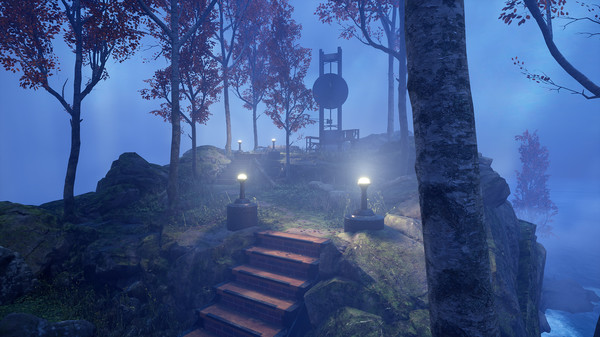 Myst store page background image — Steam store key art
Where are you with this game?
Press one and the game goes on your shelf. You can see it on your account page.
Reactions (no login)
Anonymous • one of each per visitor per day
Read next

Related reviews
Riven
Cyan Worlds' own ground-up 3D remake of the 1997 classic — a first-person puzzle adventure with no hints and no highlighting, where you walk a collapsing island and read its water, machines and D'ni number system to unlock its secrets.
Firmament
A first-person puzzle-adventure from Cyan Worlds, the studio behind Myst and Riven. You plug a wrist-mounted tool, the Adjunct, into sockets to work cranes and generators as you cross three abandoned steampunk realms — a meditative world with no ciphers and no notes to take.
Lingo
A first-person word-puzzle game where a single word on a wall is your clue: type an answer built from anagrams and wordplay to open the next door. Its non-Euclidean world — stitched together by warps and impossible staircases — is itself one enormous clue board for the rules you must deduce. A solo work by Brenton Wildes in the lineage of The Witness.


