REVIEW · 2022-02-06
7 Days to End with You
Reading the Steam reviews of a novel about deducing an unknown language
First Impressions
I write this from the Steam review pool for 7 Days to End with You. Across the helpful positive reviews the recurring notes line up: unique, clever, and above all the rush of the moment a word's meaning clicks. Japanese reviewers name that rush directly, and many set the game beside Return of the Obra Dinn and Unheard as a work that reinvented what a mystery asks you to deduce.
The numbers first: the label is Very Positive — roughly 88% across about 3,370 reviews (2,957 to 410), and 85% of 1,214 English reviews (snapshot 2026-07-26). The last 30 days sit at 85% too; the ratio has barely moved in four years. Released 6 February 2022, developed by Lizardry and published by PLAYISM.
The reserved positives and the few negatives keep returning to the same points: too short, obtuse, guess-and-check, and 'it promises free interpretation but funnels you to a right answer.' Often praise and complaint point at the same trait — one reader's 'free and beautiful' vagueness is another's 'I can't tell if I'm right.' My job is not to stir that up but to name where the split comes from in the design.
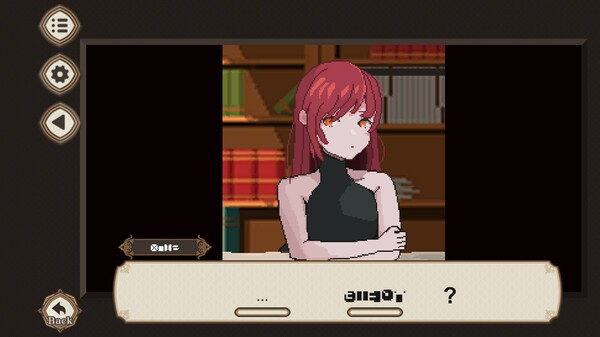 Header art for 7 Days to End with You — Steam store key art
Putting the Mechanics into Words
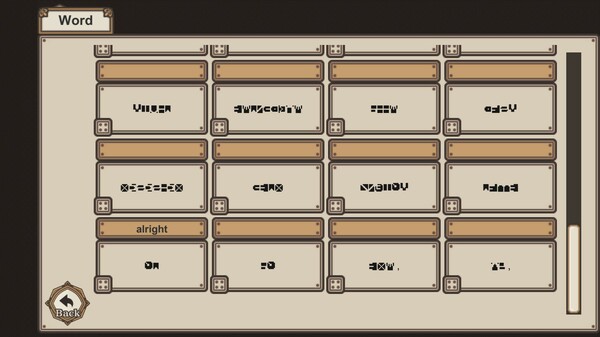
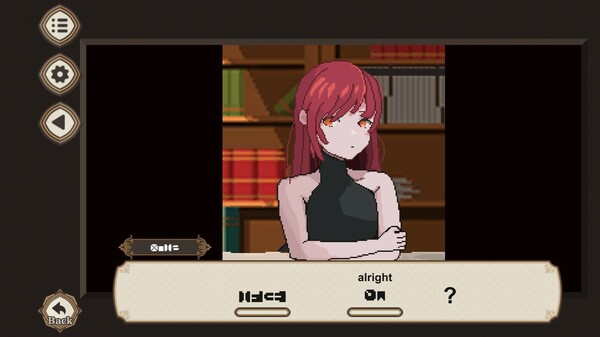
When reviewers explain the system they reach the same skeleton: an amnesiac wakes in a stranger's room, unable to understand a word the woman before them says. From conversation, books and object names you infer meanings and write your own interpretations into a word list; when a word returns, your guess is stacked above it. As one reviewer puts it, 'a visual novel without a dictionary.'
This is Puzzlebyrinth's subtraction at its most extreme. The one thing every narrative game hands you free — the ability to read — is taken away. You don't consult a dictionary; you build one. The verbs shrink to a handful (observe, hypothesize, note, re-read), and assembling a grammar from them becomes the game itself. It sits beside Chants of Sennaar and Return of the Obra Dinn for that one reason: here, reading is the solving.
The wonder positives keep repeating — 'one word clicks and the whole story flips' — is exactly observation resolution as design. No new levels, no new text, yet each loop sharpens the same seven days. What grows is not the board but your resolution on it.
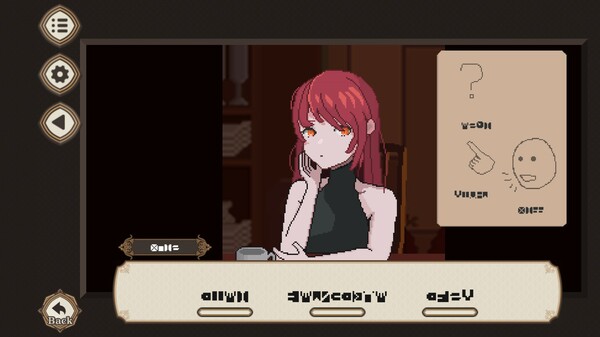 In-game screenshot of 7 Days to End with You — Steam store screenshot
The Feel of the Story
The story itself is short. Seven days of exchanges between an amnesiac and a red-haired woman, and many helpful reviews note that the plain plot feels dense because you can only advance at the speed you decode. Japanese write-ups call it 'a short, long story': the experience is the story's resolution rising as words lock in.
In my terms, the game makes the story a function of observation resolution. The same scene takes on new meaning as your vocabulary grows. As Her Story resolves through your choice of search terms, this resolves through the meanings you write in — so the story literally rises 'as many times as there are readers.' That is what the store text means by 'the story is completed by your interpretation.'
The negatives, meanwhile, say 'the late reveal didn't land' and 'there's one ending, so replay feels like busywork.' A game that flaunts free reading still converges its emotional core on specific words, and some take that gap as a broken promise.
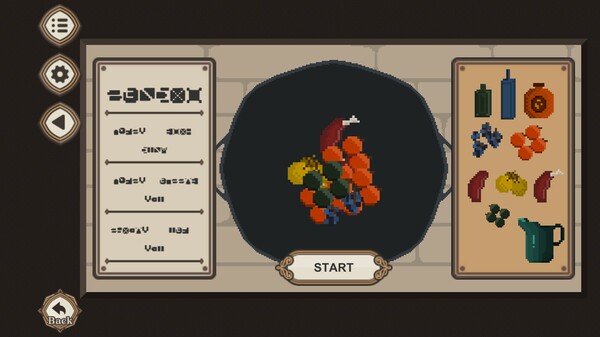 Main store capsule for 7 Days to End with You — Steam store key art
Design Craft
The most interesting thing to critique is the twist between 'free interpretation' and 'funneling to a right answer.' The store text insists 'your interpretation is the correct one.' Yet the helpful negatives and several pro reviews report the same thing: only in the end-of-day dream scenes are the 'correct' words handed to you directly, and missing them stalls your understanding. There is a clear gap between the developer's official line and the reviewers' lived experience.
I read this not as a flaw but as a necessary stake for the learning curve. Pure free association leaves the player nowhere to land; the few fixed words from dreams are the anchor points a web of inference can hang on. The catch is that those anchors seem to collide with the 'any reading is valid' pitch. The author promised both the grip of a solvable puzzle and interpretive freedom, and chose the former — a coherent choice, to my eye.
One more layer worth naming is translation. Both sides note that some sentences read awkwardly in English yet click instantly for a Japanese speaker. Because the game is built in Japanese, patterns like repeating a word to signal assent seep into the puzzle's premises. An 'unknown' language whose skeleton still leans on one natural language — that belongs in any honest measure of its reach. The system's novelty was recognized beyond users, too: it is reported to have won a Rules of Play award at INDIE Live Expo Awards 2022.
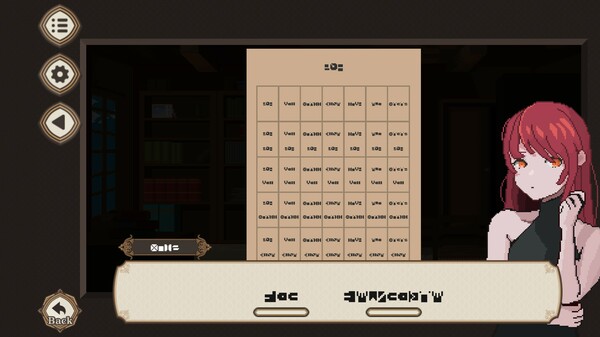 Store hero capsule for 7 Days to End with You — Steam store key art
The Texture of Difficulty
Opinions on difficulty split cleanly. Japanese write-ups call the balance 'just right — some words fall quickly, some make you sweat.' English reserved reviews and pro critics call the first few loops 'obtuse, with no confirmation you're reasoning correctly.' The same texture can be named good balance or unfriendliness — and that range is the clue.
In design terms the difficulty comes from an absence of confirmation. A sokoban board tells you plainly when you're right; this game mostly won't say whether your translation holds. There are indirect checks — can you carry out a requested task? — but most words stay provisional. Whether that suspension reads as the thrill of the detective or the dread of being lost decides the kind of difficulty you feel.
Worth flagging: your native language tilts the field. Japanese speakers get a feel for the syntax; English speakers clear one extra wall of awkward phrasing. Since the difficulty isn't fixed but shifts with linguistic background, I set diffLabel to 'standard' while stating plainly that the experience varies widely.
 Steam library hero banner for 7 Days to End with You — Steam store key art
Sources
This piece was written from the Steam store and community user reviews as of 2026-07-26. No review text is quoted directly; typical claims are reconstructed.
・Steam: 7 Days to End with You (Very Positive; ~88% of ~3,370 all-language reviews, 85% of 1,214 English, 85% of 57 in the last 30 days; snapshot 2026-07-26)
・Read the helpful- and recent-sorted positive/negative reviews via WebFetch. Developer, release date, genre tags and asset info verified against the Steam store and SteamDB (app/1859280)
・Press: Denfaminicogamer, WayTooManyGames (6.0), and Indie Games Plus
Closing
7 Days to End with You splits its audience cleanly, but the split makes sense. Taking away the dictionary and turning reading itself into the puzzle is a real invention, and the feeling of a story's resolution rising with each solved word resembles nothing else. For players who can form their own image inside ambiguity it is singular; for those who want confirmation and one answer to check against, it reads as obtuse and short. Both reactions follow from a single bet on subtraction and observation resolution.
Steam's overall sits near 88%, and from a design view I give it 8.0. The invention of making reading the act of solving, and the way a loop can flip the whole picture, are clearly top-tier. But the twist between the 'any reading is valid' pitch and the dream scenes that funnel you to a right answer, plus a translation layer that shifts difficulty by native language, are real reservations I discount for. On the one thing it sets out to do — deduce an unknown language — this game truly works.
 Steam library vertical capsule for 7 Days to End with You — Steam store key art
Where are you with this game?
Press one and the game goes on your shelf. You can see it on your account page.
Reactions (no login)
Anonymous • one of each per visitor per day
Read next
Related reviews
Return to Monkey Island
A point-and-click adventure in which series creator Ron Gilbert returns, three decades on, to the pirate comedy he left unfinished. It replaces the old verb menu with a single context-sensitive interaction, adds an in-world hint book that opens solutions in stages, and sends Guybrush Threepwood after the Secret of Monkey Island once more.
Hyperbolica
A first-person non-Euclidean adventure set in towns built from hyperbolic space, where parallel lines refuse to stay parallel, and spherical space, where distant objects look larger; you talk to residents and play races, skiing and snowball fights to build an intuition for the place. Made by CodeParade, who wrote the rendering pipeline from scratch.
Dorfromantik
A hand-painted tile-placement puzzler: draw one hexagonal tile at a time and rotate it so its forests, fields, houses, rivers and rails line up with their neighbours. Complete quests to win tiles back and keep the village landscape growing, in Berlin studio Toukana Interactive's debut.


