REVIEW · 2022-03-14
Hyperbolica
Reading the Steam reviews: did non-Euclidean space ever become a verb?
Opening
You walk, in first person, through a world built out of non-Euclidean geometry. In hyperbolic space parallel lines refuse to stay parallel, and a few steps replace almost everything in view. In spherical space the opposite happens: distant objects look larger. Hyperbolica drops a town, its residents and a set of minigames into that space. Released 14 March 2022, developed and self-published by the solo developer CodeParade, who has said the entire rendering pipeline had to be custom-built.
I am writing this from the Steam review pool. As of 2026-08-09 the label reads Very Positive: 84% of 1,218 Steam-purchaser reviews. Counting every review, 1,097 positive against 223 negative out of 1,320. The number looks comfortable. But those 223 negative reviews point at almost exactly one thing.
That one thing is the question of whether this is a game at all. CodeParade published years of development as YouTube devlogs, and a large share of reviewers arrived as viewers first. Both the height of the expectation and its content were formed outside the product, before release. As material for reading a review pool, it is hard to ask for a cleaner case.
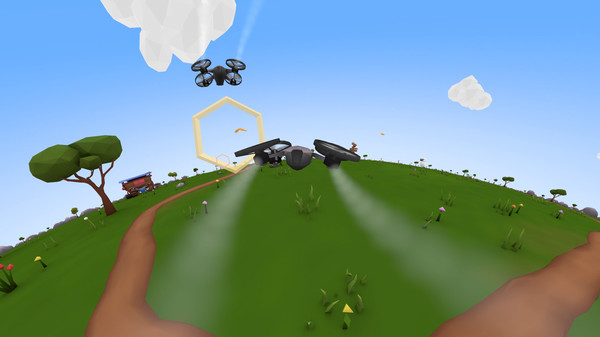 An outdoor scene under a blue sky, the ground curving away like a small planet, with drones and an orange hexagonal ring — Steam store screenshot
First Impressions
The most upvoted helpful positive review is not about the game's content at all; it is astonishment at its author. A mad scientist who tore an engine apart and made an artwork from the pieces; a digital Picasso. That is the whole review. A reviewer who identifies as a mathematician writes that they needed this — and immediately adds that for the gameplay alone they cannot recommend it. That two-step is close to the standard shape of the positive side.
The recurring words are fascinating, impressive, unique, and tech demo. It is unusual to see tech demo used approvingly and without irony. What they mean is: this is a demonstration, and nobody else is demonstrating this. What is being praised is not fun but a rewriting of one's resolution of observation.
The negative side, meanwhile, almost always opens from the same posture: I had been waiting for this, I watched every devlog. Then comes the disappointment. The sharpest summary is a single line — it is smaller on the inside. The possibility seen from outside was larger than what was in there.
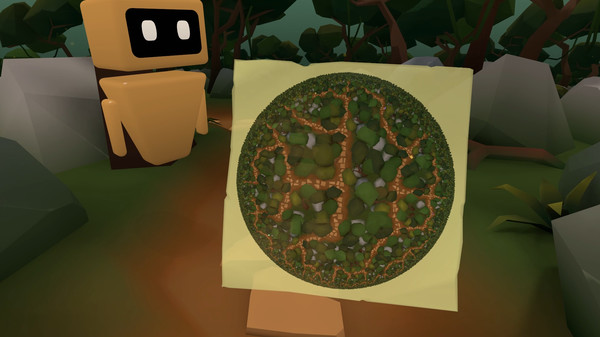 A dark forest, a notice board carrying a disc-shaped map, and a yellow boxy robot beside it — Steam store screenshot
The World
One element the pool praises almost unanimously, on both sides, is the experience of the space itself. The spherical farm and the seemingly endless café are named specifically by positive and negative reviewers alike. The most common positive formulation is that the world keeps turning out to be far larger than what you can see. Reports of trying and failing to build a mental map recur just as often.
That failure is not a metaphor. In an interview the developer explains that a map of hyperbolic space cannot be drawn on flat paper at all, and that players navigate by chains of landmarks instead. It is why the in-game map is a disc whose information packs tighter toward the rim. Few games put resolution of observation this directly on the table.
The same property, though, underwrites the largest complaint. Hyperbolic space fits exponentially more volume into the same apparent extent, so there is far more area to fill than in an ordinary game. The recurring negative charge — samey places, crowds of NPCs with nothing to say — is really a verdict on how that volume was answered: by mass production. Filled by addition rather than tightened by subtraction. Compare Manifold Garden, which solved infinite repetition by folding it into a single kind of view; this goes the other way.
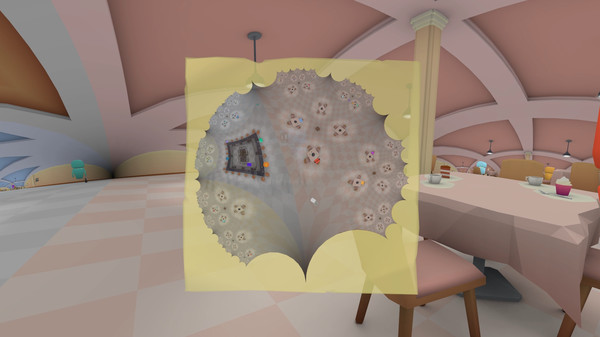 An interior of repeating pale pink arches, tables and chairs behind, and a disc-shaped map that grows finer toward its rim — Steam store screenshot
Putting the Mechanics into Words
The core negative claim is stated with unusual precision. The places where the geometry genuinely bites, these reviewers say, are a maze, a box-pushing puzzle and a couple of puzzles involving burrowing animals — and the rest would work just as well in Euclidean space. One reviewer describes an NPC explaining that walking alongside a straight fence requires turning constantly, and notes that this was the end of it. The property was displayed but never built into a solution.
Translated into the Puzzlebyrinth vocabulary, this is a question of verbs and grammar. Hyperbolic space here is thoroughly grammar: a layer of rules rewriting what distance, angle and heading mean. The verbs, meanwhile, stayed generic — walk, talk, pick up, hand over. Swap the grammar without swapping the verbs and the change sinks into the background. It sits opposite Antichamber, which made spatial inconsistency the key to progress, and Superliminal, which compressed perspective into a single verb: grab and place.
What is striking is that the negative reviewers do not stop at complaint; they write design proposals. Assign one property of hyperbolic space to each area, guide the player until they can wield it, then place harder puzzles later that assume the accumulation. Several reviews converge on nearly the same plan. That is learning-curve design, and it means the pool arrived on its own at the conclusion that what was missing was not level count but ordering.
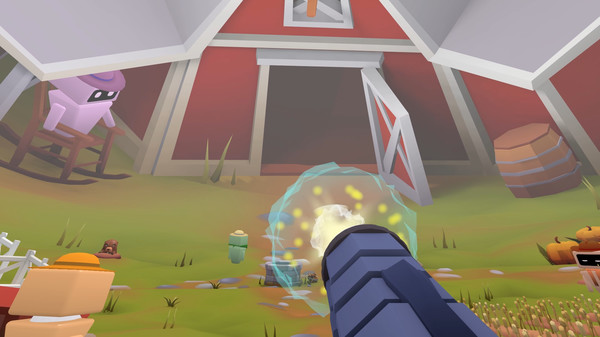 A first-person view: a glowing teal swirl on the grass before a red barn, a dark blue tube-shaped tool in the foreground, a pink robot in a rocking chair at left — Steam store screenshot
Feel of the Controls
The complaints cluster not around puzzles but around the action sequences: skiing, skating in the café, a snowball fight, a drone race, a late-game confrontation. The negative vocabulary concentrates on floaty, unresponsive, frustrating, with specifics — no crosshair, an oversized hitbox, no vertical dodging. One reviewer reports half an hour on the ski section alone. A Japanese review contains a flat request to stop putting timed races in this space.
The positive side describes the same sequences in completely different words. One long review explains that in hyperbolic space distant things rush at you while the exit of a corner is far wider than intuition suggests, so a run that would be trivial elsewhere becomes a real learning curve. Both sides are looking at the same phenomenon; one calls it undertuned, the other calls it relearning.
Motion sickness splits along the same line. A VR player writes that the distorted periphery has to be kept out of attention or the stomach objects — then says the effect alone would be worth the price. Even positive reviews use the word nauseating. A recent review, by contrast, offers a technical observation: no sickness, and no FOV slider needed, since the view is a projection from hyperbolic space rather than a normal frustum. It is rare for bodily comfort and design to be this continuous with each other.
As design, there is a finding here. Action assumes stable estimates of distance and speed. Hyperbolic space is precisely the layer that breaks those estimates. That this space is a poor fit for action is a real result — and it was established by letting people play, not by argument.
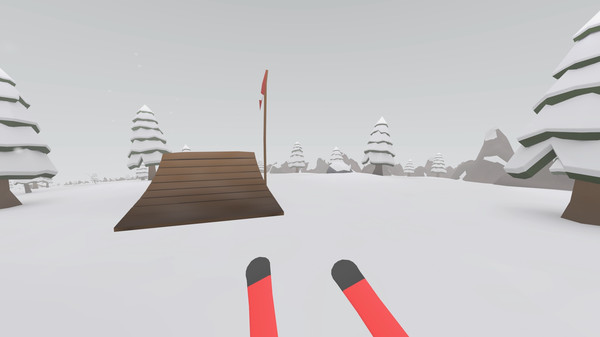 A snowfield in first person with red skis in view, a wooden ramp and a red flag pole ahead among snow-covered conifers — Steam store screenshot
Sources
This piece was written by reading the Steam user reviews as of 2026-08-09. Nothing is quoted directly; recurring claims are reconstructed.
- Steam: Hyperbolica (Very Positive; 84% of 1,218 Steam-purchaser reviews. Across all reviews, 1,097 positive to 223 negative out of 1,320)
- Read: the top 6 all-time helpful positive reviews, the top 10 negative, 3 Japanese-language reviews and 10 sorted by recency — 29 in total
- Developer's own account: Game Developer, "Q&A: The mind-bending geometry of non-Euclidean experiment Hyperbolica" (2021, interview by John Harris)
Closing
Sorted by recency, the argument has gone quiet. Reviews written in 2026 are short and generally warm — a couple of lines about a nice geometry lesson, or about living for strange worlds. The heat and the letdown of launch week are gone. Two voices remain. One wants a game that revisits this technology with a greater focus on gameplay. The other is not sure it would pay more than about eight dollars. These are the settled verdicts of people who arrived with expectations, and a price, already lowered.
The median completion time visible in the pool is roughly two to four hours; even the long runs rarely pass ten. Against that length, the $12.99 price is raised explicitly and repeatedly as the dividing line. It looks like an argument about money, but it is an argument about definition: what exactly is being paid for — the engine, or the game?
Against Steam's 84% I give it 7.0 on design grounds. The gap comes down to one thing: high marks for rewriting the grammar, a deduction for leaving the verbs alone. The power to rebuild your resolution of observation is real, and the spherical farm and the disc map offer something unavailable anywhere else. But there are only a handful of problems that genuinely require this space to solve, and the NPCs deployed to fill the remaining volume thin the whole thing out.
Who it suits is fairly clear. Anyone curious about geometry itself, or drawn to spatial illusion by Antichamber or Superliminal, will find something here they cannot get elsewhere. Arrive wanting a chain of demanding puzzles and you will meet exactly the disappointment two hundred reviews have already described. CodeParade has since released 4D Golf, and Steam now sells the two together in a bundle — the author's second answer to the question of what to put on top of the technology.
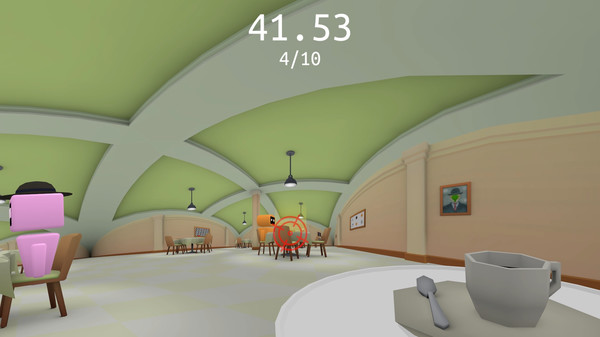 An interior of repeating green arches, a timer reading 41.53 and a counter reading 4/10 at the top of the screen, a large mug at lower right — Steam store screenshot
Where are you with this game?
Press one and the game goes on your shelf. You can see it on your account page.
Reactions (no login)
Anonymous • one of each per visitor per day
Read next
Related reviews
4D Golf
A first-person mini-golf puzzle set in a space with a fourth spatial axis on top of the usual three. You turn through it, compare cross-sections, and read hidden routes and shifting gravity on the way to the cup. Over 120 holes and a 4D course editor, from CodeParade, who made Hyperbolica.
Return to Monkey Island
A point-and-click adventure in which series creator Ron Gilbert returns, three decades on, to the pirate comedy he left unfinished. It replaces the old verb menu with a single context-sensitive interaction, adds an in-world hint book that opens solutions in stages, and sends Guybrush Threepwood after the Secret of Monkey Island once more.
The Last Campfire
A 3D puzzle adventure in which Ember, a small lost flame, walks an underground world and works through the small contraptions blocking the stranded souls it finds there. A storybook-shaped project from Hello Games, the studio behind No Man's Sky.


