REVIEW · 2024-03-22
4D Golf
Reading the Steam reviews: everyone learned the fourth dimension, nobody learned the golf
First Impressions
The most-upvoted helpful review is two lines long: the writer can now see and comprehend the fourth dimension, and still, unfortunately, sucks at mini golf. It has 205 votes. The second-most-upvoted has the same shape — a 4D game projected into 3D, rendered on a 2D screen, understood by a 1D brain.
They are jokes, but between them they state the whole structure of this game's reception. The recurring positive words are mind-bending, comprehend, visualise and teach. The claim that no explainer video gets you to four dimensions, and that being dropped into them does, comes back again and again in different phrasings. What is being praised, before fun, is the sensation of having one's head rewritten.
So what does the negative side say? There are only seventeen of them, so I read all of them. The surprise is that they praise the fourth dimension too. One gives the 4D part an A+ and says the problem is the golf — the part you would expect to be easier to get right. The split is not about the extra dimension. It is about the golf.
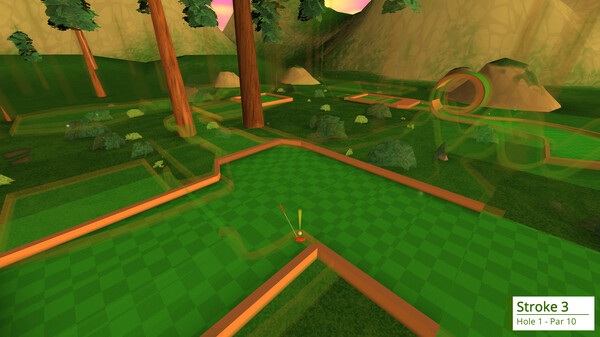 4D Golf in-game view — Steam store screenshot
Putting the Mechanics into Words
Gather the explanations scattered across the pool and the game has two verbs: turn along the fourth axis, and hit the ball. The first picks which cross-section you are looking at; the second rolls the ball inside it. Reviewers use the words ana and kata for the extra directions, and the fact that the vocabulary sticks is itself evidence the teaching worked.
In the Puzzlebyrinth vocabulary, the fourth dimension here is implemented as a verb rather than as grammar. What the negative side pressed on in Hyperbolica was that non-Euclidean space stayed a background rule and never entered the solution. The same author's next game fixes exactly that. One passage you cannot see without turning is enough to make the property part of the answer.
The interesting line comes from a long positive review: the more you play, the less it feels 4D, and the more it feels like 3D golf projected onto a surface. That is not a complaint. It is a report that the learning finished. Raise the resolution of observation and the foreign thing becomes the environment — a verb sinking into the background not by subtraction, but by familiarity.
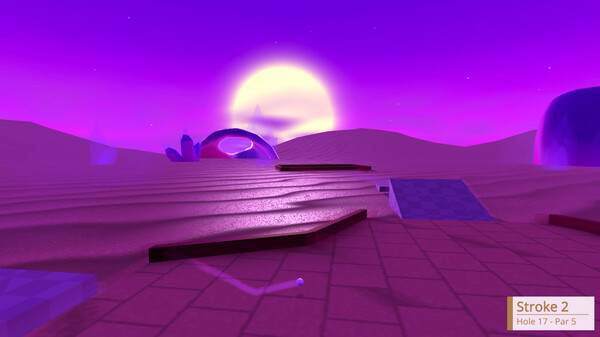 4D Golf in-game view — Steam store screenshot
Teaching
The positives are remarkably consistent about what they liked. The first few holes are entirely flat, effectively three-dimensional. Then come the mini-golf staples — windmills, ramps, sand. Only after that do the game's own devices arrive: gravity manipulators, long jumps, ice.
Known grammar first, then one unknown axis added on top. Before teaching four dimensions, the game teaches everything that is not four-dimensional. The compliment that a video could never do what being thrown in did is, in fact, praise for how carefully the throwing was staged.
A recent reviewer puts the limit well: the game is trying to explain a very complicated concept in a short time, a proper explanation would need a lecture, too long a lecture would also fail, and there is no perfect answer. They voted yes and still note they had to do a lot of their own thinking. Good teaching and light work for the student are not the same thing.
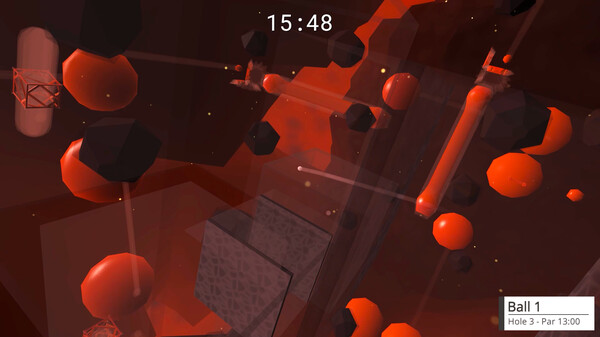 4D Golf in-game view — Steam store screenshot
The Texture of Difficulty
Testimony about difficulty sorts into three kinds: difficulty you cannot understand, difficulty you understand but cannot execute, and the tedium of repetition. Almost everything said about this game belongs to the last two.
One reviewer finished most holes around par and then went a hundred strokes over on the last hole of the Dunes Challenge. Another, at stroke ninety on a final hole, asks for a skip button or a mid-course save so they can stop without losing everything. Both voted yes. The negative side says much the same thing and adds that the putting demands pinpoint power again and again, and that the ball bounces far too hard to predict.
Complaints about controls sit on top of that: no key rebinding, the same input driving both the swing and the camera so a twitch of the mouse ruins a shot, no controller support. In a game that asks you to understand four dimensions, it is an irony that most of the sticking points are power and input — but a coherent one, since the understanding really has been taught.
There are also motion-sickness reports. One reviewer could not continue past the grid display on the third course and could not find a setting to turn it off. Showing continuous cross-sections makes this hard to avoid, and it is not something you can test before buying, so it is worth stating plainly.
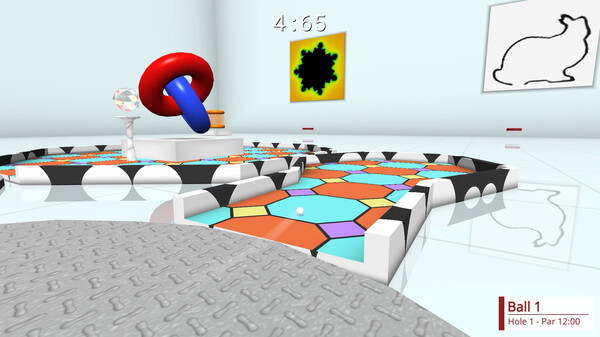 4D Golf in-game view — Steam store screenshot
Place in the Lineage
Games that take the properties of space as their subject are not rare. Antichamber made spatial inconsistency the key to progress; Manifold Garden built infinite repetition and gravity swapping into its solutions; Superliminal compressed perspective into one verb, grab and place.
This one sits slightly apart from all of them. It adds an axis and then hosts it inside the most worn-out format available: mini golf. When the pool writes it off as just a golf game, that is a complaint and an explanation at once. The more familiar the frame, the more clearly the one added thing reads as foreign. The store tags — Casual, Mini Golf — are honest about this.
The sharpest negative review is written as a request to the author: keep making engines, but hand the projects to writers and designers. Hyperbolica drew a version of the same verdict. Two games in a row is worth recording.
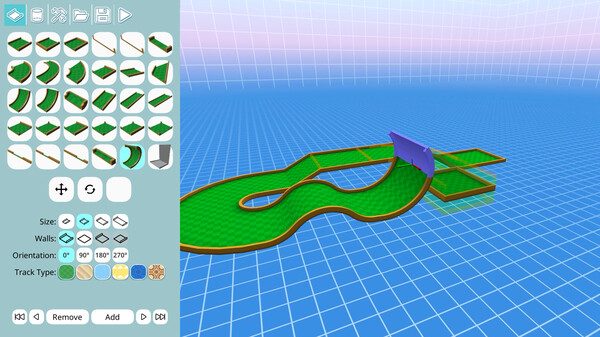 4D Golf in-game view — Steam store screenshot
Sources
This piece was written by reading the Steam user reviews as of 2026-09-10. Nothing is quoted directly; recurring claims are reconstructed.
- Steam: 4D Golf (Overwhelmingly Positive; 786 positive to 17 negative out of 803 reviews, 98%)
- Read: the top 10 helpful positive reviews, the top 10 helpful negative reviews (out of only 17 negative in total), and the 8 most recent.
- AUTOMATON coverage (2024-03-30, Japanese) — a news piece rather than a scored review, used to check the reception right after launch (Very Positive, about 97% across roughly 200 reviews at the time).
Closing
As of 2026-09-10 the pool stands at 786 positive to 17 negative out of 803, or 98%, labelled Overwhelmingly Positive. The sample is not large, but the scarcity of dissent is striking. Playtimes in the reviews start around four hours and mostly scatter between ten and thirty; with a course editor and Workshop support, the upper end is time spent building, not finishing.
I give it 8.0. The gap against 98% sits in the golf layer, not the fourth dimension. On the evidence of the pool, the hard problem — making an extra dimension into a verb — is solved. What stops people short is everything downstream: pinpoint power, unpredictable bounce, no mid-course save, no rebindable input. That is a question of finishing, not of design reach.
The recent reviews are short and uniformly positive: one of the best geometric puzzles there is; I can now picture 4D objects, and so can you. Several are pleased the engine was open-sourced. Two and a half years on, the game seems to have settled into its role as a device for experiencing four dimensions, with the golf complaints filed small. It is also the answer to the wish left in the Hyperbolica pool: someone should take this technology and aim it at play.
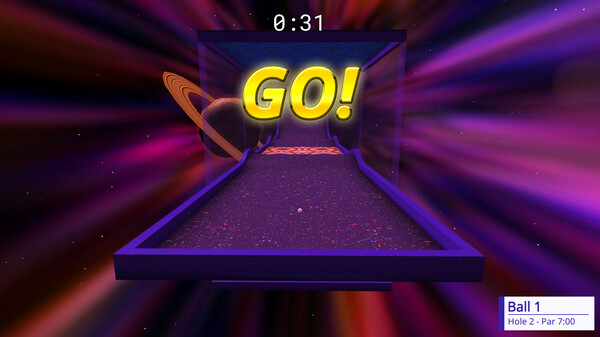 4D Golf in-game view — Steam store screenshot
Where are you with this game?
Press one and the game goes on your shelf. You can see it on your account page.
Reactions (no login)
Anonymous • one of each per visitor per day
Read next
Related reviews
Hyperbolica
A first-person non-Euclidean adventure set in towns built from hyperbolic space, where parallel lines refuse to stay parallel, and spherical space, where distant objects look larger; you talk to residents and play races, skiing and snowball fights to build an intuition for the place. Made by CodeParade, who wrote the rendering pipeline from scratch.
Cryptmaster
A word-driven dungeon crawl in first person: type the words you have recovered to fire skills and answer riddles. Built in monochrome pencil illustration with a fully voiced narrator, by Paul Hart and Lee Williams.
Riven
Cyan Worlds' own ground-up 3D remake of the 1997 classic — a first-person puzzle adventure with no hints and no highlighting, where you walk a collapsing island and read its water, machines and D'ni number system to unlock its secrets.


