REVIEW · 2024-05-09
Cryptmaster
The verbs are words you type — a skill list hidden in the dictionary
First Impressions
Two words dominate the entrance to this review pool: Wordle and Hangman. Whether sorted by helpful or by recency, positive reviewers reach for them first to explain the experience to someone else. One describes scratching the same brain-itch as Wordle, but over hours instead of seconds; RPGFan calls the structure "Hangman: The RPG." Nobody opens with the dungeon, even though you walk one in first person.
The critical side enters at the same door. The idea is good, they say, but the floor shows through after two or three hours. One reviewer admits being baffled that the game sits at 94%. From one shared starting point — the novelty of guessing words — one camp counts how many hours it sustains and the other counts how quickly it runs out.
The numbers first. On Steam, 94% of 1,660 reviews are positive, labelled "Very Positive" (snapshot 2026-07-29); counting non-Steam purchasers, 2,101 positive against 160 negative out of 2,261. SteamDB's own weighting puts it at 88.69%, slightly below the raw percentage. RPGFan scored it 85. The figures suggest calm consensus; the review texts show two different axes of judgement.
 The Steam store header image — Steam store key art
Putting the Mechanics into Words
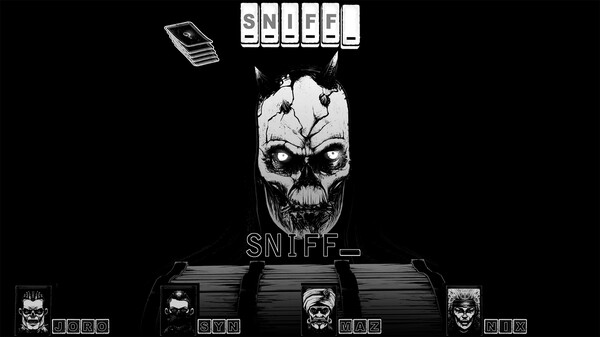
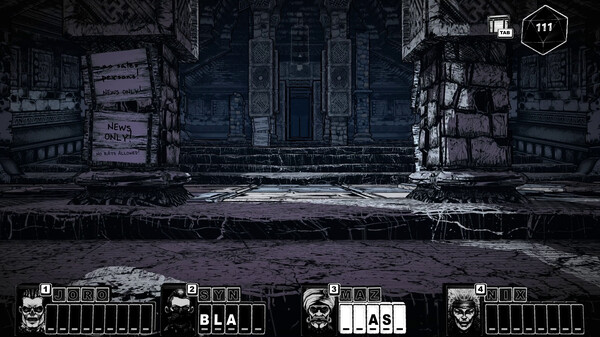
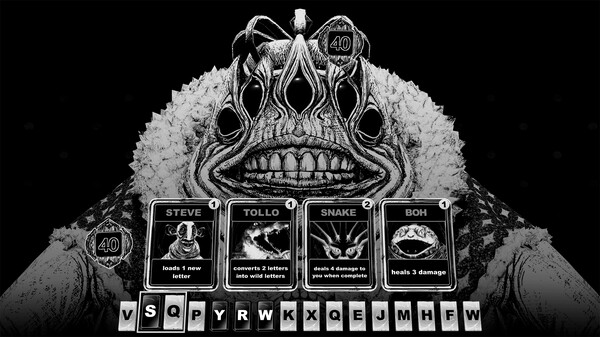
Put into words, the verbs here are the words you type. Each of the four dead heroes carries a row of blank letters; answering riddles, fishing and collecting wall-bugs fills those blanks one letter at a time, and typing a completed word in combat fires it as a skill. The skill list exists as vocabulary rather than as a menu — the opposite bet from subtraction of verbs: proliferation of them.
What the positives repeat most is astonishment that the words get spoken back. One guesses that half a dictionary was recorded. The store page promises "SAY ANYTHING," and that single line is also the most-praised feature. Where Chants of Sennaar asks you to decode an unknown language, this asks you to remember a known one. Same genre, arrow reversed.
The critical side describes the identical design differently: it is just naming the button you would otherwise click, and by the end you have dozens of skills but keep typing the first two or three. One reviewer notes the assassin's words are geography — ATLAS, FJORD — with no visible link to the character. The developer replied on the forum that her word set is geographic by design, tied to her memories. The grammar existed on the author's side and read as brute force on the player's. The complaint is not the number of verbs; it is that the grammar stayed invisible.
 The store's main capsule image — Steam store key art
The Texture of Difficulty
When difficulty comes up, the pool is unknowingly sorting it into three kinds: difficulty of vocabulary, of memory, and of reflex. All three arrive under the same word, but their causes and remedies differ.
Vocabulary. A reviewer whose first language is not English describes feeling stupid every time obscure words and puns sent them to an outside answer. Another, after long hours, calls the crypticisms ridiculously obscure and misleading. This is not a matter of observational resolution but of a precondition: the dictionary. The reach of the design leans toward English speakers, and neither camp can rewrite that.
Memory and reflex. Once the skill words number in the dozens, real-time combat leaves no time to recall them, so players spam the basics — reported on both sides. Yet the game ships a turn-based mode and difficulty options, and the forum has carried "turn-based made it far better" since the first weeks. Part of the complaint, then, is not a missing design but an unadvertised one. In terms of learning-curve design, the curve exists here; the game just does not tell you where it is.
 The official artwork used as the store page background — Steam store art
The Feel of the Story
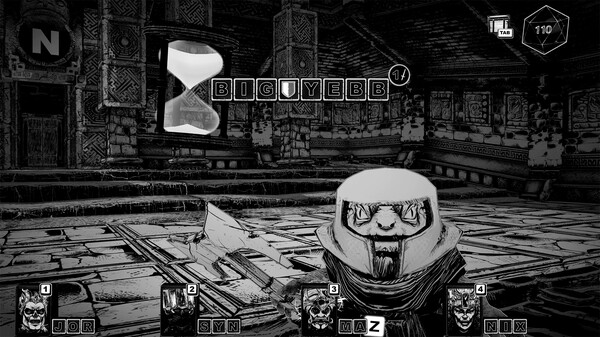
What keeps the positives warm to the end is the voice. The narrator's Vincent Price impression alone is worth the entry price, they say; the pencil-illustrated world is gorgeous; the fretless bass gives the score a character of its own. RPGFan likewise treats the Cryptmaster himself as the star, a jester you cannot quite classify as clever or dim. Because the four heroes' memories return through words, story and skill list run on the same wiring.
The critical vocabulary is equally consistent: white on white on white, disorienting in monochrome, dialogue you cannot skip. On the latter two the developer pointed to a spacebar skip and lower-contrast colour options. Again, part of the grievance sits with communication rather than with the feature set.
One thing, though, nobody defends: the ending. A long positive review from a player with 43 hours logged appends that the ending they saw was underwhelming and that the game gets worse the longer it runs. A negative reviewer says they quit on learning that another area still lay ahead. That is the price of wiring story to skill list: the late game turns into clearing word inventory, and design consistency comes back as a problem of length.
 The wide key art used in the Steam library — Steam store key art
Sources
This piece was written by reading the Steam user review pool and its surrounding material as of 2026-07-29. It is a reading of reviews, not a play diary.
· Steam: Cryptmaster (94% of 1,660 reviews positive; "Very Positive"; 2,101 positive against 160 negative across all 2,261)
· Read: 10 entries from the negative-only listing, four recent items from the most-helpful (week) view, and two long individual reviews with high helpful counts
· Developer replies come from the Steam thread "I love everything but the combat." (turn-based mode, colour options, dialogue skip, and the logic behind the skill words)
· Alternative weighting from SteamDB (88.69%); press from RPGFan's review (85 overall)
· The figures in this piece are official Steam store assets (header, main capsule, hero capsule, library key art, store background). Image files could not be downloaded and inspected in this environment, so the captions state only the asset type and make no claim about depicted content.
Closing
In closing: Cryptmaster multiplies its verbs instead of subtracting them, then hides the multiplied set inside a dictionary. Nearly everyone in the pool, on both sides, grants that turning a skill list into vocabulary is an invention. What splits is the estimate of how many hours the invention lasts — the disagreement about the game itself is smaller than the score gap suggests.
My score is 8.2, a little under Steam's 94%. Two deductions. The late game becomes inventory clearance for words. And the grammar that exists on the author's side — skill words tied to each character's memories — never reaches the player. I label the difficulty hard, but the experience genuinely varies. Excluding those who quit early, the completion times cited in reviews cluster between twelve and sixteen hours, with a median near fourteen; RPGFan calls it a nearly fifteen-hour jaunt.
For: readers who want words themselves to be the place where thinking happens, and who welcome a structure where dictionary and memory ride the same input, as in 7 Days to End with You. Not for: those who put move-count optimisation at the centre, or who cannot accept English wordplay as a precondition. The line the critics repeat — good idea, does not grow — reads to me less as a fault report than as an honest survey of how far this invention carries.
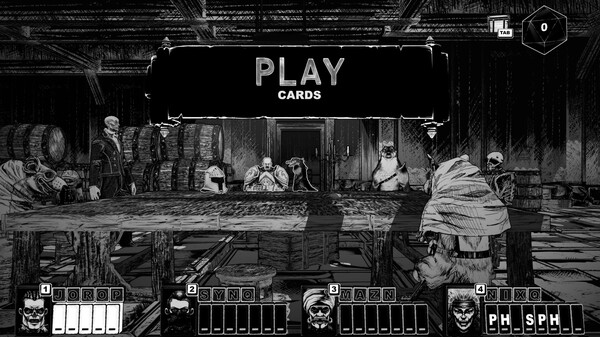 The store's hero capsule image — Steam store key art
Where are you with this game?
Press one and the game goes on your shelf. You can see it on your account page.
Reactions (no login)
Anonymous • one of each per visitor per day
Read next
Related reviews
4D Golf
A first-person mini-golf puzzle set in a space with a fourth spatial axis on top of the usual three. You turn through it, compare cross-sections, and read hidden routes and shifting gravity on the way to the cup. Over 120 holes and a 4D course editor, from CodeParade, who made Hyperbolica.
Tactical Breach Wizards
A turn-based tactical puzzle in which a squad of wizards in body armour clears a building one room at a time. Every shot lands, nothing is random, and you can rewind as many turns as you like. From Suspicious Developments, the studio behind Gunpoint.
The Rise of the Golden Idol
A 2D deduction adventure where you click through frozen crime scenes and drop harvested words into blanks to reconstruct who did what, why, and in what order. A standalone sequel to The Case of the Golden Idol, set across twenty linked cases in the 1970s.


