REVIEW · 2021-06-02
Overboard!
The Whodunnit, Turned Inside Out
First Impressions
July 1935. A murder happens aboard the ocean liner SS Hook, eight hours out of New York. Only the culprit is Veronica Villensey — the character you control. Having pushed her husband overboard, she has until the ship docks to bury the evidence and pin the crime on another passenger. It is a detective game turned inside out: instead of reconstructing a fixed past, you dismantle the genre from the murderer's side. inkle (80 Days, Heaven's Vault) shadow-dropped it in 2021.
I write this from the Steam review pool. The label is 'Very Positive,' 90% of 558 reviews (596 up, 64 down across Steam's 660-count total; snapshot 2026-07-05). Metacritic sits at 81. A mild consensus by the numbers — but read the reviews in helpful order and you find praise and complaint studying the exact same design from opposite sides.
Positive and negative reviews keep naming the same reference: Return of the Obra Dinn. One side as 'a deduction experience to rank beside it,' the other as 'buy that instead of this.' Why two detective games land on opposite axes is where I begin.
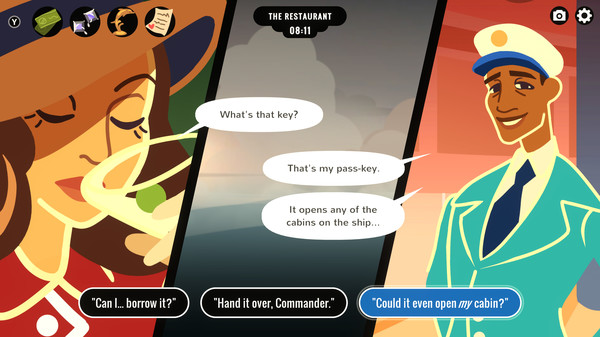 Overboard!, set aboard the SS Hook — Steam store
The Feel of the Story
The first thing the helpful positive reviews agree on is the writing and the mood: 'well-written,' 'witty,' 'the 1930s atmosphere is a pleasure.' Veronica never hesitates to seduce or scheme her way out of a killing, yet the dark-comedy voice keeps her likeable, and reviewers ride along. One writes that the game 'let me exercise the inner bastard I never indulge when I always pick the nice option.'
Casting the culprit as the lead is not mere bad taste. Detective stories usually have you reconstruct a fixed past — Obra Dinn does exactly that. Overboard! reverses the arrow: you fabricate the past and then tidy it into something the ship's would-be detective will accept. The object of observation flips from 'what already happened' to 'what I am about to do and hide.' That is why the story feels so light on its feet.
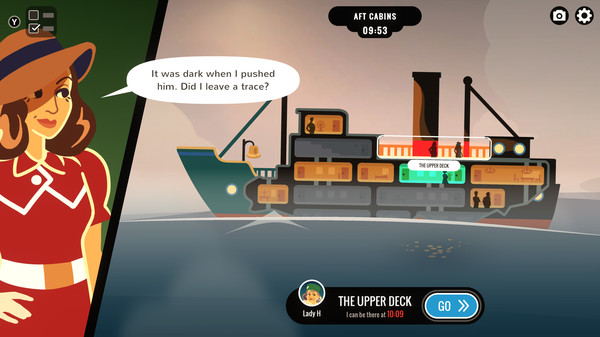 Veronica and the 1930s shipboard drama — Steam store
Putting the Mechanics into Words
What positive reviews name as the game's heart is its loop. A run is 15 to 30 minutes; every time you are caught or run out of time you snap back to 8am, but the previous run's memory carries over and a fresh objective appears. The passengers move on their own schedules and remember what they see and hear. One reviewer calls it 'a game about testing the butterfly effect.'
In Puzzlebyrinth's vocabulary this is verb design. Your verbs — lie, bribe, seduce, plant evidence, kill again — are few enough to count, and the cast and cabins are bounded. On that subtracted board, the order in which you lay verbs across the eight-hour timeline becomes the grammar. A small verb set exploding into combinations is exactly the shape this site keeps naming as the mark of a good puzzle, here transposed into fiction.
The craft everyone praises is the anti-tedium layer: dialogue fast-forwards, chosen options show in green, any scene can restart. The great enemy of loop games — repeating the same busywork — is stripped out at the UI. Next to the friction of Twelve Minutes, this is a clear step forward.
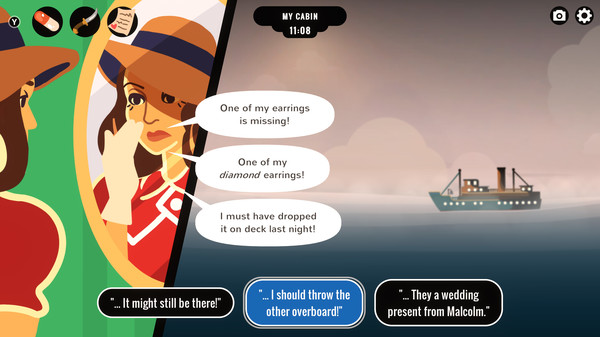 Weaving eight hours through dialogue and choice — Steam store
The Texture of Difficulty
The sharpest split is whether this counts as 'deduction' at all. The helpful negative reviews keep returning to it: 'repetitive hard work rather than intelligent deduction'; 'you just try wacky actions to shake clues loose, like hitting a pinata'; 'the logic is deterministic yet the results feel random.' One reviewer recounts framing someone with no logical holes, only to be told 'that would be too perfect, so it must have been you.' What they want is a branch map like Detroit — a picture of which move changed what.
I read this as a problem of observation resolution. The board runs deterministically, but it does not report its causes at a grain the player can read. Change one variable, check the delta — the basic move of puzzle-solving — costs more here because a whole day's replay sits in between. Hence 'I can't tell what I changed.' That is not broken logic; it is a design where the resolution of state fed back to the player is coarse.
The telling thing is that the positive side describes the very same phenomenon as a virtue: because causes are not fully legible, 'you want to try what happens next,' and 'the unexpected fallout makes the loop fun.' So this is less a flaw than a question of the design's reach. For players who can regard the ship as clockwork to be learned, the opacity becomes room to explore; for players who demand move-by-move deterministic clarity, it looks like brute force. Not which is right — who it is for.
 A deterministic ship whose causes are hard to read — Steam store
Sources
This piece was written by reading the Steam store page's user reviews as of 2026-07-05.
・Steam: Overboard! (Very Positive, 90% of 558 reviews; Steam total 660, 596 up / 64 down)
・Read via WebFetch: the top 10 helpful positive reviews, the top 3 helpful negative, and recent posts (positives from Poto_Oil, lleon, constantcompile, Narmaya, Ross, Feena; negatives from SomeKindaBliss, yuirick, Punchy).
・Developer, release date, genre tags and engine were verified on SteamDB; the critical angle on NME's 4/5 review. What users call 'brute force,' NME rephrases mildly as 'no hidden depths,' so the gap between critics and users is small.
Closing
Overboard! is an experiment that reverses the detective game's arrow: not reconstruct the past, but write it and make others believe it. Wound tight by an eight-hour deadline and carried-over memory, inkle's branching narrative becomes a dense board you can run in fifteen minutes. Reviews put full completion at roughly five to six hours.
Steam's overall is a high 90%. From a design standpoint I give it 8.0. This site's concern is the feel of a thinking puzzle, and by that ruler the coarse resolution of cause fed back to the player slightly dulls it as pure deduction. As interactive fiction it is unimpeachably fine; come expecting move-by-move legible reasoning and you hit the brute-force feeling the negatives describe.
For players who savour clean subtraction and loop design — who enjoy learning the ship as small clockwork — it is as elegant an inside-out whodunnit as you will find. If instead you want the clarity of Return of the Obra Dinn, where everything is disclosed and you find the connections, adjust your expectations a notch before boarding.
 A whodunnit turned inside out — Steam store
Where are you with this game?
Press one and the game goes on your shelf. You can see it on your account page.
Reactions (no login)
Anonymous • one of each per visitor per day
Read next

Related reviews
Twelve Minutes
A real-time, top-down thriller in a single apartment: you are killed, snap back to the moment you opened the door, and loop the same twelve minutes, using only what you have learned to break the cycle. Luis Antonio builds dread from few verbs and one room.
The Forgotten City
A first-person mystery-adventure set in an underground Roman city bound by a golden rule — if one person sins, everyone dies — where you relive a single day through a time loop, unravelling the city's doom through conversation and moral choice. By Modern Storyteller.
Tiny Room Stories: Town Mystery
An escape-room puzzle game in which a private detective, summoned to the deserted town of Redcliff, inspects diorama-like rooms that can be rotated and viewed from any angle, opening keys and combination locks while searching for his father. Made at a very small scale by Kiary Games and ported from mobile.


