SOUNDTRACK · 2026-08-27
Soundtrack: A Little to the Left — music that never rushes you to finish
Justin Karas
Introduction — the feeling of one record sitting crooked
When I put a record back on the shelf, I always notice the one that sits at a slight angle. A Little to the Left turns that exact feeling into a tidying puzzle. As Komugi's review notes, you rearrange cluttered tabletops and drawers according to a hidden order of size, color, and count.
The music was written by Canadian composer Justin Karas. Out of habit I tried to clock the theme's tempo, and once again I couldn't quite pin it down. Roughly 70-something, closer to a heart at rest than a beat to follow. No drum anywhere is hurrying you.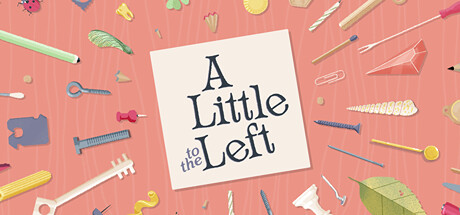 A tidying puzzle about rearranging everyday clutter
A puzzle-specific trait — the snap sound as a hidden percussion part
This game has more than one right answer. According to an interview with developer Max Inferno, the challenge of straightening a picture eventually flips into the opposite question: how do you nudge a picture that's already straight? Failure, as a state, doesn't exist here.
So the music has no wrong-answer sound either. The only cue is a light "snap" that plays when something settles into its correct spot. I hear it as a second percussion part folded into the score — the piano keeps the accompaniment, and the player taps out the beat.
Getting stuck doesn't speed anything up. Alongside hints, there's a skip button literally named "Let It Be." The music carries the same slack. Karas's theme holds its main melody a long beat, then leaves a small silence before the next note lands — a chord in no hurry to resolve.
A hidden link to the experience — the tidying gets stranger, the music's mood does not
The team started this game in 2020 from a game-jam theme, "out of control." Co-founder Annie Macmillan has said, in an interview with MCV/DEVELOP, that she pictured someone coping with a feeling of powerlessness by turning their attention to the small details of their home.
The further you go, the further the clutter drifts from the ordinary. Drawers that started out merely messy begin to hold coincidences with no explanation — what the studio itself calls "magical realism."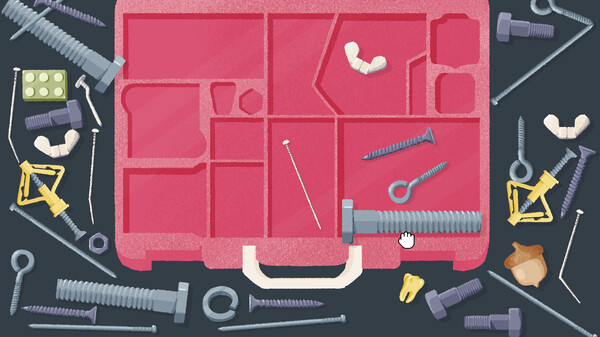 As tidying progresses, the contents of the clutter turn quietly stranger
Karas's music, though, never changes character. The base game and both DLCs, "Cupboards & Drawers" and "Seeing Stars," are all described in the same words on their official listings: playful, bright, a little mischievous. Max Inferno's own studio account confirmed on X that "Justin A Karas" composed the score and that eight tracks were extended and remastered by @m_feuerstack. However strange the content gets, the mood carrying it never moves. That's a lesson worth stealing — when the content is the thing that misbehaves, let the music be the anchor.
The puzzle analogy — a chord that waits for you to finish placing
Tidying-puzzle solving isn't so much a search for the right answer as it is stumbling onto a placement that simply feels right. Nothing rushes you, nothing fails, and you finish at your own pace.
Karas's theme unfolds at the same pace. Higher Plain Music, a review site, points to soft woodwind and string tones that carry over from his solo work. One chord is held a while before sliding slowly into the next — music that waits for you to finish placing the object.
Baba Is You uses chiptune to hurry you back into another attempt. A Little to the Left stands at the opposite pole, sounding out the reassurance that you can no longer really get it wrong.
Tracks worth hearing
Starting with the theme — soft-edged woodwinds and piano that stretch out without ever asking you to count a beat.
Next, the music for the first level, "Home Sweet Home." It's written so a new melodic line joins in as your tidying progresses.
Both are official uploads on the composer's own YouTube channel. All eight tracks are on Justin Karas's own Bandcamp ↗.
Closing — what I would steal for my own music
Three things to steal. First, a design with more than one right answer shouldn't have a wrong-answer sound. Second, write UI feedback sounds as part of the accompaniment — a snap can double as percussion. Third, however wild the content gets, don't let the music's temperament move with it.
If you relisten, do it before you tidy a room. Brew black coffee, put on "Theme," and the room you haven't touched yet starts to look a little more agreeable. On the subject of tidying-adjacent music, I've also written about Unpacking — that one is the sound of memory unraveling along with the boxes; this one is the sound of tidying without disturbing a thing.
Reference links
・Bandcamp: A Little to the Left (Original Game Soundtrack) — Justin Karas
・Max Inferno official X — soundtrack release announcement (names composer and remaster credit)
・MCV/DEVELOP — "When We Made... A Little to the Left" (developer interview)
・Light in the Attic — vinyl release page (description of the music's character)
Reactions (no login)
Anonymous • one of each per visitor per day
Part of these series
Puzzle SoundtracksEpisode 80 of 116
Read next
Related reviews
Tetris Effect: Connected
The falling-block game you already know, with its rules left exactly as they were. Across thirty-odd stages the music and light move in step with every piece you drop, and two things sit on top: a Zone that freezes time so you can clear more than four lines at once, and a three-player co-op mode that joins the boards together. Made under Tetsuya Mizuguchi's Enhance.
FRACT OSC
A first-person musical-exploration puzzle set in a vast synthesizer-built ruin, where you actuate glowing nodes and sound rigs to wake dormant machinery and music back to life. There's almost no instruction; working out what is even interactive is itself the puzzle. Phosfiend Systems, 2014, winner of IndieCade's audio design award.

