SOUNDTRACK · 2026-08-31
Soundtrack: Untitled Goose Game — the piano that reveals itself the louder you misbehave
Dan Golding
Introduction — a lone piano waits in a quiet garden
Boot up Untitled Goose Game and, at first, there's almost no sound. Just birdsong in the garden. The piano stays quiet.
The moment I knock over a bucket, the piano stirs. Maybe 70 BPM or so — by ear, but it's a tempo that feels like it's watching, sizing things up.
The score is by Dan Golding, a Melbourne-based composer who also researches game music. His source material is Debussy's Préludes — not a choice you'd expect in a puzzle game.
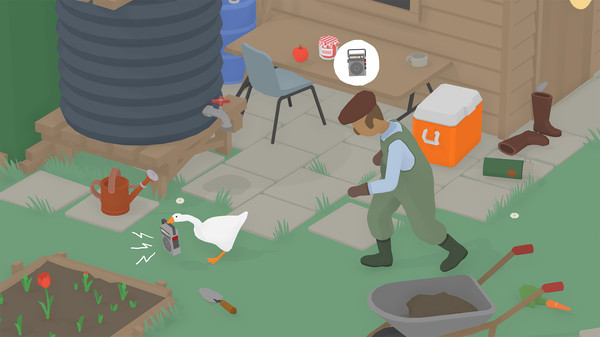 Untitled Goose Game (official Steam screenshot)
A puzzle-specific trait — the performance itself shifts with how suspicious you look
This isn't one fixed recorded track. According to House House, the music runs through three states — silence, low-energy alertness, and full-on chase.
Just walking around, the piano stays quiet. Get half-noticed, and it drops into a lower-energy performance. Get properly chased, and both tempo and volume jump.
To build this, Golding recorded each piece twice — a calmer take and a higher-energy one — then cut both into hundreds of fragments along beat boundaries, keeping the reverb tails intact so they'd splice back together smoothly (per Game Developer).
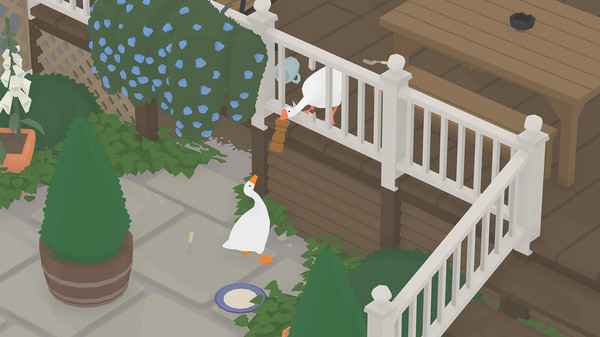 Untitled Goose Game (official Steam screenshot)
He's said the combinatorial variation for just the first piece alone runs into the septillions. Even in the same garden, you'll never hear quite the same performance twice.
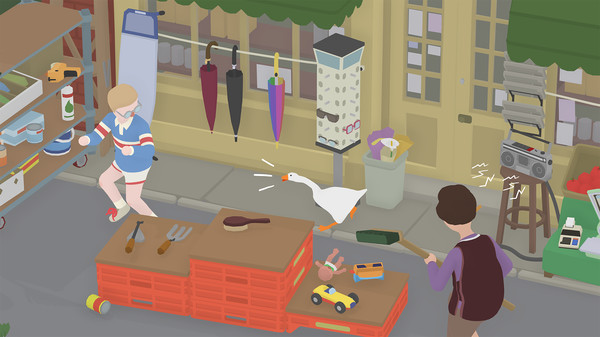
The puzzle analogy — the silence of planning, and the speed of things falling apart
The 'puzzles' in Untitled Goose Game are sequences of stealing, carrying, and startling. While you're working out the sequence, your head is nearly silent.
That thinking-silence has the same shape as the piano's idle state. Only once your hands start moving and the plan starts to unravel does the music catch up.
Most puzzle games pair the silence of being stuck with the sound of the moment it clicks. This score builds that same pair inside one performer's hands on one instrument. The gap I always measure in BPM — stuck time versus the instant you move — gets translated directly into how hard the keys are struck.
Tracks to hear — start with the official solo-piano album
The official audio streams in full on Dan Golding's own Bandcamp. Untitled Goose Game (Original Soundtrack) — Dan Golding official Bandcamp ↗. 14 tracks in total: 12 built from Debussy's Préludes, plus 2 original compositions by Golding.
This official House House trailer lets you hear the performance shift in motion alongside real gameplay. The same recording also streams on Spotify (via Decca Classics). Listen to the full album straight through first, and the 'same performer, three states' arc from silence to full chase comes through clearly.
Closing — if I were stealing something, it wouldn't be more keys, it'd be one variable
If I were writing music, what I'd steal isn't the timbre — it's the design itself. Don't add instruments; hand one performer a single hidden parameter and let it drive the entire performance. That alone produces near-endless variation.
As for when to relisten: right in the middle of tidying a room, hands paused mid-task. That low, watchful tempo fits right alongside the feeling of being almost caught. I think I'll pour another black coffee and head back to the garden.
Reference links
・Dan Golding official Bandcamp: Untitled Goose Game (Original Soundtrack)
・Game Developer: Getting goosey with Debussy — Creating an adaptive score for Untitled Goose Game
・Mixdown Mag: How Dan Golding created the score for Untitled Goose Game
Reactions (no login)
Anonymous • one of each per visitor per day
Part of these series
Puzzle SoundtracksEpisode 84 of 84
Read next
Related reviews
Tetris Effect: Connected
The falling-block game you already know, with its rules left exactly as they were. Across thirty-odd stages the music and light move in step with every piece you drop, and two things sit on top: a Zone that freezes time so you can clear more than four lines at once, and a three-player co-op mode that joins the boards together. Made under Tetsuya Mizuguchi's Enhance.
FRACT OSC
A first-person musical-exploration puzzle set in a vast synthesizer-built ruin, where you actuate glowing nodes and sound rigs to wake dormant machinery and music back to life. There's almost no instruction; working out what is even interactive is itself the puzzle. Phosfiend Systems, 2014, winner of IndieCade's audio design award.

