REVIEW · 2014-04-22
FRACT OSC
A musical-exploration puzzle in a synthesizer's ruins
First Impressions
Reading the Steam pool in helpful order, the first thing I notice is that positive and negative reviewers describe the opening minutes almost identically: "beautiful," "I have no idea what's going on," "nothing else plays like this." The split only opens up after that.
The positive top reviews keep reaching for beautiful, atmospheric, like nothing else, and rewarding. They welcome the absence of instruction; being dropped in with no goal, they say, makes every discovery entirely their own.
The negative side starts from the same confusion but flips the verdict: obtuse, no direction, confusing, with one helpful review calling it "more obtuse than The Witness." The same missing instruction reads as a gift to one camp and neglect to the other. That is the axis for reading this game's reviews.
 The wireframe view at start-up — Steam store
The World
The positive reviews burn hottest about the world itself, a place of light and sound. "Like TRON," "like Boards of Canada or Brian Eno" recur; walking wireframe canyons while hums and arpeggios seep out of the space, many describe it less as a game than as a place to be.
In my terms, FRACT OSC turns its world into the UI. Instead of menus and markers, the terrain and the sound carry the cue that something happens here. As I noted writing about Manifold Garden and NaissanceE, abstract-space games make reading the landscape the first mechanic.
Notably, most positive reviews put sound, not sight, at the centre. When a puzzle resolves, there's no text or chime; bass and beat "drop" into the world. Reviewers name that drop as the reward again and again. World and reward design dissolve into the same audio layer.
 The wide, sound-built space to explore — Steam store
Putting the Mechanics into Words
So what do you actually do? Pooling the reviews, the verbs are few: walk, look, actuate a node, sequence tones. Yet positive and negative agree on one thing: the verbs are few, but you are never taught how to use them.
Most games promise a visual grammar early, "glowing means interactive," "a frame means a door," and you play by that grammar. FRACT withholds it on purpose. The recurring complaint about "doors that don't look like doors, switches that don't look like switches" is, flipped around, a confession of design: decoding the grammar is the puzzle. In my terms, that's subtraction of instruction and a total reliance on observation resolution.
On the late-game music studio and sequencer, reviews split: positive calls it "a game and a music studio at once," while some negative reviews dismiss it as barely more than a bonus. It's the core verb, making sound, opened into a sandbox, and how people receive it swings widely.
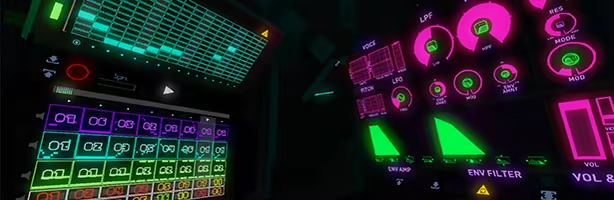 Actuating nodes and sound rigs — Steam store
The Texture of Difficulty
"Difficult" points at two different things in this pool. Sorted out, the stuck points come in two kinds: the observation difficulty of not knowing what's interactive, and the movement difficulty of not knowing the way, or falling and being sent back.
On the first, the positive-versus-negative clash is really just different yardsticks. One camp reads the thin hinting as "the joy of building the rules yourself," the other as "neglect." Neither is wrong; it's a question of scope: the author designed for people willing to raise their own observation resolution. I saw the same fault line writing about The Witness.
The second is harder to defend. There's no jump; gaps are sometimes walkable and sometimes a small crack drops you to the bottom to climb back up. That inconsistency isn't an intentional wall for training observation; it's underbuilt wayfinding. Much of the "unfair" in the negative reviews comes from movement, not from the puzzles. Separate the kinds of difficulty and the game's weak spot has a name.
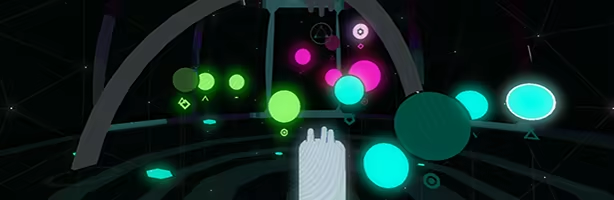 Footing and falls in traversal — Steam store
Sources
This piece was written by reading the user reviews on the Steam store page as of 2026-07-09. No review text is quoted directly; typical claims are reconstructed.
・Steam: FRACT OSC (Overall 85% positive; 421 Steam-purchaser reviews; label "Very Positive." Across all 610 reviews, 525 positive and 85 negative.)
・Read the top 10 helpful positive, top 7 helpful negative, and about 5 recent reviews, plus the Steam screenshots and discussion boards.
・Critics: Metacritic (75), alongside Edge, Eurogamer, Game Revolution and GameSpot, to check the gap between users and professional critics.
Closing
Read across the whole pool, there's a small gap between users and critics. Steam purchasers sit at 85% positive (2026-07-09 snapshot, 421 reviews), while Metacritic is a cooler 75. Many critics docked "the puzzle as a game," whereas the crowd that stayed on Steam forgave it as "experience, sound, place" — natural, since a pool that chose to buy a niche musical-exploration game tends to be tolerant of friction.
Reviews and HowLongToBeat put the run at roughly four to six hours, a bit more with detours. Because difficulty is experienced so differently from player to player, I rated it just above the middle. The key to measuring this game fairly is to split observation difficulty (a virtue) from movement difficulty (a flaw).
My design-critique score is 7.5. That's cooler than Steam's 85%, but it points the same way. I rate highly the nerve to make the world itself the UI and to place the reward in an audio drop rather than in text. The marks come off for the rough wayfinding that is the cost of withholding the grammar to the end — the unfairness of falling and being sent back. Subtracting instruction doesn't license subtracting consistency of movement too.
 A wide view of the sound-built world — Steam store
Where are you with this game?
Press one and the game goes on your shelf. You can see it on your account page.
Reactions (no login)
Anonymous • one of each per visitor per day
Read next
Related reviews
Escape Goat 2
A 2D puzzle platformer about escaping a trap-filled stronghold with a goat and its mouse companion. Each room is a single screen, solved with jumps, an immortal mouse that crawls walls and stands on switches, and a magic hat that swaps the goat's position with the mouse's. Over a hundred rooms across ten zones, from MagicalTimeBean in 2014.
Ether One
A first-person adventure where, as a "Restorer," you dive into a dementia patient's memories, gathering letters and objects in the seaside town of Pinwheel and solving optional puzzles to rebuild the past — carrying just one item at a time. By the UK's White Paper Games.
Hexcells Plus
An ambient logic puzzle in which numeric clues on hexagonal cells let you sort blue from black without guessing. Matthew Brown's sequel keeps the first game's grammar and adds new helper tiles for deeper deduction.


