DESIGNER-STUDY · 2026-08-07
Inside William Chyr's Philosophy — making infinity a place you don't get lost in
Manifold Garden, seven years of development, and navigating by architecture
Intro — the man who built infinity spent his time worrying about lost players
William Chyr is a Chicago-based game designer who came out of installation art, and who made Manifold Garden (2019), a first-person puzzle game whose world repeats infinitely in every direction. This site has written about the game; it has never read the man.
He is worth reading because the centre of gravity in his own statements is not where you would expect. A designer of Escheresque infinities might be expected to talk about awe. Line up what he actually says, and the recurring subjects are far more mundane: keeping the player from getting lost, and letting the player decide for themselves.
This is a study of a person, not of a product. Every quotation below comes from a source I read in full, and my own interpretation is confined to the final section.
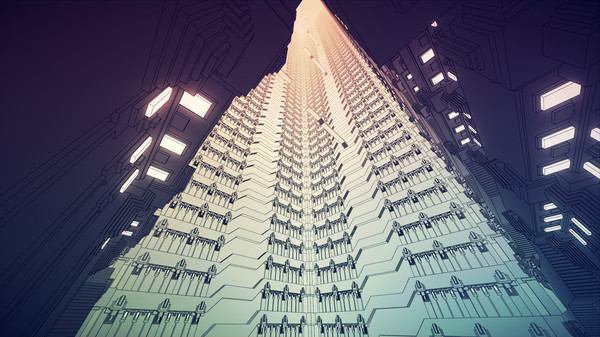 Manifold Garden (from the official Steam screenshots)
Background — from a latex allergy to infinite architecture
Chyr studied physics, worked briefly in advertising and on science museum exhibits, and became known as an installation artist working in balloons. "The wonderful thing with balloons is that it's a non-prohibitive medium" — one suitcase, and you can fill a seventy-foot space. Then he developed a latex allergy: "My throat was starting to constrict, so I decided to stop" (Gamasutra, Oct 2015 ↗).
Glass and fabric would have meant structural engineers and shipping costs. "I still wanted scale," he says — and games were the medium where scale cost nothing. The trigger was watching Indie Game: The Movie with a friend, and through it discovering Braid, FEZ and Journey. "I had no experience making a game before, but I thought a game is just some art and design and programming. How hard can it be? Maybe I'll spend a few months" (AUTOMATON WEST, 2021 ↗).
That few-month practice project became Manifold Garden: begun 2012, shipped 2019. "I was 25 when I started and I was 32 years old when I finally shipped it." Three years entirely alone, two years of people revolving in and out, and something like a real team only from 2017.
Philosophy — "everything the player can see, the player should be able to get to"
The most consistent thread across the sources is a refusal to let the world lie. In his GDC 2016 slides, explaining how infinite world-wrapping entered the game, he names exactly two self-imposed constraints: "1. everything the player can see, the player should be able to get to 2. no invisible colliders" (GDC 2016 slides, Level Design with Impossible Geometry ↗). Two separate problems — blank distance outdoors, and players falling off the world — were solved at once by folding the world back on itself rather than by walling it in.
The same norm governs his attitude toward the player. Early in Manifold Garden there is a chasm you must jump into to reach a switch. The game says nothing. "It was an intentional design decision to not give players any instructions for this part, and to let them make the decision to take the leap," he says, and then states it flatly: "It needs to be the player's agency that gets them to take the leap, and not an instruction from the designer" (Game Developer, Jan 2020 ↗).
It extends to how he judges solutions: "A large part of designing puzzles is eliminating the 'bad solutions', especially if they're teaching the player the wrong thing." A bad solution, for him, is not a shortcut that lowers difficulty but a path that teaches the wrong rule. Early puzzles are single-solution and late ones open up, because the teaching order comes first.
Obsessions — solving navigation with architecture
Across his work, the recurring method is to guide the player with architecture rather than UI. At GDC 2016 he notes that in a 3-torus "Height and Directions are meaningless" — neither altitude nor compass directions survive as reference points — and lists four techniques that still work: iconic parti, logic to level, intentional architecture, and patterns in architectural elements. Parti is an architect's word for the organising diagram of a plan.
The obsession becomes concrete rules. "We had a rule that if you looked at the thumbnail of a level's layout, you need to be able to immediately recognize which level it was (eg 'the diamond level' or 'staircase level'). Otherwise, it was too complicated." Indoors, windows carry direction: "Windows are placed along one side of each corner, and point in the correct direction" — go the right way and you see light; go the wrong way and you see wall. "It's a subtle element, and players might not even consciously register what's happening" (Game Developer, 2020 ↗).
Notably, he turns the same obsession on his own tedium. Recalling when a single window took an hour to build: "The thing with tedious processes is also not just the time it takes up. ... It also makes you mentally dread working on it, because it's just not fun" and "it meant I was reluctant to iterate. If a window was good enough, but not great, I would just leave it at good enough" (personal blog, Manifold Garden – State of Development ↗). Tooling, on this reading, was less about speed than about staying uncompromising.
Failures — throwing out every "exampuzzle"
The sharpest failure he discusses publicly comes with a coinage of his own. Early Manifold Garden was full of drills built only to teach a new concept: "At the beginning, there were a lot of what I called 'exampuzzles', and they turned out to not be very fun at all. Even just me calling them that should be a sign." Every playtester found them tedious. He threw them all out: "Now, every single puzzle highlights something interesting, and that's it. It's just focusing on that moment of discovery, and the puzzle isn't any harder than that" (Gamasutra, 2015 ↗).
The second is the development itself. "The hardest part of development for me was probably the middle of the project - around 2015. At the time, I still had a 'sprint' mentality ... There was no end in sight ... so it was very stressful and disheartening." The remedy he names is a reframing: "It wasn't until I started to think of the project as a marathon that I started to enjoy the process" (Game Developer, 2020 ↗).
The third is his inability, at first, to work with others. "When I first started, I felt I needed to prove everything, I needed to do everything myself, but in 2017 especially working with Arthur, I realized that the game was so much better because of his input." On early friction with sound designer Martin Kvale he puts the fault on himself: "I was so used to working by myself, and I wasn't good at communicating. ... But of course not, he's not a mind-reader" (AUTOMATON WEST, 2021 ↗).
Dilemmas — art and product, infinity and disorientation, finishing and letting go
The conflict he articulated earliest is between two different jobs. "With art, you make your thing, you have your artist statement, and then your job as an artist is done. But with designing a game, it has to be fun and entertaining. You have to make sure that everyone wants to get through it" (Gamasutra, 2015 ↗).
The second is that infinity itself makes a game hard to play. "A common feedback we got from playtesters early on was that when the game worked, it worked really well. But in between, there was a lot of tedium. They were constantly lost." Hence: "A major focus for us was minimize the time player spent feeling lost or confused" (Game Developer, 2020 ↗). Wanting to astonish while refusing to bore in between is exactly what produced his architectural navigation toolkit.
The third is authorship against business. On the Epic Games Store and Apple Arcade exclusivity he hides nothing: "We wanted to have stability for the studio. ... My priority at that point was to ensure that we had stability, that we can continue to work on the game, and that we can pay back investors, and pay back the people who worked on the game." And on finishing at all: "There are imperfections, there are flaws but I think they ultimately contribute to making the game what it is. It wouldn't quite be the same if every part of the game was exactly perfect like I wanted" (AUTOMATON WEST, 2021 ↗).
Influences — only the ones he names himself
On art, film and literature he is generous with names: "Works that have influenced Manifold Garden include the architecture of Frank Lloyd Wright and Tadao Ando, books like House of Leaves by Mark Z. Danielewski, Blame! by Tsutomu Nihei, and of course films like Inception, Blade Runner, and 2001: A Space Odyssey" (Game Developer, 2020 ↗). On architecture specifically, he describes combining Ando's brutalism and scale with Wright's intricate detail — detail being the only way to convey scale in a world with no textures and no human objects.
Escher is central. The GDC 2016 slides cite Relativity, House of Stairs and Cubic Space Division directly. The original title, Relativity, was a literal attempt to adapt the print: "So the initial game was to make the M.C. Escher print called Relativity a game." He also explains the rename: "Relativity was more about the mechanics. It would be like calling the game Gravity Changer" (AUTOMATON WEST, 2021 ↗).
He names his game influences too. Portal was the first game he played after a decade away, and the early structure imitated it. For design vocabulary he borrows from Zach Barth: "I think Zach Barth [creator of Infinifactory] called it 'design based puzzles', and it's actually something that I build towards with my game" (Gamasutra, 2015 ↗). He calls Droqen's Starseed Pilgrim "a big inspiration", and in 2019 brought Droqen in to help design the ending. FEZ and The Witness are "some of my favorite games", and getting feedback from Jonathan Blow after sending him a build at PSX was, he says, "a very formative experience".
Kizuki's reading — he was designing trust, not infinity
What follows is my interpretation, not his words. I read William Chyr not as an artist who built an infinity, but as someone who rebuilt, piece by architectural piece, the trust that infinity destroys. Everything visible is reachable; no invisible colliders; windows point the right way; a level is identifiable from its thumbnail. These are all the same promise under different names: the world will not deceive you. Placing a silent cliff instead of an instruction to jump belongs to that promise too — you can only stay silent if you have made a world worth trusting.
So the move from balloons to infinity does not look like a break to me. Filling seventy feet from a suitcase, and rendering five hundred times more geometry so that the distance contains places you can actually reach, are the same job: making a size a viewer can believe. Discarding every exampuzzle, switching from sprint to marathon, and finally trusting a collaborator's ear in 2017 all point the same way. What took him seven years to learn was probably not how to handle space but how slowly he trusts anyone other than himself. When someone told him "too much manifold, not enough garden," he adopted the phrase — that, to me, is the most characteristic thing about him.
Closing — where to start
If you want to understand him, play the first thirty minutes of Manifold Garden ↗. The hesitation you feel standing at that first cliff is his design philosophy in demonstration. If you cannot play it, the GDC 2016 slides alone convey the theme: how to put handrails on impossible geometry.
For adjacent designers, read him alongside Marc ten Bosch ↗, who uses the same found-not-invented vocabulary; Alexander Bruce ↗, who made spatial reinterpretation his main verb; and the two he names himself, Jonathan Blow ↗ and Zach Barth ↗.
Sources
Primary sources consulted for this article:
・Gamasutra / Game Developer, "How Manifold Garden makes reality fold back on itself", 16 Oct 2015 ↗
・GDC 2016 slide deck (PDF): William Chyr, "Level Design with Impossible Geometry" (his own talk) ↗ (video: GDC Vault ↗)
・Personal blog, "GDC Talk, Portals, and World 002 WIP", 2016 ↗
・Personal blog, "Manifold Garden – State of Development" ↗
・AUTOMATON WEST, "Manifold Garden, the gravity-bending puzzle game, took 7 years to make [Developer interview]", 2021 ↗ (Japanese original: AUTOMATON, 25 Mar 2021 ↗)
Reactions (no login)
Anonymous • one of each per visitor per day
Learn — Curriculum
LearnPart 8 Designers — The Philosophies Behind the WorkChapter 18 Those Who Doubt the Rules4 / 9
Part of these series
The Designer's PhilosophyEpisode 40 of 63