DESIGNER-STUDY · 2026-08-12
Inside Andrew Plotkin's Philosophy — Folding a Solved Puzzle Into a Single Move
Spider and Web, Hadean Lands and thirty years of nested play
Introduction
Andrew Plotkin, born 1970, is an American game author and programmer, more often called by his handle "Zarf". He writes parser-based interactive fiction — text adventures you play by typing English commands — including Spider and Web (1998), Shade (2000) and Hadean Lands (2014). He is also the engineer who designed Glulx, the virtual machine that let Inform games escape the limits of Infocom's old Z-Machine, and Glk, its input/output library.
Why now? In November 2025 he gave a talk at ThinkyCon called "Towers of Pen: puzzle experiences that zoom out and out", and posted the full text on his own site (eblong.com, 2025). It is thirty minutes spent trying to name a structure: a solved puzzle folds into a single move of a larger puzzle, and then that happens again. To my eye it is the explanation he has retroactively given to thirty years of his own work — and with it as a starting point, his scattered remarks line up.
This is not a review. It is a study of the person: his philosophy, his obsessions, the failures he has described himself, his dilemmas and his acknowledged influences, built only from what he has said on the record.
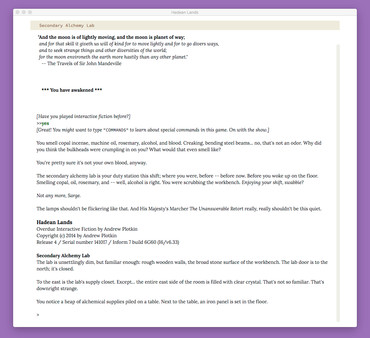 Hadean Lands (from the official Steam screenshots)
Background: an eight-year-old parked in front of a teletype
By his own 2024 account, he was born in Syracuse, New York, and grew up outside Washington, D.C. (The Digital Antiquarian, 2024). The decisive moment came around 1979, on a bring-your-family-to-work day at his father's company. A teletype there was running Adventure. "My father plunked me down in front of it and explained what was going on. I thought it was the best thing in the universe." Months later, reading the fan-fold printouts his father brought home, he supplied the solution to the troll-bridge puzzle — give the troll the golden eggs. That was the first adventure puzzle he ever solved.
Rejected by MIT, he went to Carnegie Mellon and graduated in 1992. Staying on in Pittsburgh with a job in the CS department, he wrote System's Twilight, a Macintosh shareware puzzle game. When Kevin Wilson called for the first Interactive Fiction Competition in 1995, Plotkin blasted through the Inform 5 manual five times in a week and won the Inform category with A Change in the Weather. So Far, Spider and Web and Shade followed, alongside his design work on Glk and Glulx — he dates the Glulx specification to 1 April 1999.
In 2010, with Jason Scott's documentary Get Lamp putting IF back in front of outsiders, he raised $30,000 on Kickstarter and quit his job to write full time. The result was Hadean Lands (2014). Since then he has moved from author to organiser: co-founding the Interactive Fiction Technology Foundation as its first treasurer, and starting NarraScope, a conference for narrative games. As of 2024 he says plainly that he is not writing games anymore.
Philosophy: puzzles do not interrupt story — they underpin it
Asked in 2003 which mattered more, the puzzle camp or the story camp, he folded the question back on itself: "In fact IF is split into two camps: those that believe that there is a split between puzzles and storyline, and those that don't." Then: "Really I consider puzzles an underpinning of storyline in IF, just as exposition, physical description, dialogue, and scene-structure are" (PC Gamer UK, 2003).
The core of the claim is the third option he names in the same answer. "In static fiction, showing is better than telling. In IF, you can show or tell, but there is a third option: to guide the player into discovering for himself. This is why I care." A puzzle is not a pause in the story; it is a mode of delivery. He closes the same answer with a hard edge: "Truly puzzle-less IF would be an e-book; a window with a 'click for next page' button. It would not be interactive fiction at all."
In 2011 he traces that discovery back further. When Will Crowther built the first parser, the help text did not list the available verbs; you found them. "That quality of design -- the hazy, suggested-but-never-certain range of possibility -- is the core of IF. It hasn't changed at all in thirty-five years" (Adventure Classic Gaming, 2011). For him the parser is not a machine for understanding English; it is a machine for keeping the edges of the possible blurred.
His yardstick appears in the same interview: "If the game has puzzles, are they fun? (Fair? Challenging? Those are optional, but fun is not.)" And I want to flag two statements twenty-two years apart that have the same shape. 2003: "Give me a world I can believe in. Things should make sense... at least in hindsight." 2024, on the famous turn in Spider and Web: "Any kind of good puzzle solution is a surprise when you think of it. Afterward it seems obvious" (The Digital Antiquarian, 2024).
Obsessions: fold the solved thing into one move, then climb
What he tried to name in 2025 was this: "You're playing a game. You discover a new layer. The original layer gets out of your way. But not entirely." He warns against reading it as things made of smaller things. "It's really actions made out of smaller actions" (eblong.com, 2025).
Hadean Lands is that idea implemented. Once you know a recipe you type CREATE FIRE RESISTANCE POTION and the game fetches the ingredients and performs the ritual for you. "The recipes were puzzles in the first game, but now they're single moves." As the recipe book fills, the game climbs from recipe-hunting to resource management to how much of the starship you can reach in a single loop. He sees the same property in Baba Is You (tiles made of tiles), and in COCOON, Carto and The Fool's Errand.
The condition that matters is that the lower layers never vanish entirely. "Holding the entire shape of the game in your head is the hard part! Which is to say, the fun part." So you must occasionally dive back inside a composite tool and swap out a low-level move — Baba does this well, he says; HL doesn't do it as well as he would like.
The other obsession is simply alchemy. In 2021 he heckled himself: "At this point you fix me with a Vulcan eyebrow and say, 'Really, Zarf, alchemy? Haven't you done alchemy to death?' Yes! I have done it to death, and yet I keep finding new and interesting angles" (Zarf Updates, 2021). The post lays three reaction diagrams side by side — The Dreamhold's playful mix-and-zap lab, Hadean Lands' sparse network of one-wrong-step recipes, and a Seltani lab where you reduce a mixture by feel, like caramel sauce. It also states plainly what he hates: "I hate when gameplay is constrained by the fear of running out of stuff."
Failures: a game four years late, and an on-ramp nobody used
The failure he is most candid about is the lateness of Hadean Lands. The Dreamhold had taken nine months, so he budgeted a year. "Ha! It turned out that writer's block is a hell of a thing." He got "totally knocked over" by the idea of a hypertext MUD and spent a year on Seltani; it was hugely popular in the Myst fan community for about two months, but Hadean Lands wasn't moving and his Kickstarter backers began to get upset. "I did slog through it. I got Hadean Lands done. I don't feel like the story is hugely successful, but I'm very happy with the puzzle structure and the game layout" (The Digital Antiquarian, 2024).
The other is The Dreamhold (2004), designed on purpose as an on-ramp for newcomers. Asked whether the outreach push of that era worked, his answer is short: "Yes, it is. None of it actually worked. It's great that we made the on-ramps and it's good that we still maintain them, but there was not a huge influx of new people coming onto the scene at that point." His response was to decide, "well, The Dreamhold didn't make an impact, so I'm just going to go back to writing wacky puzzle games."
He concedes the commercial failure with numbers too: Bob Bates' Thaumistry Kickstarter and his own raised almost the same money from almost the same backers. "It's the same crowd showing up: 'Yeah, we still love ya!' But they're not enough to make a living from." After Meanwhile and Hadean Lands, "I felt very stuck", and "bummed around for a while trying to find something that would make any kind of money at all, but I was not successful."
He describes two ways through. One is turning his own work into the object of criticism: in 2021 he called HL's alchemy "a sparse web of narrow paths", said the Mutuai lab "relies too much on guesswork", and immediately converted that into a next design — hidden variables are right, but they "should be hidden in a mass of sensory detail" (Zarf Updates, 2021). The other is changing the job: "I'm very proud to have transitioned from being a hotshot game writer to someone who is doing community support... I really didn't want to be a person who was famous for having been a big game writer in the 1990s. That's a sucky position to be stuck in. There needs to be a second act."
Dilemmas: a friendly on-ramp and an inconvenience he refuses to drop
The Dreamhold has his contradiction built into it. Declaring it a beginner's game, he still deliberately included rooms you enter going north and leave going east. "I figured, this is really uncomfortable, but people are going to run into this if they get into IF, so they should be familiar with the concept." So he softened the delivery — "The corridor turns as you head to the north" — while refusing to cut the complicated maps, the darkness, "all of the hardcore stuff that the community was used to. And also make it fun" (The Digital Antiquarian, 2024). He would not trade the difficulty away for the welcome.
The second dilemma is competing with his own back catalogue. On Spider and Web: "It's always tricky to have a game which is so purely built out of a single idea because then, when you try to write another game, you think you have to come up with another idea that's as good, and it's never possible." On slowing down: "I slowed down writing games because I started to second-guess myself too much. When you've written a lot of games that people got really excited about..." — and when his interviewer supplies "then you're competing with your own back catalog", he answers, "It doesn't feel good. I've had trouble getting away from that."
The third is determinism against feel. His 2021 post argues both sides with himself and refuses a general answer: "I'm not saying that every game needs to feature arcane caramel sauce... It depends on the rest of the game's mechanics!" If the play is really about finding rare ingredients, he says, you want recipes that are deterministic and foolproof — an argument against his own taste (Zarf Updates, 2021).
Influences: his father's teletype, Cliff Johnson, and Powers of Ten
The influences he credits split into games, books and one short film. Among games: Colossal Cave on his father's teletype; then Cliff Johnson's The Fool's Errand (1987) — System's Twilight, he says flatly, "was an homage." He remembers solving Johnson's meta-puzzle at two in the morning in a campus computer cluster: "Every time I used one of the clues, I'd grab the piece of paper, crumple it up, and throw it over my shoulder. When I finished, the desk was empty and I was surrounded by paper" (The Digital Antiquarian, 2024). And Myst, which he came to late in 1994: "It felt like someone was finally doing the graphical adventure right."
The film is Powers of Ten. In 1978 he watched the 1968 prototype looping at the National Air and Space Museum in Washington: "I was hypnotized." In his 2025 talk he places that memory next to the Colossal Cave memory from the same year and asks, "What do these two things have to do with each other? Nothing, really. But maybe in my head they do" (eblong.com, 2025). He declines to assert the connection, and so will I.
For books the primary source is a 2015 interview (BookFlocks, 2015). Hofstadter's Gödel, Escher, Bach: "I could open it at any spot and be in a playground of ideas." Luigi Serafini's Codex Seraphinianus, an encyclopedia in an untranslatable language: "One has the sense that they make sense, but on a level just out of one's grasp." Christopher Manson's Maze, whose puzzle came in three parts of which only the first was tractable to a young solver: "I suppose that's the magic ratio for hooking people." And Daniel Pinkwater's Alan Mendelsohn, The Boy From Mars: "It's not a world I believed in, but it's a world that I felt should exist, and one thread of my game design practice is giving people a way to find it."
Individual games have individual seeds. The first notions for Hadean Lands came from a lecture Jeff Howard gave at MIT's game design lab about modalities of ritual magic, merged with a line from Steven Brust's Taltos about a witch's teleport requiring "hours of preparation, rituals, chanting, and filling all the senses with the desired result." Plotkin's comment: "That's exactly right. The magic that I present shouldn't feel like pushing a button or walking through a door" (Adventure Classic Gaming, 2011).
Kizuki's reading
What follows is my own reading. I read Plotkin as a designer who spent thirty years building one moment: the moment a hidden thing turns out to have been there all along. Spider and Web inverts everything you were told the instant its lie comes apart. Hadean Lands inverts the layer of play itself. When he wrote in 2025 that the key moment is "I didn't realize this part of the game existed, but now I see it was always here to be found", I think he finally put words to the single line his two best-known works share. And I read that obsession as older than his design theory — it is already in his reading list. The meaning in Codex Seraphinianus that sits "just out of one's grasp"; Pinkwater's world he "felt should exist"; the two unsolvable thirds of Maze. Each is a thing that is definitely there and whose outline refuses to resolve. His long defence of the parser as a blurring machine rather than a comprehension machine follows from the same taste. So, I would argue, does his habit of dismissing his own alchemy as "a sparse web of narrow paths": a design whose outline has fully resolved is one he cannot forgive himself for. This is my inference. He himself says only that Powers of Ten and Colossal Cave have "nothing, really" to do with each other.
Closing: where to start
If you want to meet him, start with Shade (2000): free, one room, about thirty minutes, and the shortest route to his "makes sense in hindsight" design. Then Spider and Web (1998) — and do not read about its famous turn beforehand. Then Hadean Lands (2014), where the folding structure described here is something you operate with your hands. If you would rather start with prose, the 2025 talk "Towers of Pen" reads in half an hour (eblong.com, 2025) and is a fine entry point for anyone interested in puzzle design.
For further reading, take the designers he named himself. On layered boards: Arvi Teikari (Baba Is You) and Jeppe Carlsen (COCOON). On text-game lineage: Jon Ingold and Sam Barlow, of whom Plotkin said in 2024 that everything they have done "is informed by" their early text games. This site has designer studies of all four; read them together and you can watch one question being solved with four different sets of tools.
Sources
Primary sources used in this article:
・Zarf Updates (author's blog), "A plenitude of alchemical domains", 19 Sep 2021
・The Digital Antiquarian, "A Conversation with Andrew Plotkin" (interview by Jimmy Maher), 6 Dec 2024
・BookFlocks, "Interview with Andrew Plotkin" (on the books that influenced him), 22 May 2015
・Adventure Classic Gaming, "Andrew Plotkin" (interview by Philip Jong), 7 Jan 2011
・Brass Lantern / PC Gamer UK, "Interactive Fiction" (full interview by Richard Cobbett), Jan 2003
・Zarf Interviews (the author's own index of interviews and appearances)
Reactions (no login)
Anonymous • one of each per visitor per day
Learn — Curriculum
LearnPart 8 Designers — The Philosophies Behind the WorkChapter 18 Those Who Doubt the Rules5 / 9
Part of these series
The Designer's PhilosophyEpisode 42 of 64