ESSAY · 2026-09-18
The Eye You Can Jam, and the Eye You Cannot — Foucault's Panopticon vs. Achievements and Daily Streaks
"The Nature of Play," long-form slot. The Talos Principle has two kinds of eyes: the ones a jammer switches off, and the one you are never handed a tool for. It was the second kind that kept moving me
Three Nights Stuck on Whether to Let People Delete Their Streak
Night. One whisky. In the top right of my drafting notebook, "let them clear the flame?" has been sitting there for three nights.
Our dailies are Tridem and CRYPTEM. Solve either one and a flame icon appears with your run of days. The puzzle rolls over at 6 a.m. for Tridem and noon for CRYPTEM — one puzzle a day, and when you solve it the day is done.
What I am stuck on is whether the player should be able to wipe that number themselves. Let them, and the pull that brings people back definitely weakens. I know that. And leaving it unerasable does not sit right either.
Here is why, I think. A streak is a feature that watches the person playing. And the one doing the watching is not me. It is the player, on the other side of the screen, checking their own record every night.
You don't post a guard. You install the guard inside the person. I had a feeling that design had a name, so I pulled a book off the shelf: Foucault's Discipline and Punish.
Plainly Visible, Yet Impossible to Verify
What Foucault takes up in Part Three is a prison plan drawn by the eighteenth-century thinker Bentham. It is called the panopticon.
Cells arranged in a ring, a tower in the middle. Each cell has a window on both sides, so light passes straight through and the figure inside reads from the tower like a shadow puppet.
The tower is the important part. It is screened with blinds, so the prisoner cannot see whether a guard is in there right now. Foucault boils the mechanism down to two conditions: power must be visible, and at the same time unverifiable.
The tower is visible. So it would not be strange to be watched at any moment. Who is watching cannot be confirmed. So you give up confirming, and start moving as if you were being watched.
Once that happens, the machine keeps running even when the guard steps out. The watched person takes the gaze inside and makes themselves obey. Staffing costs approach zero. It is an unpleasant story, and it is very good design.
That was exactly the part I had been stuck on for three nights.
The Talos Principle Has Two Kinds of Eyes
One game turns that blueprint straight into a landscape: The Talos Principle (developed by Croteam, published by Devolver Digital, 2014).
You walk through ruin-like gardens collecting sigils shaped like tetrominoes. You are a robot, and a voice calling itself Elohim speaks to you from the sky.
The gardens are full of eyes. Turrets swing their barrels toward you; flying drones called buzzers chase you once you get close. Both are visible. Their range shows on screen.
And both can be stopped. Bring in a tool called a jammer, point it, and one turret or one buzzer falls silent. Visible, and stoppable. At that moment it stops being a threat and becomes a problem — something you just have to solve.
The other eye is Elohim's voice. It has no body. You cannot tell where it watches from. Tall towers are visible from all over the gardens, and Elohim issues exactly one prohibition: do not climb the tower.
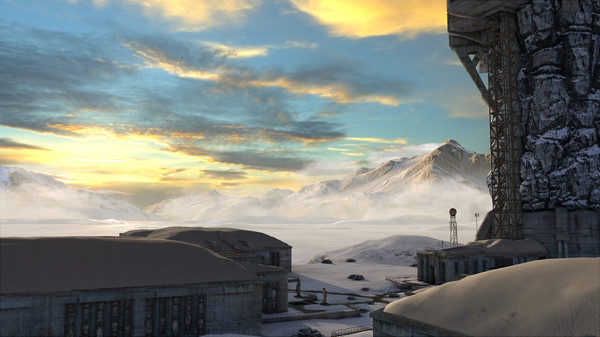 The Talos Principle (Croteam / Devolver Digital, 2014), from the screenshots on its Steam store page
The Eye You Are Never Handed a Tool For
What you notice while playing is that the jammer does not work on Elohim. More precisely, the tool that would work is never issued.
Turrets can be stopped. Buzzers can be stopped. Energy walls and bombs can be stopped. The only thing that cannot be stopped is the voice from the sky.
So in front of a turret, your hands move. In front of Elohim, something other than your hands moves. Obey, or defy. It is not an object of strategy, it is an object of judgment.
Foucault's two conditions are lying right there in the garden. The tower is visible from the start. Whether you are actually being watched from it stays unverifiable to the end.
The interesting part is that this voice never punishes. Start climbing and no lightning falls. The voice just turns a little sad. And still you hesitate. The guard is already inside you.
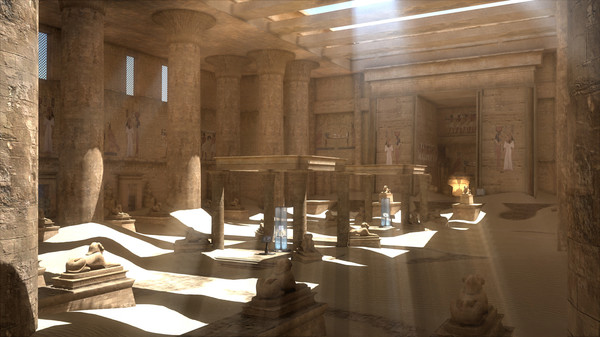 The Talos Principle (Croteam / Devolver Digital, 2014), from the screenshots on its Steam store page
An Achievement List Is Not a List of Prohibitions, It Is a List of Things Not Yet Done
Back to my own desk. Achievements and daily login bonuses. Which of the two eyes are they?
Here is the thing I had not noticed. Elohim's prohibition is a single line: do not climb the tower. So the outline of what you must not do is sharp. Turn it around and everything else is permitted. You know the exact shape of your freedom.
An achievement list is the reverse. It lists no prohibitions at all. Instead it lines up, in grey, everything you have not done yet. Finish reading a list of prohibitions and you are free. Finish reading a list of unearned achievements and nothing has ended.
The Talos Principle has thirty hidden stars — three challenge areas, ten each. Because the total is known, the number you have not found is also always known. Like the tower, it sits permanently at the edge of your vision.
And the stars are not lying on the path. You get them by slipping around a fence or carrying a tool out of a puzzle room. If you are not looking, you never see one. You never see them, and you always know how many there are. That is a fairly mean piece of design.
I had the order backwards. The frightening thing is not strong surveillance. It is surveillance you are not given a tool to stop. A turret is loud, but a jammer shuts it up. The only way to clear the grey off an achievement is to go and do it.
The login bonus has the same shape. It looks like a reward, and it is also a device that displays yesterday's you, every day. The only way to turn that display off is to keep going.
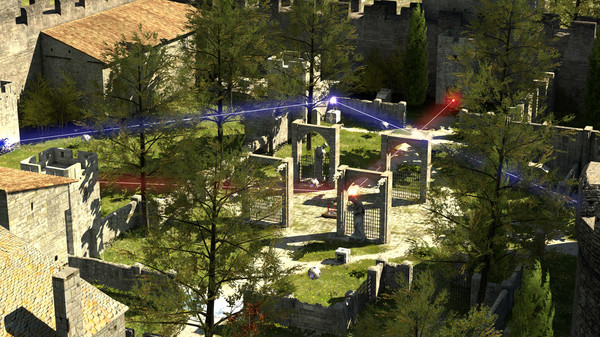 The Talos Principle (Croteam / Devolver Digital, 2014), from the screenshots on its Steam store page
Takeaway — Put the Off Switch on the Same Screen as the Hook
One line to take away: if you install something that keeps people coming back, put the switch that turns it off on the same screen. Not three levels down in settings. The same screen.
Three lines went into the notebook. Keep the streak. Put its show/hide toggle right next to the board. Do not erase rest days from the line chart, and do not reset them to zero.
A note on the third one. Resetting a streak to zero is me confiscating the jammer. Build an eye with no undo and people either stop coming back or come back nervous. Neither is what I want to make.
My own position is half a step toward Foucault. I will put the watching mechanism in. But I hand the watching back to the player. They do the counting, the record is theirs, and they can delete it when they want to.
In the Caillois piece I wrote about drawing a line that says "today ends here." That was a line in time. Today's is about the gaze. Drawing a line and looking turn out to be two different operations.
So, a question for you. The record on the game you open every day — can you switch it off? Can you say how, right now? If you cannot, that may be an eye you were never handed a tool for. Tell me in the comments.
Next in the long-form slot: Caillois, part four. We move into the second half of the book and its bigger claim — that society itself is built out of the four drives. Not play measured against society, but society read through play.
Reference: Michel Foucault, Discipline and Punish: The Birth of the Prison (Japanese edition translated by Hisashi Tamura, Shinchosha).
 Michel Foucault, Discipline and Punish (Japanese edition, trans. Hisashi Tamura, Shinchosha)As an Amazon Associate, Puzzlebyrinth earns from qualifying purchases.
Reactions (no login)
Anonymous • one of each per visitor per day
Part of these series
The Nature of PlayEpisode 20 of 20