ESSAY · 2026-09-04
What Does Play Become When It Spills Out? — Reading Caillois, Part 3
"The Nature of Play," long-form slot. Outside the game, the four drives turn into violence, superstition, alienation and addiction. The line that decides which is not strength — it is the frame
Does a design that keeps you coming back every day break play?
Does a "keep them coming back every day" mechanism break play? Caillois's answer was not the one I expected. What decides it is not how strong the mechanism is, but whether there is a frame outside the game.
Late at night, a glass of whisky. It has been three weeks since I put a streak counter on our daily puzzle. The numbers went up, plainly. So did the share of people who come back the next day. Still, I had left one line in the margin of my drafting notebook: "Isn't this a device for dragging play out into everyday life?"
Notifications, a deadline that resets each day, a streak. Every one of them exists to say "come back tomorrow." They work, so I put them in. But each time I do, play leaks a little further into the day. Not more time spent solving puzzles — more time spent being chased by one.
Today I read chapter three of Caillois's Man, Play and Games. Its title is "the corruption of games." So far I have looked at the four drives and at how they combine. Today is about what happens when those four spill outside the game.
Of the conditions of play, the second one is the frightening one
Early in the book Caillois lists six conditions of play. It is free. It is separate. Its outcome is undetermined. It is unproductive. It is governed by rules. It is make-believe. The one that matters today is the second.
"Separate" means confined within limits of time and place fixed in advance. On the board. Inside the court. The thirty minutes before dinner. What Huizinga called the magic circle, Caillois rewrites in far more clerical language. I wrote about that circle in the first instalment of this series.
And Caillois does not frame corruption as playing too much. Corruption begins when play gets mixed up with ordinary life — when the enclosure vanishes and the principle of the game starts being applied inside reality itself. It does not break because it grew too strong. It breaks because the boundary disappeared.
That was a slightly inconvenient definition for a maker. If the problem is over-absorption, I can dial back rewards or lower the difficulty and be done. But if the cause is a vanished boundary, what needs work is not the strength but the outline. Which also means: with a firm outline, even a strong mechanism is not a problem.
Four drives, four places to fall, and four homes
For each of the four drives Caillois lists where it lands once it leaves the game. Agôn (competition) turns into violence and the exercise of force. Alea (chance) turns into superstition. Mimicry (make-believe) turns into alienation — no longer telling yourself apart from the role. Ilinx (vertigo) turns into intoxication and addiction. Go for the win where there are no rules and you get violence; try to read luck where there is no board and you get fortune-telling.
Here I stopped. Caillois also lists a respectable home for the same four. Competition goes into sport, into examinations, into commercial rivalry. Chance goes into lotteries and speculation. Make-believe goes into theatre, uniforms, ceremony. Vertigo goes into mountaineering, skiing, the taste for speed. All of these are outside the game. And none of them is corruption.
So in Caillois's scheme, a drive leaving the game is not itself the accident. What decides is whether a new frame is waiting on the other side. The frame called a stadium. The frame called a lottery. The frame called a stage. The frame called a ski slope. Only the part that gets out without a frame becomes violence, superstition, alienation, addiction.
Now that it is put that way, of course. Throughout this series I had been reading Caillois as saying "keep play inside the circle." He does not say that. He says you may go outside — but build a frame out there too.
A game that took off the enclosure of time, and one that reached into someone else's night
Let me look at two real games where the enclosure comes off. One is the enclosure of time; the other is someone else's daily life.
Cookie Clicker (developed by Orteil / DashNet, published by Playsaurus; released on the web in 2013, on Steam in 2021) is a game about nothing but raising the number of cookies. At first you click yourself. But once you buy buildings, the number keeps rising even when your finger stops. There is a moment when the rate of increase is tied to the clock rather than to your input. Caillois's "within limits of time fixed in advance" quietly comes off right there.
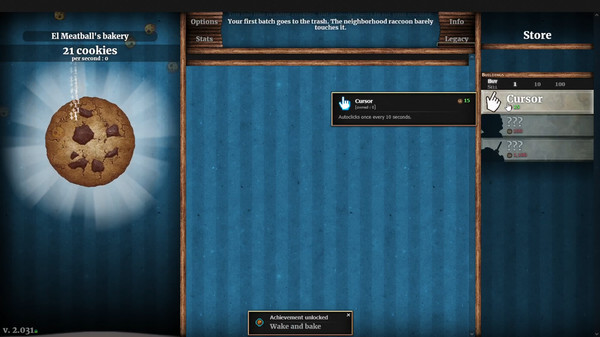 Cookie Clicker (Orteil / DashNet, Steam version 2021). From the screenshots on its Steam store page
To be clear, this is not a flaw. The idle genre builds a different pleasure precisely by taking the enclosure off. The feeling that things are moving along while you are not looking is something a board can never give you. But something was handed over in exchange: the break that says "close it and it is over."
The second is Rust (Facepunch Studios, full release 2018). It is a survival game on a deserted island, and the base you build stays on the server. Which means it gets torn down while you sleep. Raiding someone who is logged out — offline raiding — is perfectly ordinary scenery in this game. Both the enclosure of time and the enclosure of place are removed from inside the official rules.
 Rust (Facepunch Studios, 2018). From the screenshots on its Steam store page
What made me sit back was the players' response. Any number of community servers advertise a rule of their own: no raiding while the owner is offline. The enclosure the official rules took off, the people playing put back up on a different layer. It has exactly the shape of the players' self-imposed "code of honour" I wrote about in the For Honor instalment.
One puzzle a day — a ceiling
So is there a game that builds a frame on the everyday side? A clear example is the daily in A Little to the Left (developed by Max Inferno, published by Secret Mode, 2022). The store page puts it like this: "A puzzle unique to you delivered each day."
 A Little to the Left (Max Inferno, 2022). From the screenshots on its Steam store page
One puzzle arrives. Solve it and that is the end. Which is to say this daily has a ceiling that refuses to let you keep playing. A ceiling looks like a restriction, but it is really a frame built on the everyday side: the judgement "that's it for today" is carried by the game rather than by the player's willpower. Coverage before release explained that the badges accumulate without having to keep a streak alive. It is not designed to stop you breaking the chain; it is designed so that breaking it does not matter.
That shape is the same as our own daily puzzle, and it is what Wordle (Josh Wardle, 2021) did worldwide. One puzzle a day is a clever design because it lets play bite into everyday life while the designer, not the day, decides how deep the bite goes. One notification a day, one deadline a day, and that is the lot.
Here is today's discovery. A daily can be read not as "a device that makes you play every day" but as "a device that makes you stop here every day." Turn the same feature around and it becomes an enclosure. I had my eyes on the streak number and had not noticed that the ceiling of one puzzle a day was doing the heavier work.
Seen from the other side, the moment you lift the ceiling the daily loses its frame. Offer "three more, if you like" once today's puzzle is solved and the enclosure is gone. It is a common improvement proposal, and time played would certainly go up. Caillois's line falls exactly there.
The takeaway — if it bites into the day, draw a line on the day's side
It is a book from 1958, so let me note the smell of the period too. In part two Caillois sketches a grand map: from societies of the mask and possession (mimicry and ilinx) to societies of merit and chance (agôn and alea), with modernity as the latter. Arranging civilisations in stages like that reads today as plainly of its time, and there is nothing to do but discount it. The underlying idea — that a society itself is built around one of the four drives — is still very much usable.
The takeaway in one line: if you install a device that makes play bite into everyday life, install just as many lines that say "this is where it ends" on the everyday side.
Concretely, I wrote three things in the drafting notebook. One notification a day, at a fixed hour. Once today's puzzle is solved, do not serve the next one. Show the streak, but do not erase a rested day from the line graph and do not reset it to zero. Sharpen the outline instead of dialling down the strength. All three push the numbers down — but what goes down is time on site, and what does not go down, I think, is the wish to open it again tomorrow.
My own position is half a step towards Caillois. I will keep the daily. I will keep the deadline that resets each day. But I will admit that this is a design that pushes play out into the day, and I will build the frame on the other side myself. In the Pascal instalment I wrote that a game should be as easy to close as it is to open — but that was about the vessel. Today's is about the line drawn outside the vessel.
One last question for you. Does the game you are keeping up every day have a line that decides "this is where today ends"? And is that line drawn by the game, or by you? Tell me in the comments.
The next long-form slot returns to the pairing type: Michel Foucault's panopticon against achievements and login bonuses. Today was about the enclosure of play; next time I read the design that moves people by being watched, through the two kinds of eyes in The Talos Principle.
Reference: Roger Caillois, Man, Play and Games (Japanese edition: trans. Michitaro Tada and Mikio Tsukasaki, Kodansha Gakujutsu Bunko).
 Caillois, Man, Play and Games (Japanese ed., trans. Tada & Tsukasaki, Kodansha Gakujutsu Bunko)As an Amazon Associate, Puzzlebyrinth earns from qualifying purchases.
Reactions (no login)
Anonymous • one of each per visitor per day
Part of these series
The Nature of PlayEpisode 17 of 20