ESSAY · 2026-09-01
Who Is 100% Completion Actually For? — Perfectionism and the Philosophy of Play
An imagined dialogue between Suits and Aristotle, prompted by Hollow Knight's "112%"
I saw the ending. The 93% is still there
Late at night, whisky in hand, I opened my Hollow Knight (Team Cherry, 2017) save file. "93%" sits in the corner of the screen. The story is over. I have seen the ending. And still that number will not go away.
A few charms are missing. Behind some wall, probably. Go back for them and the number fills in. But the version of me who goes back — is he still playing? Or just tidying up?
Tonight I take that "one more" into the margin of my drafting notebook. Facing each other: Bernard Suits, who wrote that playing a game is the voluntary attempt to overcome unnecessary obstacles, and Aristotle, who split doing into two kinds. These are not real remarks, of course. It is an imagined dialogue in my head, inferred from what each of them wrote.
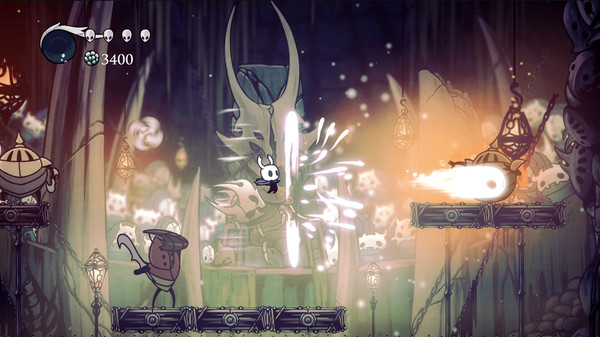 Hollow Knight (Team Cherry, 2017). From the screenshots on its Steam store page
In the margin of the notebook, the two of them count to 100%
Suits. What is there to agonise over? In The Grasshopper I wrote that to play a game is to attempt the voluntary overcoming of unnecessary obstacles. Achievements are precisely unnecessary. Skip them and the story still ends. Nobody is harmed. Going out of your way to collect what you need not collect — that is the definition of play itself. Whoever fills the bar to 100% is playing most deeply of all.
Aristotle. Wait. You are looking only at what he is doing. That is not the line I drew in Book X of the Nicomachean Ethics. There is a movement, like building a house, which is only complete once it is over. And there is an activity, like seeing or enjoying, which lacks nothing at any moment of it. I called the latter energeia. Play should belong there.
Aristotle. But the number in the corner of the screen turns play into the former. A night at 93% becomes an unfinished night. And the moment the bar fills, the pleasure has nowhere left to go. What follows his picking up the last item is not satisfaction but idleness.
Suits. So one readout changes the attitude. Yet he is the one choosing. Nobody is forcing him.
Aristotle. He chooses, yes. But he did not arrange them. Scattered about, they were detours. The instant they are lined up and numbered, they become an inventory — and an inventory exists to be crossed off. And incidentally: in that same Book X I wrote that happiness does not lie in amusement, that amusement exists for the sake of rest. Coming from me, then, hear it: a readout that turns rest into a chore is no friend of play.
Suits. I will concede one point. I distinguished the player from the trifler, the cheat and the spoilsport. If he is chasing 100% only to display it, only to be done with it, then he is no longer enjoying the unnecessary obstacle. An obstacle that has become necessary is not an obstacle but a job. Still — that is not the readout's crime. It is a question of his attitude.
The takeaway — don't make 100 the perfect score
Here is the thing I noticed. Completion in Hollow Knight does not stop at 100%. With the free content packs included, the maximum is 112%. Bosses, charms, equipment, extra trials — add them up and you go past 100.
So in this game, "100%" is not even a perfect score. It is just a round number that happens to appear along the way. Which suggests that what pulls us back in is not the content at all, but the roundness of the number.
The takeaway for a maker fits on one line: if you are going to show a completion rate, don't make 100 the perfect score. Or put "found" and "total" in two separate fields and never divide them. The same information, turned into a percentage, invents a remainder.
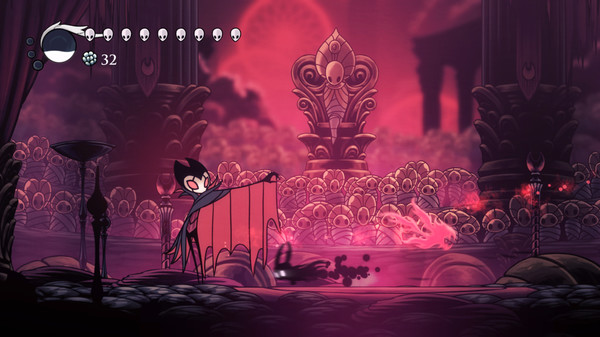 Hollow Knight (Team Cherry, 2017). From the screenshots on its Steam store page
I stand half a step towards Suits. I do not want to disown the hours spent picking up what nobody required me to pick up. But on the drafting table, the side that actually bites is Aristotle's. You cannot design an attitude; you can design a readout. So I will show a completion rate — and I will not make 100 the top of it.
Let me ask you. When you went back for that last item, who was there — you, or the inventory? And: if the game had shown no completion rate at all, would you have gone back for it? Tell me in the comments. The next Fragment: "Why do we feel guilty about NPCs? — Ethics towards fiction." Nobody on screen has actually been hurt, so why do we want to apologise? Two more philosophers, face to face.
References: Aristotle, Nicomachean Ethics, vol. 2 (Japanese ed., trans. Kunio Watanabe and Koji Tachibana, Kobunsha Koten Shinyaku Bunko — Book X on the distinction between a movement that is complete only when it is over and an activity that lacks nothing at any moment, on pleasure completing the activity, and on happiness not lying in amusement, amusement existing for the sake of rest) / Bernard Suits, The Grasshopper: Games, Life and Utopia (Japanese ed., trans. Shigeki Kawatani and Takahiro Yamada, Nakanishiya — game-playing as the voluntary attempt to overcome unnecessary obstacles, and the distinction between players, triflers, cheats and spoilsports). The game examined here is Hollow Knight (Team Cherry, 2017; maximum completion including the free content packs is 112%).
 Aristotle, Nicomachean Ethics vol. 2 (Japanese ed., trans. Watanabe and Tachibana, Kobunsha)
 Bernard Suits, The Grasshopper: Games, Life and Utopia (Japanese ed., trans. Kawatani and Yamada, Nakanishiya)The cover images are Amazon Associate links. As an Amazon Associate, Puzzlebyrinth earns from qualifying purchases.
Reactions (no login)
Anonymous • one of each per visitor per day
Part of these series
The Nature of PlayEpisode 16 of 16