RETRO-REVIEW · 2026-09-01
Solomon's Key (1986) — The Year Its Own Maker Let Go of the Magic to Create
Tecmo's Michitaka Tsuruta invented block-creation as a puzzle grammar — then sealed it away in the sequel
Introduction
This is an arcade game Tecmo (then still called Tehkan, based in Tokyo) released in July 1986. You play Dana, a young sorcerer, clearing one fixed-screen room at a time, collecting a key (and sometimes treasure) before slipping through the door.
Most action games of the era changed the board in one direction only: dig, dodge, destroy. Solomon's Key added the reverse. A wave of the wand conjures a block; the same wand erases it again. Making things and unmaking them, both counted as weapons — an unusual design for its time.
This piece isn't nostalgia for its own sake. I want to read it as a fork in the road: why later puzzle-platformers so rarely picked up the ability to create.
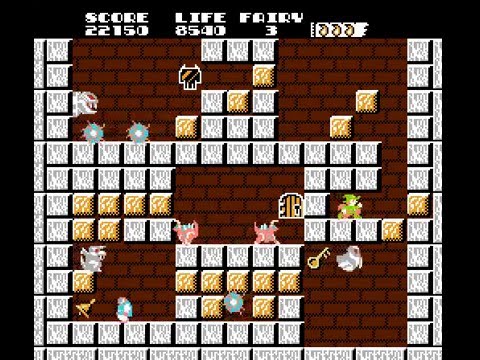 Thumbnail from "NES Longplay [585] Solomon's Key" (WorldofLongplays, YouTube)
The Time It Came From
The creator was Michitaka Tsuruta, who had made Bomb Jack in 1984 — Solomon's Key was his second game. In an interview years later, he traced the idea back to a rival's Lode Runner (1983): he wanted to do the opposite of digging pits to drop enemies into.
He says he first pictured it as a pure action game. Kazutoshi Ueda, the development lead, pushed him toward the puzzle angle instead, suggesting the feel of blocks appearing and vanishing was closer to a puzzle and worth developing further. 1986's Japanese arcade market had room for that kind of unforgiving action-puzzle hybrid — see also The Tower of Druaga (1984) and Spelunker (1983).
Home ports followed within the same year: a Famicom release in Japan, then an NES release in North America in 1987. From there it spread further than most games of its time — Sega Mark III, a PC Engine remake credited as Zipang, a Game Boy version called Solomon's Club, and, via U.S. Gold and a Probe Software port, European home computers: Commodore 64, ZX Spectrum, Amstrad CPC, Atari ST, and IBM PC.
Mechanics
The core loop is simple. Dana can conjure a block into an adjacent empty space, and undo the same action to destroy one. Cast it with the wand, or headbutt it from below. That single two-way choice, repeated, builds platforms, blocks corridors, and buries enemies alive.
Blocks alone can't stop every enemy, so a limited-use fire spell (called Manda's Pot in the game) handles the rest. Gamest's 1998 retrospective book The Best Game 2 credited that limited fire magic with sharpening the game's completeness as an action-puzzle.
Every room shares the same goal: gather the key (and sometimes treasure), then reach the door before the timer runs out. Both the arcade and Famicom versions hold roughly 50 rooms. The NES version added more: twelve hidden rooms unlocked by matching zodiac tiles, a hidden scoring system, and "Solomon Seals" leading to multiple endings.
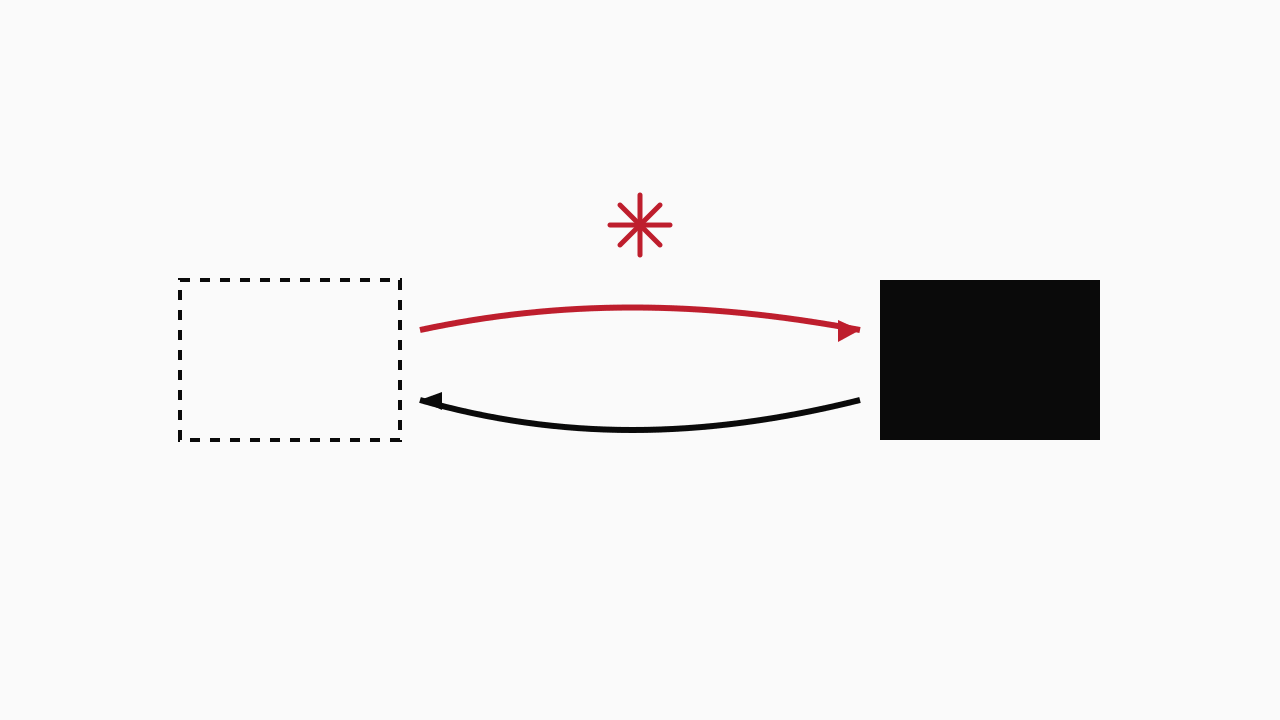 One flick of the wand handles both appearing and vanishing (illustration, AI-generated)
Its Line into the Present
In January 1992, the sequel — Solomon's Key 2: Coolmin Island Rescue Operation in Japan, Fire 'n Ice abroad — arrived on Famicom/NES. Same developer, Tecmo; same designer, Tsuruta. And here he made a striking choice: he replaced the original's core skeleton, create-and-destroy, entirely.
In the sequel, Dana can conjure only a single ice cube, and only diagonally below himself. Push it, roll it, and clear every flame on screen to finish the room. In Tsuruta's own words, this time he wanted to make "a true puzzle game." It's also, in effect, a merge into the "pushing" grammar this column has traced repeatedly since 1982's Sokoban (see Sokoban (1982) and Sokobond (2013)).
The creator himself let go of his own invention and fell in line with the dominant grammar. That's telling. I looked through the English-language puzzle-history literature and found no source that names Solomon's Key's create-block mechanic as an ancestor of any specific later title. This column doesn't stretch a lineage on speculation, so I won't claim one here.
What remained instead was a trail of ports and remakes. The 1990 PC Engine version, Zipang, made by Arc System Works, swapped in a different protagonist and reskinned the Western zodiac as Chinese-themed. The 1991 Game Boy version, Solomon's Club, developed by Graphic Research, added a shop system and lowered the difficulty. In 2000, an unauthorized Korean clone, Tang Tang, from GameVision, appeared as well. If nothing else, it's clear this was a design worth borrowing, even under a different name.
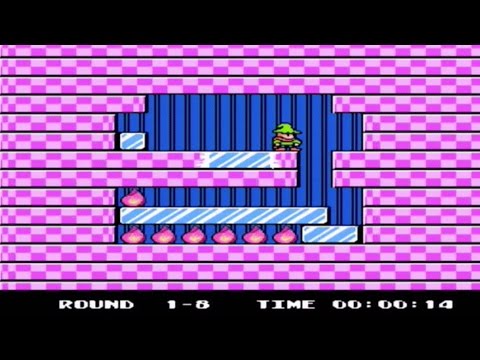 Thumbnail from "Fire 'n Ice (NES) gameplay" (316whatupz, YouTube)
Sources
Sources consulted for this article:
・Wikipedia (Japanese): Solomon's Key (video game)
・Wikiwand (mirror of English Wikipedia): Solomon's Key
・Hardcore Gaming 101: Solomon's Key
・Hardcore Gaming 101: Fire 'n Ice (Solomon's Key 2)
・Hardcore Gaming 101: Solomon's Key spin-offs and rip-offs
・Game Developer: Michitaka Tsuruta interview, "A History of Tecmo and Classic Platform-Puzzlers"
Closing
Giving the player both creation and destruction was unusual even in 1986, and it never really caught on afterward. While Sokoban's "pushing" grammar became the mainstream, the path Solomon's Key opened was quietly folded up by its own creator.
Every time I dig up a fork in the road nobody took, I think the same thing. A design that never caught on usually isn't a failure — it's often just ground nobody has properly tried yet.
Getting to file one more July in 1986 into the record is, quietly, its own small satisfaction today.
Reactions (no login)
Anonymous • one of each per visitor per day
Part of these series
Retro RevisitedEpisode 38 of 38