ESSAY · 2026-09-08
Is Choosing Easy Mode a Retreat?
The day Celeste rewrote its Assist Mode preamble — seating Hegel and Mill across from each other
The studio rewrote its own preamble, once
Night. One whisky. For two weeks I have been stuck on whether to put a difficulty toggle into my own puzzle.
What has stalled me is not the code. It is that the moment the toggle is there, the person who picks the gentler setting may feel they retreated. An option that lowers the difficulty becomes two things at once: permission to lower it, and a record that you did.
So I went to look at the Assist Mode in Celeste (Maddy Makes Games / Extremely OK Games, 2018). Slow the game speed. Grant yourself infinite stamina. Turn on invincibility. Skip whole chapters. Before you switch any of it on, a preamble appears.
Here is the thing I had never noticed. That preamble was rewritten. In September 2019, alongside the release of Chapter 9.
The old version closed like this: "We believe that its difficulty is essential to the experience. We recommend playing without Assist Mode for a first time."
The new one reads: "Celeste is intended to be a challenging and rewarding experience. If the default game proves inaccessible to you, we hope that you can still find that experience with Assist Mode."
Two sentences changed. "We recommend against it" became "we hope you find it." The revision was reported to follow input from Clint Lexa, a one-handed speedrunner, and narrative designer Kathy Jones.
So the makers themselves answered "is easy mode a retreat?" once, and then answered it again, differently. If the answer can change, my two weeks are not wasted.
In the margin of the drafting notebook, two men measure "retreat"
In the margin of the drafting notebook I wrote out two sets of objections. The lines below are not invented quotes; they are what I infer each man's own books would have him say. Hegel's Phenomenology of Spirit, and Mill's On Liberty. I sat them across from each other.
Hegel. What offers no resistance gives you nothing back. That is what I was writing in the scene of master and bondsman. The master merely consumes the thing, and so never gets the chance to take on a shape. It is the one who works the thing and endures who is given form. To shave off difficulty is also to shave off the shape that comes back.
Mill. Wait. Who grades that "shape that comes back"? What I wrote in On Liberty is that each person should be free to pursue their own good in their own way. The shape you speak of is your shape.
Hegel. This is not a matter of taste. Work does not hand you what you want at once. Only what you endured becomes your outline. Halve the game speed and you halve the enduring.
Mill. And someone will always turn up to fix that quantity of enduring from the outside, the same for everyone. That is exactly what I most warned against. A person who follows custom merely because it is custom makes no choice at all. Nor does the person who picks Normal because everyone plays on Normal.
Hegel. …I grant you that. The bondsman I described begins his work under fear of the master. Work that starts in fear is not yet free self-formation. Resistance shapes a person only when that person has taken the resistance on.
Mill. Then I will grant something too. Individuality grows only by choosing. Which means it does not grow in someone who always picks whatever resists least. To choose is to take on what you chose.
They met closer together than I expected. What settles whether something is a retreat is not the value of the difficulty. It is whether the person can say: I chose this.
One game does that meeting point in plain numbers. God Mode in Hades (Supergiant Games, 2020). Switch it on and you get 20% damage resistance. Then it rises by 2% every time you die, up to a cap of 80% — it tops out after thirty deaths.
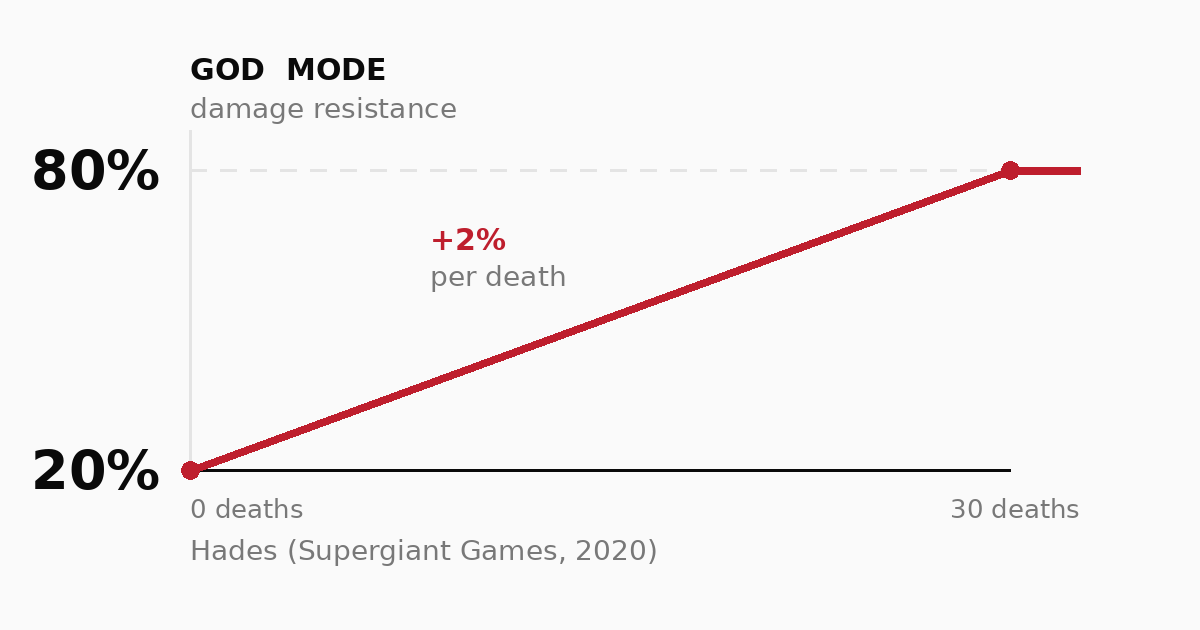 (Diagram) God Mode in Hades — resistance starts at 20%, adds 2% per death, and stops on reaching 80% at thirty deaths (made by Puzzlebyrinth)
What goes down is the difficulty, but the way it goes down is tied to how many times you actually faced it. The resistance is not removed up front; it yields exactly as far as you went at it. Hegel's resistance-taken-on and Mill's choose-it-yourself sit on one and the same slider.
Takeaway — move difficulty out of the options screen and back into play
If I write the takeaway in one line: move the difficulty choice out of the corner of the options screen and back into play itself.
Three things went into the drafting notebook. Let it be changed at any time (do not lock it to the first choice). Keep the record of the change somewhere only that player can see. Do not push the player away in the preamble.
The third is Celeste's revision, unchanged. "We recommend against it" is written as a kindness. But it can land on the reader as: you are stepping outside of this. The same content can be written without pushing anyone away.
My own position is half a step towards Mill. The difficulty options go in. I will not ask who picked what. But the feel of "I chose this" I want left on the board, not in the options screen. Because Hegel's resistance-taken-on lives nowhere else.
I want to ask you something. The last time you turned on an easy mode or an assist option — did you choose it, or were you pushed into it because there was nothing else? Tell me in the comments.
Next shard: "What do you say when someone calls it a waste of time?" That moment when you have to justify playing to another person. Two more thinkers, seated across from each other.
References: G.W.F. Hegel, Phenomenology of Spirit, vol. 1 (Japanese ed., trans. Sumihiko Kumano, Chikuma Gakugei Bunko) / J.S. Mill, On Liberty (Japanese ed., trans. Masashi Sekiguchi, Iwanami Bunko). For the history of the Assist Mode rewrite I drew on Vice's 2019 report.
 Hegel, Phenomenology of Spirit, vol. 1 (Japanese ed., trans. Kumano, Chikuma Gakugei Bunko)
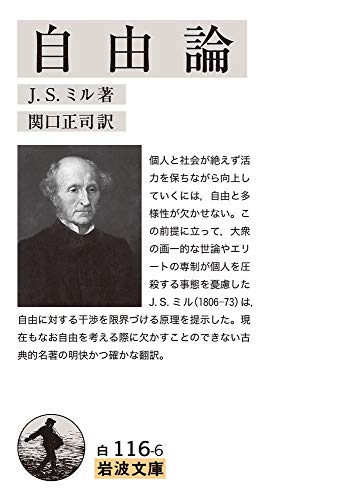 Mill, On Liberty (Japanese ed., trans. Sekiguchi, Iwanami Bunko)As an Amazon Associate, Puzzlebyrinth earns from qualifying purchases.
Reactions (no login)
Anonymous • one of each per visitor per day
Learn — Curriculum
LearnPart 4 Difficulty — Designing the Learning Curve and FailureChapter 12 Measuring Difficulty9 / 10
Part of these series
The Nature of PlayEpisode 18 of 20