ESSAY · 2026-09-15
When Someone Calls It a Waste of Time, What Do You Say?
Why Unpacking gets a free pass — seating Aristotle and Schiller across from each other
The night I wanted to write "it's good for your brain"
Night. One whisky. For three days I have been rewriting the blurb for my own puzzle.
One line is what has stalled me. "Improves your focus." Write that and fewer people will hesitate, I think. It hands them a reason to play, ready-made.
But the moment that line is there, my puzzle becomes a device for making you smarter. It stops being play.
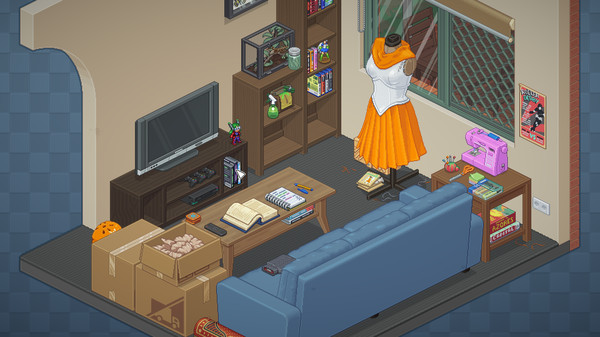
While I failed to write it, I kept thinking about Unpacking (Witch Beam, 2021). You take belongings out of cardboard boxes and put them on shelves and in drawers. That is the whole of it.
 Unpacking (Witch Beam, 2021). © Witch Beam (official Steam screenshot)
Here is the thing I had never noticed. I have never seen anyone call that game a waste of time.
It is because the game has the shape of tidying up, and tidying up looks useful. Play wearing the face of work gets waved through. It was not permitted. It was disguised.
In the margin of the drafting notebook, two men recount what "waste" means
In the margin of my drafting notebook I sat two men down. Aristotle and Schiller.
Aristotle speaks first. In Book X of the Nicomachean Ethics he treats play as rest, and rest exists for the sake of the activity that follows. So happiness does not lie in play. He goes as far as to say that toiling for the sake of play is childish.
He looks like the founding member of the waste-of-time party. And then, a little further on, he goes after the premise instead.
We are unleisurely, he writes, in order to have leisure — the time in which we do not have to work. That thought sits in the later stretch of Book X.
This is the part that lands. Whoever says "waste of time" believes time has a purpose, and usually files that purpose on the side of work. Aristotle says the filing is the wrong way round.
 Unpacking (Witch Beam, 2021). © Witch Beam (official Steam screenshot)
Schiller takes it from there. The fifteenth of his Letters on the Aesthetic Education of Man arrives at this: a person plays only when they are human in the full sense of the word, and is fully human only while playing.
What he calls the play drive sits exactly between the power to feel and the power to give things form. As long as we lean to one side, we are only half a person. Play is not a luxury for leftover hours; it is where a person becomes whole.
The two never quite meet. For Aristotle, leisure is time for quiet thinking, not time for play. Schiller fills that gap in and puts play itself where human completeness goes.
And yet there is one point where they join. Both refuse "play so that you can work." Play justified by its effects is, by either man's standard, no longer play.
The takeaway: pull one "it works on you" out of the blurb
If I write the takeaway in one line: pull the "it works on you" out of the blurb and write what happens instead.
I fixed it in the drafting notebook. "Improves your focus" is gone; in its place, "the moment you see three moves ahead, the board goes quiet." Not an effect. A thing that happens.
My own position is half a step toward Schiller. I do not think play needs an excuse. But staying silent when an excuse is demanded feels wrong too. What I would say back is not "it is useful" but "this is the time in which I am a person."
I want to ask you something. The last time someone said "isn't that a waste of time?", what did you answer? If there is something you swallowed instead of saying, tell me that too.
The next short piece: what does it mean to be good at a game — skill, knowledge, or attitude? It is about two people using the same word and missing each other completely. I will seat another pair across from one another.
References: Aristotle, Nicomachean Ethics, vol. 2 (Japanese translation by Kunio Watanabe and Koji Tachibana, Kobunsha Classics) / Friedrich von Schiller, On the Aesthetic Education of Man (Japanese translation by Takanori Oguri, Hosei University Press).
 Aristotle, Nicomachean Ethics, vol. 2 (Japanese translation by Kunio Watanabe and Koji Tachibana, Kobunsha Classics)
 Friedrich von Schiller, On the Aesthetic Education of Man (Japanese translation by Takanori Oguri, Hosei University Press)※ Cover images are Amazon Associates links. As an Amazon Associate, Puzzlebyrinth earns from qualifying purchases.
Reactions (no login)
Anonymous • one of each per visitor per day
Part of these series
The Nature of PlayEpisode 19 of 20