COUNTER-REVIEW · 2026-09-17
Counterpoint on Thomas Was Alone — Reading Through the Negative Reviews
What Komugi's review didn't say
Introduction
Komugi's review gave Thomas Was Alone a 7.2 — a 2D puzzle-platformer from Mike Bithell's Bithell Games, released in 2012, where you switch between coloured rectangles and combine their individual abilities into stepping stones. A 7.2 out of 10 isn't a soft score. She'd already touched on the negative side's core complaint herself: the verbs are split one per body, and they barely interfere with each other, leaving little room to choose. I went to read Steam's negative reviews anyway. Does the low-scoring crowd settle for a 7.2? Thomas Was Alone — official Steam store asset
Steam counts 9,391 reviews, 8,798 of them positive — 93.7%, "Very Positive" (as of 2026-09-17). Only 593, or 6.3%, are negative. But a small share doesn't mean a weak argument. Read the top negative reviews and the same complaints keep recurring.
Komugi's conclusion was that splitting verbs across bodies isn't a bad choice in itself. My question is slightly different: which of the negative side's complaints are inherent to that design, and which are just rough edges. I'll sort out where I agree and where I don't.
What the negative reviews say
Reading the most-helpful, most-recent, and negative-only review pages together, the claims cluster into roughly five patterns.
First, a sense of repetitive busywork. Reviewers describe "the same solution over and over" and late levels that turn into memorized procedure. Second, rough controls: complaints about heavy jump response and input lag when coordinating several characters at once.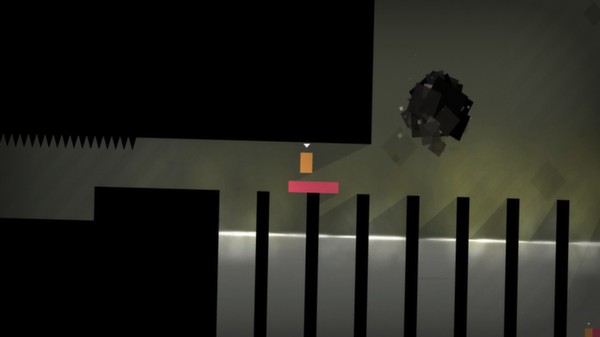 Combining characters with different abilities to cross a gap (Steam store screenshot)
Third, an overbearing narrator. Some reviews call the narration "trying too hard to sound clever," or say it hands you the conclusion before you've had time to think. Fourth, technical neglect — broken achievements, cutting audio and music — the kind of thing you'd expect from a decade-plus-old title nobody actively maintains.
Fifth, a mismatch between length and price. At 2 to 4 hours to finish, some reviewers find full price steep. Many reviews frame it as a sale purchase or a decade-later revisit rather than something worth recommending fresh.
Examining 1 — are the repetition and control complaints fair
I stand fully behind the repetition complaint. The game hands each body exactly one verb, and those verbs barely interfere with each other. A given body gets called in for one specific ledge and otherwise just waits in line. Trine 2: Complete Story's trio draws a similar critique. More bodies in your hand doesn't mean more choices.
The control complaints mostly land too. Physics-driven jumps inherently wobble on landing. LIMBO and INSIDE also demand precise footing, but there, failure snaps back as an immediate, dramatic result — the precision itself builds tension. Here, an unstable landing is just friction, with no tension to show for it. The critique is accurate.
There's no defending broken achievements or cutting audio. That's not a design argument, it's maintenance. It's hard to believe a 2012 title is still getting active support. On this point, the negative side is simply right.
Examining 2 — the narrator and the price
The "narrator trying too hard" complaint is, I think, half a matter of taste. The narrator isn't handing out puzzle hints — it's an interpretation of what each character is feeling. Compared to a game like Brothers - A Tale of Two Sons, which keeps its distance with no dialogue at all, this narrator does sit closer. But closer isn't the same as spoiling the solution. What it explains is the shapes' inner state, not the puzzle.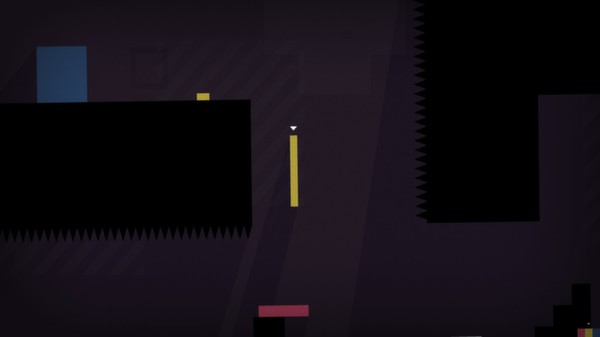 A moment where the narration voices each character's inner state (Steam store screenshot)
That said, the "over-explained" complaint has a point about the first few levels, where the narration rushes to assign emotional meaning while you're still learning the controls. I'll partly agree with the negative side here.
On price, the per-hour math holds up. At $9.99 for a 2-to-4-hour run (per Steam's own listing as of 2026-09-17), that's $2.50–$5 an hour — not unusual for an indie puzzle game this size. "Short" is a fair description. "Not worth the price" is a step further than the evidence supports.
Where I agree
What I agree with most strongly is the repetition, and the rough controls. Splitting verbs across bodies, and then never letting those verbs interfere with each other, is the exact weakness Komugi flagged and the one the negative reviews name again and again. The complaint that physics-driven wobble reads as friction rather than tension is just as accurate. It's a rare case where popular sentiment and design-level critique land in the same spot.
I also agree on the technical neglect — achievements that don't unlock, audio that cuts out. More than a decade without upkeep is information a buyer should have. Komugi's review barely touches this. That's a blind spot in her piece.
Where I disagree
Where I disagree is the "clever and overbearing" read on the narration. What it's doing isn't explaining solutions — it's translating what the rectangles are feeling. In Puzzlebyrinth's terms, it redirects where you're looking, from the puzzle to the character, without defusing the puzzle's difficulty.
I also disagree with "not worth the price." The short runtime is real, but the per-hour cost sits in normal range for an indie puzzle game this size. Short and overpriced are two different claims.
Sources
This piece is based on reading the Steam store page's user reviews as of 2026-09-17.
· Steam: Thomas Was Alone (Overall 93.7% positive — 8,798 of 9,391 reviews positive, 593 negative)
· Read the top most-helpful negative reviews and the top of the negative-only page (all in English)
· Referenced Komugi's review (2026-09-10) as the comparison point
· Images are the screenshot and header URLs returned by Steam's appdetails, used as-is
Closing
So how much do I agree with the low scores? On the busywork repetition, the rough controls, and the technical neglect, I agree with the negative side. On the overbearing narrator and the price complaint, I don't. Of the five claims, I back three and reject two.
That splits the purchase recommendation. If you want puzzle depth — real range of choice, combinations that matter — don't buy this. That's exactly the weakness the low scores name. I wouldn't recommend it as a precision platformer either.
But if you want a short, complete story and don't mind letting a narrator carry you through it, this still holds up. 2 to 4 hours at $9.99 is the right scale for that. Go in for the narration, not the puzzles, and the rating makes sense.
Reactions (no login)
Anonymous • one of each per visitor per day
Part of these series
The Counter-ReviewEpisode 23 of 23
Read next

Related reviews
Primordia
A 2D point-and-click adventure in which a robot called Horatio and his small companion Crispin lose their power core and descend into the city of Metropol. You combine salvaged parts to restart broken machines, and read the ruins for traces of who built you. Made by Wormwood Studios and published by Wadjet Eye Games.
La-Mulana 2
A 2D exploration-puzzle action game in which Lumisa Kosugi descends into the ancient ruins of Eg-Lana with a whip and a notebook. You copy down the inscriptions on the walls and match them to contraptions several rooms away. NIGORO's sequel to La-Mulana.
Evan's Remains
A 2D puzzle adventure built from single-screen block puzzles — platforms that vanish once you step off them, blocks that switch other blocks on and off — carrying the story of Dysis, a girl searching for a missing boy named Evan. A game by maitan69.


