REVIEW · 2013-06-06
Trine 2: Complete Story
Stack two boxes and most of the obstacles are over — inside 5,712 reviews at 94%, the difficulty has moved off the board and onto the player's own restraint
First Impressions
What I read is the review pool on the Steam store page for Trine 2: Complete Story. The store shows 94% of 5,712 reviews positive, labelled Very Positive. Recounted across all languages it becomes 20,972 positive out of 22,018, and the label moves up to Overwhelmingly Positive (both as of 1 September 2026).
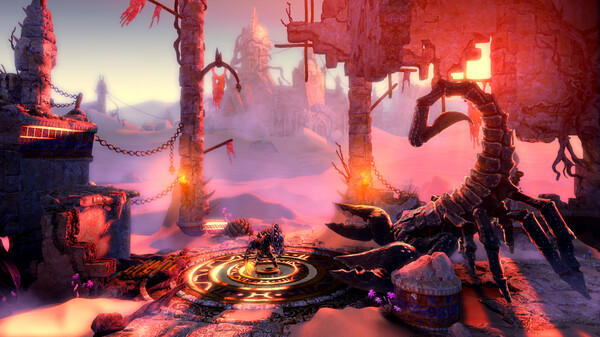
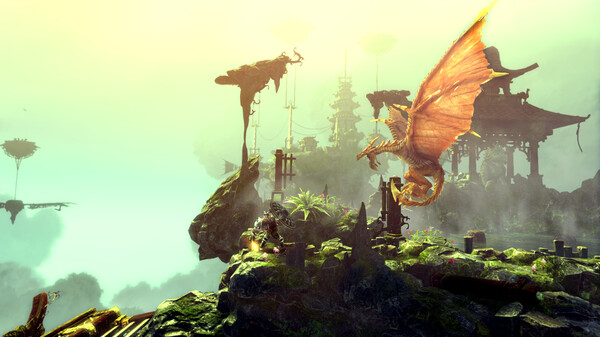
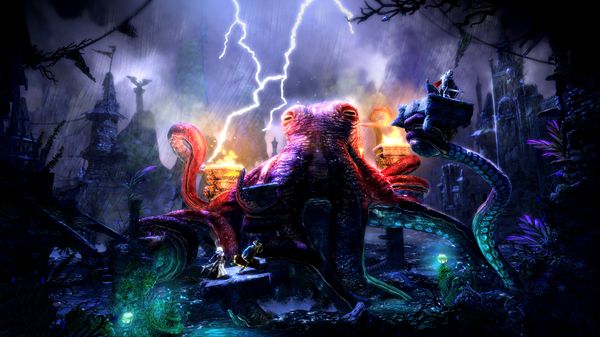
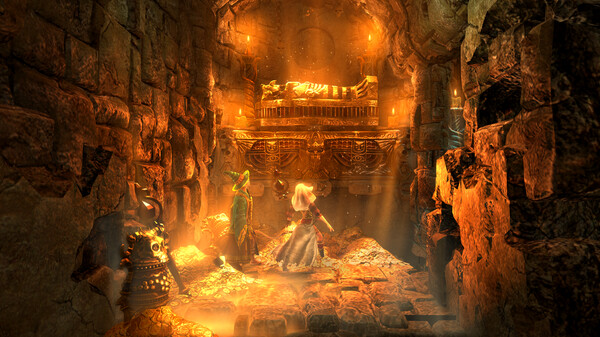
Line up the ten most helpful positive reviews, though, and the puzzles barely appear. What appears is the painting: watercolour skies, hand-drawn detail, people stopping to look at the background. Only a handful of the top votes touch the feel of solving anything.
The ten most helpful negative reviews are the opposite. They name the rules of the board, and they nearly all name the same point: the wizard breaks it. The positive side goes quiet exactly where the negative side gets specific. That gap is what this piece follows.
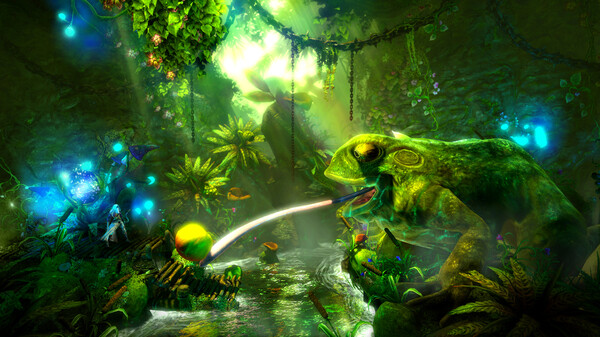 Screenshot published on the Steam store page (image 1)
Putting the Mechanics into Words
Count the verbs and this game has plenty. The knight swings and blocks, the thief shoots and grapples, the wizard conjures boxes and planks and lifts objects around. You can switch between the three at will, so the abilities stack on one board. The store text says the combination is what gets you through each stage.
The phrase the review pool keeps reaching for is that there are many ways to solve things. Top positive votes talk about difficulty options and multiple approaches as reasons to replay, and about switching freely being what lets ideas come. So far the developer's description and the players' experience agree.
The Japanese-language pool is where they part. One top vote notes that although solutions are supposed to vary with the ability combination, players lean on a single character's ability instead. Another says one character solves most of the obstacles alone. The board assumes combination; the reports describe people not combining.
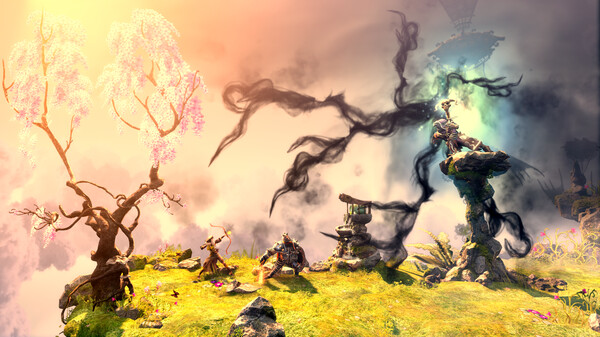 Screenshot published on the Steam store page (image 2)
The Texture of Difficulty
Three of the ten most helpful negative reviews make the same claim. The wizard's abilities break the difficulty. Strategic jumping skips the obstacles. The wizard opens a bypass. The move itself is simple: conjure two boxes, stack them, stand on top. The gap you were meant to reason about is over.
What matters is that this is not a bug. You can conjure the boxes. You can stack them. You can stand on them. The board does not forbid the sequence. So what the negative side calls broken is not something outside the rules; it is the fact that the rules never drew a line there.
That moves where the difficulty lives. Once the board stops grading solved against unsolved, whether an obstacle is hard depends on whether the player can refrain from stacking boxes. The difficulty has shifted off the board and onto the player's own restraint.
The Japanese pool confirms the shift. One top vote says the single-player hardcore setting turns it into a purer puzzle-action game without brute-force solutions; another says the wizard only gets stronger and the game easier as skills accumulate, so self-imposed restrictions are where the depth is. Players add rules of their own and redraw the line the board declined to draw. It is the mirror image of the subtraction traced in Fewer Verbs, Richer Play.
 Screenshot published on the Steam store page (image 3)
Teaching
So when do you get the bypass? The game has experience points and skill trees, and the abilities grow as you go. As the Japanese top votes put it, the wizard gets stronger the more skills it learns. The bypass is not sitting on the board from the start; it is handed over in instalments as you progress.
As a learning curve that is an unusual shape. Normally you keep the board getting harder slightly faster than the player gets stronger, and that is what preserves the feel of solving. Here, tools handed out later rewrite the solutions to obstacles you already passed. Instead of the vertical wall described in Cutting the Learning Curve, the wall gets lower afterwards.
The tools are not wasted, though. Another Japanese vote reports that the expansion levels are hard to progress through unless you do grow the wizard's skills. The same ability dissolves obstacles early and becomes a prerequisite late. That is probably why difficulty options ship with the game at all. If the board cannot narrow the solution to one, difficulty has to move outside it and become a setting the player picks, much like the choices in Designing Hint Systems.
 Screenshot published on the Steam store page (image 4)
Place in the Lineage
A physics foundation that refuses to narrow the solution is nothing unusual. World of Goo does not grade how you stack; Mosa Lina makes the way tool combinations break the intended answer its whole subject. The dividing line is whether breaking is taken on as design.
Judging by the review pool, Trine 2 sits in the middle. It keeps the freedom to break things and then lets experience points and difficulty options decide how much of that freedom you carry. So the positive side calls it freedom and the negative side calls it broken. These are not two phenomena; they are two names for one absence.
In co-op the absence changes meaning. Three of the ten most helpful positive reviews, and five of the ten most helpful Japanese ones, give cooperative play as a main reason to play at all, while the most helpful negative review says co-op mostly means sabotaging each other. As in Human: Fall Flat, unstable physics is a flaw alone and a joke with company.
One more note. Three of the negative votes dated January 2026 have nothing to do with design; they are complaints about launcher linking, matching the update announced on 30 December 2025. None of it appears in the last thirty days of reviews. I mention it only as the ordinary reminder that an aggregate is not scoring the design alone.
 Screenshot published on the Steam store page (image 5)
Sources
This piece was written by reading the Steam user reviews on the store page as of 1 September 2026, together with the official update announcements, aggregate figures and press scores. No review text is quoted directly; recurring claims are reconstructed.
- Steam: Trine 2: Complete Story (94% of 5,712 reviews positive on the store page, Very Positive; 20,972 of 22,018 positive across all languages = 95%, Overwhelmingly Positive; 22 reviews in the last 30 days at 95%; list price $19.99)
- Read in full: the ten most helpful positive reviews, the ten most helpful negative reviews, the ten most recent, and the ten most helpful Japanese-language reviews
- Official update announcements (30 December 2025 added Steam and Epic Games Store account linking; 5 June 2025 announced Trine 6: Together in Time for 17 September 2026)
- Metacritic: Trine 2 (PC 84 from 55 critics, user score 8.3 from 821 ratings; PS3 85 from 15 critics; Xbox 360 85 from 20 critics), and Wikipedia (original release 7 December 2011, platform history, over seven million series copies sold as of October 2014)
- Note: the images here use screenshot URLs returned by Steam's official API, each checked individually for existence. From this execution environment the image CDN could not be reached directly, so I could not open the files and look at them. Captions therefore state only which store-page image each one is, and describe nothing about their contents.
Closing
I give it 7.2. The distance from Steam's 94% (95% across all languages) is mostly explained by whether you score the art and the co-op. The painting still holds up for a 2011 game, and it makes sense that the top positive votes gather there. What I deduct is for a board that did not defend its own solutions.
The critical interest here is not that the game is broken but that breaking it sits inside the specification. Add verbs to widen freedom and the combinatorial explosion happens on the solution side rather than the board side. The intended answer stops being unique, and the board stops grading. What is left is the rule the player imposes on themselves.
Total playtimes in the review list scatter from six hours to over two hundred, but votes in the ten-to-twenty-hour range are the most common. That is not short. Some people say they spent most of it looking at the scenery and shoving a friend off a ledge; others spent it deciding not to stack boxes. When difficulty sits outside the board, what the play consists of varies this widely.
The series is still moving: the official announcement puts Trine 6: Together in Time on 17 September 2026. Half the reason a fifteen-year-old game still holds Very Positive is the painting. The other half is that it left room for players to add rules. Whether you call that generosity or a failure to draw a line is where the signs on 5,712 reviews divide.
 Screenshot published on the Steam store page (image 6)
Reactions (no login)
Anonymous • one of each per visitor per day
Read next
Related reviews
Brothers - A Tale of Two Sons
Two brothers set out to find the Water of Life for their dying father. The left stick moves the older brother and the right the younger, both at once, and you cross ravines, waterways and the bones of giants by pairing what each of them can do. Every line is spoken in an invented language. Directed by Josef Fares at Starbreeze Studios, released in 2013.
Human Fall Flat
A physics puzzle platformer about Bob, a wobbly figure you steer by grabbing, climbing and dragging your way through buildings that float in a dreamscape. Each arm is controlled separately, and no puzzle has a single fixed solution. Made by Lithuania's No Brakes Games, with online co-op for up to eight players.
Vessel
A 2D physics puzzle-platformer where a single liquid-spraying backpack lets you move water, lava and glowing protoplasm, and grow living liquid creatures called Fluros to repair a machine-run world. Set across a foundry, orchard and mines, Strange Loop Games builds its grammar out of fluid simulation rather than a grid.


