REVIEW · 2012-03-01
Vessel
Reading the split on a steampunk puzzler that makes fluid its grammar
First Impressions
Vessel is a 2D physics puzzle-platformer where a single liquid-spraying backpack lets you move water, lava and glowing protoplasm, and grow living liquid creatures called Fluros to repair a machine-run world. Strange Loop Games shipped it, via IndiePub, in March 2012. I wrote this by reading the Steam user reviews, not by reporting a playthrough of my own.
The label is Very Positive: 89% of 425 Steam-purchaser reviews are positive, and across all 830 reviews 731 are positive and 99 negative (snapshot 2026-07-22). Across the helpful reviews the first word of praise is always 'fresh' or 'nothing else like it,' while the negative side opens, just as reliably, with 'controls' and 'physics.'
That fault line is a design choice: the puzzle's grammar is fluid, not a grid. The positive side calls that choice emergence; the negative side calls it 'it never does what I want.' Same decision, two readings.
 Key art of Vessel — Steam store key art
Putting the Mechanics into Words
The verbs reviewers name are few: spray liquid, suck it back, throw a seed. They describe growing Fluros from seeds and using them to press switches, chase light or hide from it, swapping nozzles and tanks to widen what you can spray.
That is verb economy, in Puzzlebyrinth terms. The difference is that these few verbs act in continuous space, not on a grid. Where The Swapper's clones or Braid's time resolve on discrete states, Vessel's water and lava flow, mix and spill in analog. 'Gameplay is liquid,' the praise goes — a compliment to that continuity.
The learning curve reads well even to skeptics: one reviewer who usually avoids the genre notes that when stuck, the reason was simply a tool not yet unlocked. Gating difficulty by tool acquisition is a clean curve.
 Gameplay of Vessel — Steam store screenshot
The Texture of Difficulty
On difficulty the pool splits cleanly. Some call it easy and quick; others say the floaty controls are 'a constant source of frustration,' or that you 'fight the physics to enact an obvious solution.' Note that both groups mostly describe difficulty of execution, not of logic.
Here I reach for 'observation resolution.' On a grid you read a discrete state and confirm a solution in your head before acting. Vessel's fluid is continuous — 'off by a pixel changes a Fluro's behavior,' one reviewer writes. The board can't be fully read. The recurring complaint that 'the aha moment never comes' is exactly this: insight is the closure of 'I see it, it's confirmed,' and stochastic execution never quite closes it.
Still, that isn't simply a flaw. The positive side welcomes the same continuity as emergence. Like Poly Bridge, which is less about building bridges than bargaining with physics, Vessel makes negotiating with unruly fluid the game itself. A matter of range, not quality.
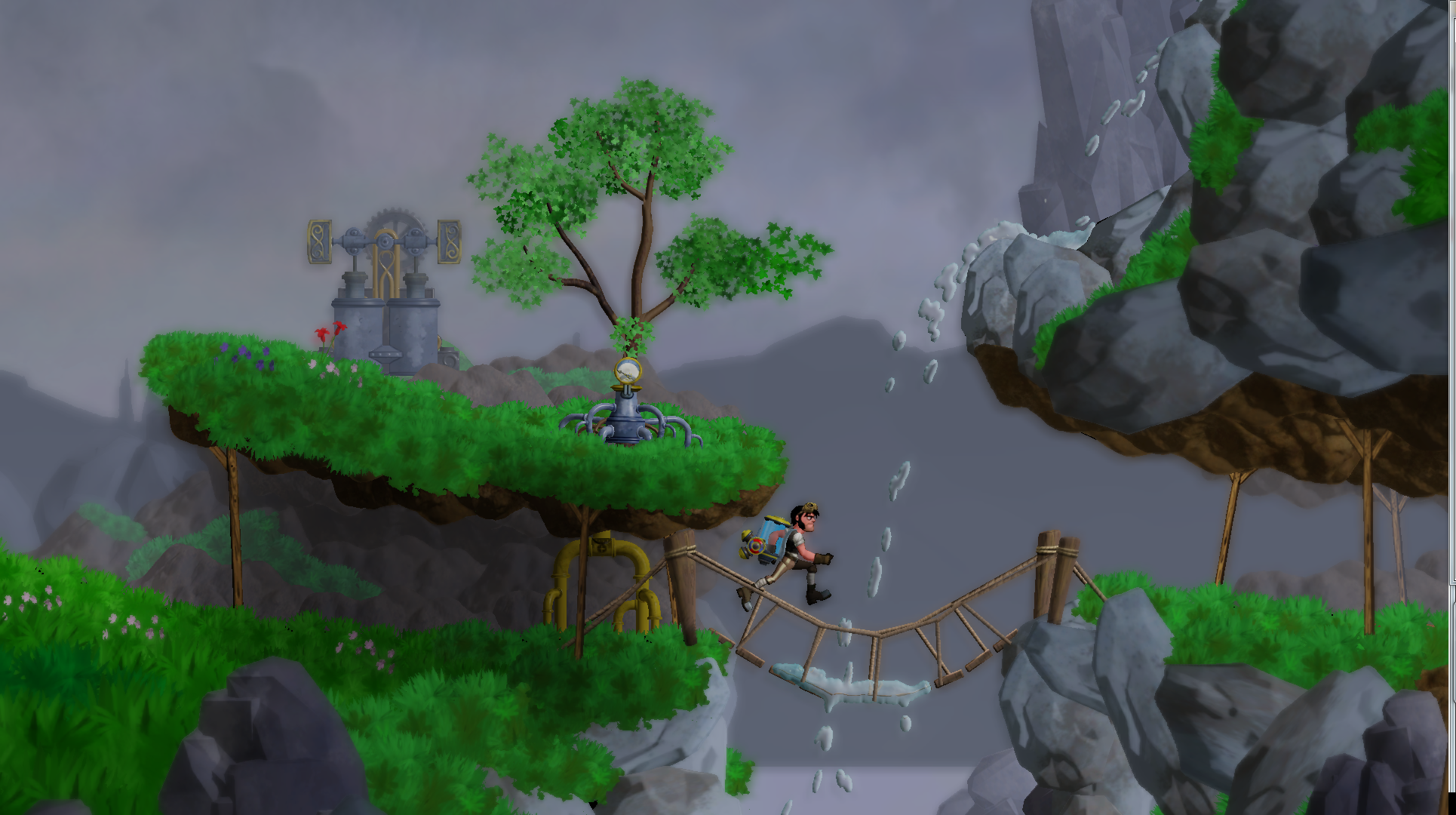 In-game view of Vessel — Steam store screenshot
Reviews Consulted
This piece was written by reading the Steam store user reviews as of 2026-07-22.
- Steam: Vessel (overall Very Positive; 89% of 425 Steam-purchaser reviews positive; 830 total = 731 positive / 99 negative, snapshot 2026-07-22).
- Read about 15 top reviews by Most Helpful (All Time), positive and negative, plus recent ones, posted from launch (2012) through July 2026.
- (Reference) Critics sit at 81 on Metacritic; PC Gamer and Game Informer ('Clever Puzzles, Finicky Solutions') praised the invention while flagging the finicky physics, echoing the user complaints of 'floaty' controls and a missing aha moment.
Closing
Read together, the reviews grow from one root: fluid as grammar. The positive side calls it an experience with no equal; the negative side calls it the absence of insight. Both are right — continuous physics brings emergence and unreadability at once.
Steam sits at 89% positive; from a design view I give it 7.4. The gap is observation resolution. Few verbs, a careful curve, Jon Hopkins's score and a painterly steampunk world — the materials are fine. But the fluid grammar keeps the closure a puzzle needs just out of reach. Reviewers report roughly 8-12 hours to finish.
So the recommendation is clear. For those who love playing with physics like World of Goo, who welcome the unexpected, and who can hold a gamepad, this is a cheap, lasting hidden gem. For those who want the sharp logical closure a grid gives, look elsewhere. Choose it by range, not score.
 Vessel library key art — Steam store key art
Where are you with this game?
Press one and the game goes on your shelf. You can see it on your account page.
Reactions (no login)
Anonymous • one of each per visitor per day
Read next
Related reviews
Closure
A 2D puzzle-platformer in which only lit ground exists — step into the dark and you fall straight through it. You carry glowing orbs, swivel wall lamps to aim their light, and bring the platforms you need into being on the way to the door. Drawn entirely in black and white across a factory, a forest and a circus. Eyebrow Interactive, 2012.
Quantum Conundrum
A first-person physics puzzler in which a boy searches a deranged mansion for his missing inventor uncle, armed with the Interdimensional Shift Device. Swap between four dimensions — Fluffy makes heavy things weightless, Reverse Gravity flips the pull, Slow slows time — and bend boxes and physics to clear each room. Built by Portal's lead designer Kim Swift (as reported) and published by Square Enix.
Trine 2: Complete Story
A side-scrolling physics puzzle-platformer in which you switch between a knight, a thief and a wizard, conjuring boxes and planks to get past each obstacle. Made by Finland's Frozenbyte, the Complete Story edition bundles the main campaign with the Goblin Menace expansion and an extra level.


