REVIEW · 2012-09-07
Closure
Darkness does not exist, and the reviews split over one word: unreadable
Introduction
A many-legged shadow of a protagonist walks a 2D side-scrolling space drawn only in black and white. The rule is one line long: only what is lit exists. Unlit ground is not ground, and stepping on it drops you through. You swivel wall lamps, carry glowing orbs, and bring the platforms you need into being on the way to the door. Made and published in 2012 by Eyebrow Interactive.
I write this from the Steam review pool. The label is 'Very Positive' — 848 of 994 reviews across all languages are positive, about 85% (snapshot 2026-08-06; 146 negative). The store page itself shows the Steam-purchaser subset: 85% of 445. Press-side, Metacritic sits at 78, and the store quotes IGN at 8.5, Joystiq 4/5 and 1UP an A-, with an IGF award badge on the page. Every number is mildly high.
Read the bodies of the reviews, though, and the two sides turn out to be arguing past each other over a single word: unseen. The positive side names it as the virtue, the negative side as the discourtesy, and both are pointing at exactly the same mechanism. This piece is an attempt to take that one word apart.
 A tall tunnel-like structure picked out in white, with a small figure standing at its foot — Steam store screenshot
First Impressions
On first impressions the pool barely disagrees. Positive and negative alike open by praising the art and the sound: beautiful, creepy, minimal, Tim Burton-ish, Lovecraftian, a great soundtrack. That vocabulary appears inside negative reviews too — one of the most-upvoted pans begins with attractive, unique visuals, a delightfully atmospheric score and a genuinely clever central mechanic, and only then turns. The look is not what anyone is arguing about.
The reference points are stable as well. Several writers put it beside LIMBO: black and white, almost no UI, no words. One reaches for The Bridge — simpler than that, enjoyed just as much. Another compares the small circle of visibility to the dark stages in Yoshi's Island.
One gap is worth noting. The store text says you follow the stories of three human characters. Almost nobody in the pool mentions those stories; one positive review states flatly that there is no story, only three sets of themed levels, and another admits he remembered a story existed only on re-reading the blurb. The scenery moves from factory to forest to hospital to circus. Whether that movement counts as narrative is left, quite plainly, to the player.
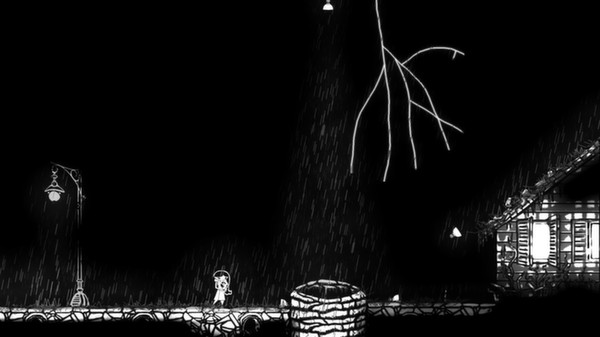 Rain at night: a lit street lamp and a few white branches are all that shows — Steam store screenshot
Putting the Mechanics into Words
The verbs are countable: walk, jump, pick up and set down a glowing orb (one at a time), swivel a wall lamp, carry a key or push a box. The grammar is a single line — what is lit exists, what is not does not. When positive reviews keep saying minimal, clean, simple but deep, they are describing verb subtraction. Colour, text and UI are all gone, and one line carries everything.
The negative side gives that same line a different name: obfuscated; it takes a while to work out what I am even looking at; the hardest part is deciding whether what you are attempting is possible at all. That is not merely taste. Most puzzles show you the board and hide the move; this one hides the board. So the player's first job is not solving but drawing the board — a step of raising observation resolution inserted ahead of thought.
Where it works, the pool is specific. Carrying only one thing at a time makes the placement of the orb the puzzle. Walk past a wall with light and the wall exists for that moment, then stops. Swivel a lamp and a floor becomes a moving floor. Reviewers list the derivations themselves: a travelling light works as an elevator, a transporter lights two places at once. New levels without new verbs — here that policy holds.
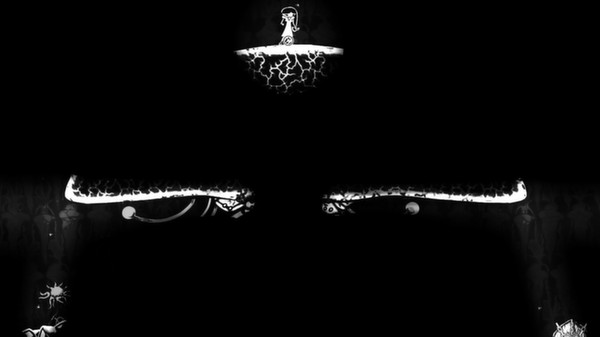 A round orb resting on a narrow lit ledge, with a figure standing on a disc-shaped platform above — Steam store screenshot
The Texture of Difficulty
On difficulty the positive side splits against itself. The single most-upvoted recommendation says the levels were a bit on the easy side, kept too minimal, that more could have been done with the gimmick. Another positive review says the game messes with your head, that it is so hard many players never finish. Upvoted recommendations rarely point this far in opposite directions.
Collect where reviewers got stuck and the difficulty separates into three. First, reading the board — guessing what sits in the dark. Second, composing a solution — light overall, and even the negative side agrees the puzzles themselves are not hard. Third, executing — jump precision, and carrying an orb or key without losing it. The 'hard' camp means the first and third; the 'easy' camp means the second. The verdicts invert because one word is measuring different things.
Failure cost amplifies all three. There is no rewind and no undo. Drop an orb into the dark and it is gone; lose a key and the level restarts. Several pans say a minor error forces a full repeat, and one asks openly for a Braid-style rewind. Set against Baba Is You, which made undo part of its grammar, the contrast is clean: there, unlimited attempts at thought; here, weight on every move. But that weight lands just as hard on a move of execution as on a move of thought — and that, I think, is the main fault line.
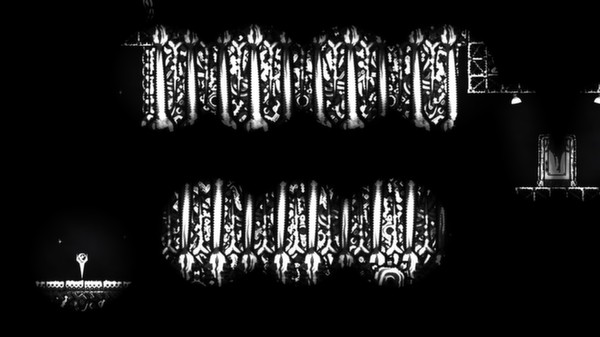 Two rows of lit column-like structures, with a door visible at the right — Steam store screenshot
Feel of the Controls
The negative vocabulary clusters on the controls: clunky, slow movement, jump height barely passable, scalpel-precision jumps required, item babysitting. One pan names the structure in a sentence — a puzzle platformer where the puzzles are easy and the platforming is clunky. Verbs of thought and verbs of execution share one board, so a second gate of dexterity waits after the solution is already known.
The positive side mostly shrugs at this. It calls the game intuitive and praises the fact that you can play fifteen minutes, clear a level or two and come back. The same control scheme reaches one group as a gate and the other as convenience. The levels really are short; how much failure you will absorb is what the split is measuring.
A separate layer feeds the distrust: bugs. Falling through the floor forever, failing to launch, crashing — reported concretely in pans from 2017 and 2021, and hedged even in a 2025 recommendation that calls it a short fun puzzler as long as it does not crash. The store notes Apple Silicon is unsupported; Steam Deck, meanwhile, is rated Playable (tested 2026-08-05). Design gates and implementation gates need separating here, and reading the pool carefully means doing that work.
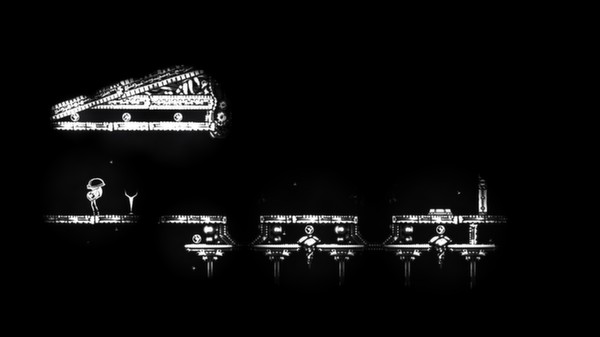 Separate platforms floating in darkness, with an angled machine at the upper left — Steam store screenshot
Sources
Written by reading the user reviews on the Steam store page as of 2026-08-06. No review text is quoted directly; typical claims are reconstructed.
- Steam: Closure (Very Positive; 848 of 994 reviews positive across all languages, about 85%, with 146 negative. The store displays the Steam-purchaser subset: 85% of 445)
- Read: the top 13 helpful positive reviews, the top 12 negative, and the 9 most recent (community review listing plus Steam's appreviews data)
- Compared the press scores quoted on the store page (Metacritic 78, IGN 8.5, Joystiq 4/5, 1UP A-) against what users complain about
- Consulted the official store description (three human characters, developer commentary, no Apple Silicon support) and the Steam Deck rating (Playable, tested 2026-08-05)
Closing
Steam reads about 85% positive across all languages; my design-critique score is 7.5. Credit for the idea of hiding the board itself behind a one-line grammar, and for deriving new levels without adding verbs. Marks off for never building anything — rewind, hints, or finer checkpoints — to absorb the observation cost that one line creates. The gap between the numbers lives there: the first is sharpness of premise, the second is finish, and % positive catches the former far better than the latter.
Playtimes shown on reviews cluster between 8 and 16 hours, with a median around nine; some writers quit inside an hour, one logged twenty-four. Reviewers do not even agree on the level count — some say 82, others over a hundred. Recent reviews are calmer, filing it as a forgotten puzzle game, or a short eerie one worth trying for the light mechanic alone.
Who it suits is unusually legible. Anyone who can take darkness as a question rather than as missing information, who enjoys drawing the board before solving it, and who is forgiving about the hands after the head is done. Anyone who can accept failing at thought but not being sent back a whole level for failing at execution will stay annoyed to the end. The pool splits over one word because the game bet everything on that word — not because it betrayed anyone's taste.
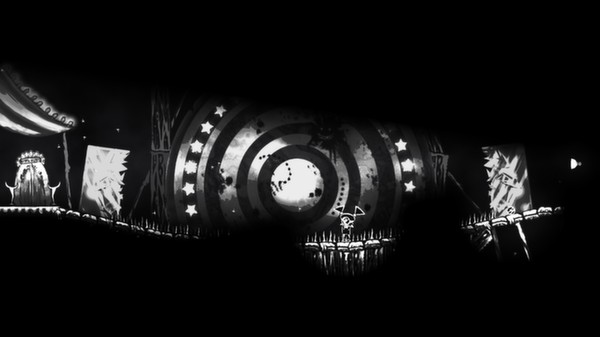 A circus stage with a large round backdrop of spirals and stars — Steam store screenshot
Where are you with this game?
Press one and the game goes on your shelf. You can see it on your account page.
Reactions (no login)
Anonymous • one of each per visitor per day
Read next
Related reviews
Vessel
A 2D physics puzzle-platformer where a single liquid-spraying backpack lets you move water, lava and glowing protoplasm, and grow living liquid creatures called Fluros to repair a machine-run world. Set across a foundry, orchard and mines, Strange Loop Games builds its grammar out of fluid simulation rather than a grid.
Quantum Conundrum
A first-person physics puzzler in which a boy searches a deranged mansion for his missing inventor uncle, armed with the Interdimensional Shift Device. Swap between four dimensions — Fluffy makes heavy things weightless, Reverse Gravity flips the pull, Slow slows time — and bend boxes and physics to clear each room. Built by Portal's lead designer Kim Swift (as reported) and published by Square Enix.
Thomas Was Alone
A 2D puzzle-platformer in which you switch between coloured rectangles, each given exactly one ability, and combine them into stepping stones across 120 levels. A narrator reads out what the shapes are thinking as you go. Released in 2012 by Mike Bithell's Bithell Games.


