REVIEW · 2013-09-03
Brothers - A Tale of Two Sons
One thumbstick per brother — the board is easy because the hands were made hard
First Impressions
Start with the numbers. The Steam store page reads Very Positive: 94% of 16,387 reviews, as of 2026-08-27. SteamDB, which counts every language, shows roughly 41,000 reviews at 92.58%. That is a lot of votes for a 2013 game.
I read the ten most helpful positive reviews. What struck me is how rarely the word puzzle appears. What appears instead is crying, short, two thumbsticks, brothers. Only one of the ten says anything about the pleasure of solving.
The ten most helpful negative reviews read differently. Five of them call the puzzles far too simple. The top negative review, with 746 votes from November 2013, grants the visuals and then dismisses the puzzles as oversimplified and the ending as orchestral scaffolding.
So both sides agree on the fact: the board is easy. What splits them is whether that is a flaw or a precondition. That single question is what I want to follow through this pool.
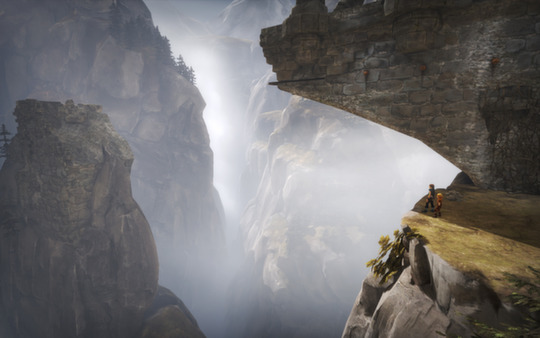 Brothers - A Tale of Two Sons — Steam store screenshot #1
Feel of the Controls
The control scheme is stripped to almost nothing. Left stick moves the older brother, right stick the younger, and each trigger makes that brother touch whatever is in front of him. The store blurb calls it co-op play inside a single-player game.
The top Japanese reviews put the machine into words more carefully than the English pool does. One says the dual control makes precise movement impossible, and that this is exactly what lets the puzzle design work. Another adds that it looks hard but never actually gets hard.
In my own vocabulary: there are two verbs, move and touch. The verb count has been cut. But both verbs run twice over, at the same time. What the player spends is not thought. It is divided attention.
Both pools keep repeating the same warning: you need a gamepad. A design that dictates your input device would normally count against it. The reason it does not count much here shows up in the next section.
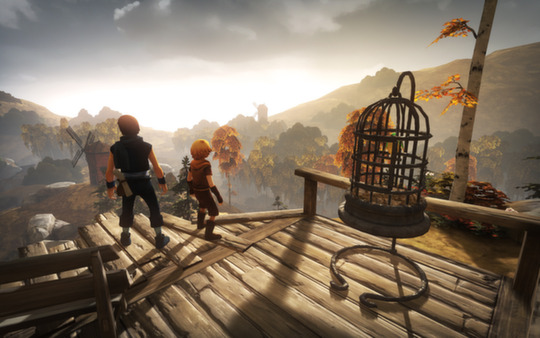 Brothers - A Tale of Two Sons — Steam store screenshot #2
The Texture of Difficulty
The negative side is factually right. You almost never get stuck. One brother braces a ladder, one goes ahead and throws a rope, the older turns a lever while the younger slips through a gap. The next step is usually visible at a glance, and checkpoints are generous.
The positive side does not dispute this. Good difficulty for playing with a child. Modest challenge. Same fact, different temperature. As I argued in is difficulty unkind, the presence or absence of difficulty is not itself a verdict. What it is there for is.
This is where that Japanese review earns its place. With two sticks running at once, precise movement is off the table. So the board had to be easy. The currency of difficulty has been moved out of the head and into the hands.
It is the structure I described in when the control scheme sets the difficulty, pushed to an extreme. Raise the complexity of the board and it adds to the load on the input until the whole thing collapses. One side had to come down. Too simple is the visible face of that decision.
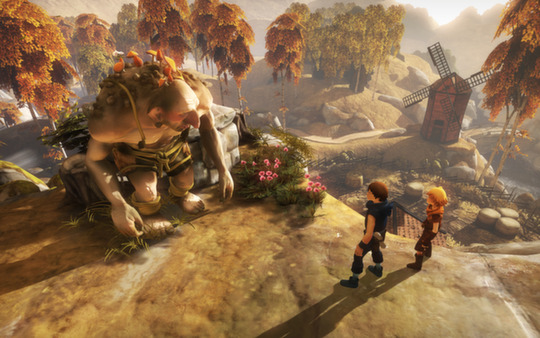 Brothers - A Tale of Two Sons — Steam store screenshot #3
The Feel of the Story
Every line is spoken in an invented language, with no subtitles. Even so, seven of the ten most helpful positive reviews are about the story. The top one, with 832 votes, puts it as: the words are made up and it lands anyway.
The negative side pushes back here too. The 746-vote review says the ending has no dramatic core. A 39-vote review says the characters never earned its sympathy. Predictable is the word the negative pool keeps reaching for.
What caught my attention is something else. When positive reviewers reach the ending, most of them describe it as the controls turning into meaning. They do not say what happens. They point at a structure: what your fingers have been doing all along gets collected at the end.
By the split I drew in puzzles with stories and puzzles without, the story here does not sit outside the puzzle. The form of the input belongs to the story. That is where it parts from a comparably wordless design like RiME.
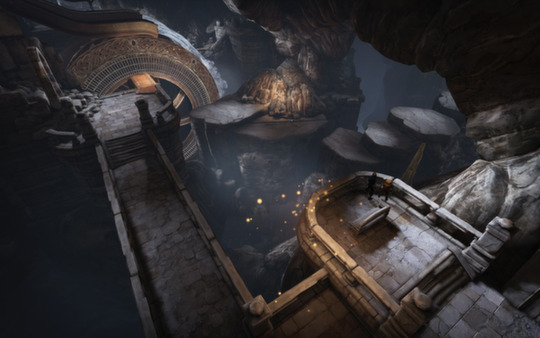 Brothers - A Tale of Two Sons — Steam store screenshot #4
Place in the Lineage
The second most helpful positive review, 566 votes from 2017, is about sharing one controller with a son. Father on one stick, child on the other. The game is designed for one player. The reviewer simply re-read it as a two-player game.
The second most helpful negative review, 105 votes from 2023, is a single line: why is there no co-op. The same wish sits near the top of both columns, once as a discovery and once as a complaint.
On 28 February 2024 a remake by the Italian studio Avantgarden shipped on its own store page, and that version does have proper co-op. The request landed eleven years later. One of the most recent reviews here, though, tells people not to play the remake.
As I set out in the grammar of solving together, co-op puzzles work because control and information are split between two people. This game staged that split inside one person. Hand it to two, and the split closes. It is the opposite move from The Gardens Between, which draws two characters and binds them to a single input.
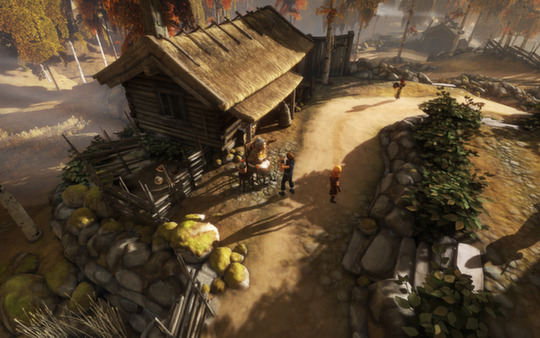 Brothers - A Tale of Two Sons — Steam store screenshot #5
Sources
This piece was written from the Steam user reviews as they stood on 2026-08-27.
· Steam: Brothers - A Tale of Two Sons (Overall 94% positive, 16,387 reviews, Very Positive; last 30 days 78% of 23)
· SteamDB (about 41,000 reviews across all languages, 92.58% positive)
· Read via WebFetch: the top 10 helpful positive, the top 10 helpful negative, the 8 most recent, and the top 10 helpful Japanese-language reviews
· Metacritic (PC 90 from 9 critics; Xbox 360 86 from 56 critics, user score 8.3 from 602 ratings)
· Wikipedia (director, engine, over 800,000 copies sold as of January 2015, the remake of 28 February 2024)
· Images are the screenshot URLs returned by Steam's appdetails API, used verbatim. The image CDN is not reachable from where this was written, so their contents were not inspected; the captions state only the asset type and store order.
Closing
The aggregates line up: 94% of 16,387 on Steam, 92.58% of about 41,000 across all languages, 90 from nine PC critics and 86 from fifty-six on Xbox 360.
I give it 7.6. As a puzzle game it offers little resistance, and the negative reviews are right about that. What keeps the score up is that this game answers a real question — where do you put the difficulty — and answers it clearly.
Not on the board. In the hands. And then it turns that decision into meaning in the closing scene. Over 800,000 copies by January 2015 and a BAFTA for Best Game Innovation in 2014 are not, I think, credit owed to the art and the story alone.
It suits someone who wants to walk a wordless three-to-five-hour game to its end without getting stuck. It does not suit someone who wants to be made to think on the board. The review pool has been drawing that line, quite accurately, for over a decade.
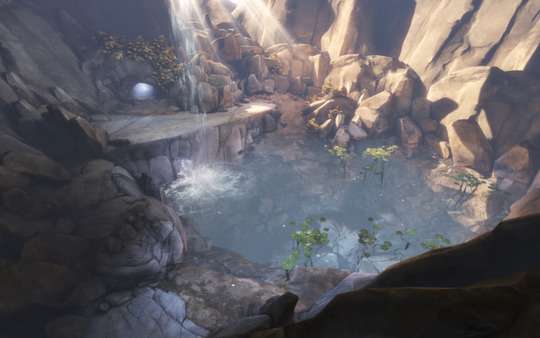 Brothers - A Tale of Two Sons — Steam store screenshot #6
Where are you with this game?
Press one and the game goes on your shelf. You can see it on your account page.
Reactions (no login)
Anonymous • one of each per visitor per day
Read next
Related reviews
Thomas Was Alone
A 2D puzzle-platformer in which you switch between coloured rectangles, each given exactly one ability, and combine them into stepping stones across 120 levels. A narrator reads out what the shapes are thinking as you go. Released in 2012 by Mike Bithell's Bithell Games.
Trine 2: Complete Story
A side-scrolling physics puzzle-platformer in which you switch between a knight, a thief and a wizard, conjuring boxes and planks to get past each obstacle. Made by Finland's Frozenbyte, the Complete Story edition bundles the main campaign with the Goblin Menace expansion and an extra level.
Escape Goat
A 2D puzzle platformer in which a goat escapes a prison, collecting keys and opening doors with a mouse that fits small gaps and a magic hat that swaps their places. By MagicalTimeBean.


