ESSAY · 2026-09-16
The Verb of Overlaying — When Two Images Become One Meaning
Gorogoa, Moncage, and Storyteller — three ways to let the “seam” hold the answer
Introduction
Some puzzle games make “overlaying” the verb. The player only ever moves, rotates, or places an image. The answer is never made by that hand — it lives at the seam where two images touch.
The site's mechanics vocabulary calls this Panel Composition: overlay and slide illustrated panels so new meaning emerges at the seam. Exactly three catalogued games use it: Gorogoa, Moncage, and Storyteller (as of September 2026).
The three treat the seam differently. Gorogoa overlays flat windows. Moncage overlays cube faces. Storyteller builds its seam along the order of panels in time, not space. Comparing them exposes what makes a “seam” hard to design.
Gorogoa — the image you move becomes another image's window
Gorogoa is a panel-composition puzzle game Jason Roberts began building alone in 2011 and released after roughly six years, on December 14, 2017 (per Wikipedia, as of Sept 2026). The player's verbs are just two: move an image, and zoom it.
Up to four images share the screen. Move one over another and it becomes a mask, revealing the image behind through its own outline. When a tower's silhouette lines up with a window frame in another scene, the two become one connected space.
The rule barely translates into words. There's no open, push, or carry — only whether one image's outline matches another's. The player spends most of their time comparing silhouettes, not memorizing steps.
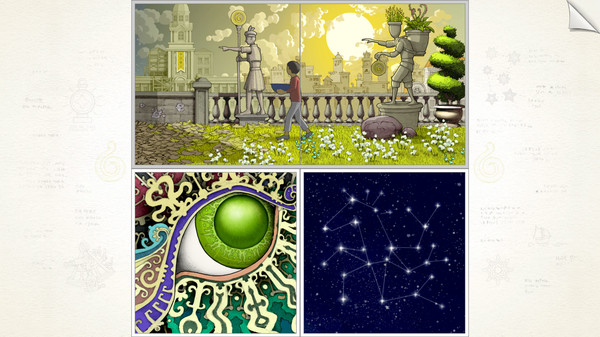 Gorogoa (from the Steam store page)
Moncage — five faces lock together the instant the view lines up
Moncage is a panel-composition puzzle from the Chinese studio Optillusion, released November 15, 2021. Its verbs are even fewer: rotate the cube, touch, lean in, and check what's lit.
The whole board is one cube, each face showing a different place. A ladder on one face and a matching grid of the same shape and color on the next face lock together the moment their outlines align at the seam.
It plays differently from Gorogoa, though. With only five faces and few adjacent pairs ever visible at once, brute-force rotation eventually finds every seam. As I noted in my own review, that small search space is exactly what splits players into delighted and bored.
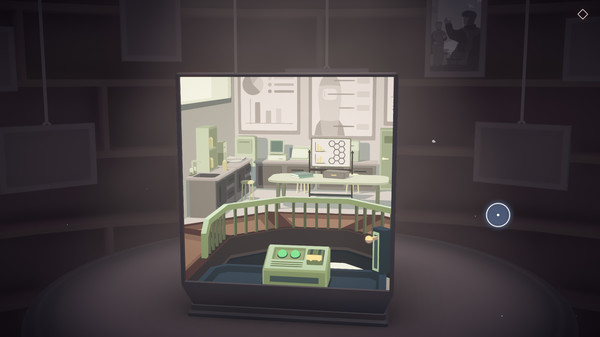 Moncage (from the Steam store page)
Storyteller — the seam runs between panels in time, not in space
Storyteller is a panel-composition puzzle Daniel Benmergui built over roughly fourteen years, releasing it for Switch and Windows on March 23, 2023. The player's one verb is placing a character or scene into a panel.
Whatever gets placed reacts automatically to the panel beside it. Drink poison and you die; witness a death and someone grieves; grieve and someone else steps in to console them. The player writes causes, never the outcome directly.
Gorogoa and Moncage build their seam on space — matching outlines. Storyteller builds it on time — the order of panels. That's why it alone allows multiple valid solutions: any arrangement counts, as long as the story it produces means the same thing.
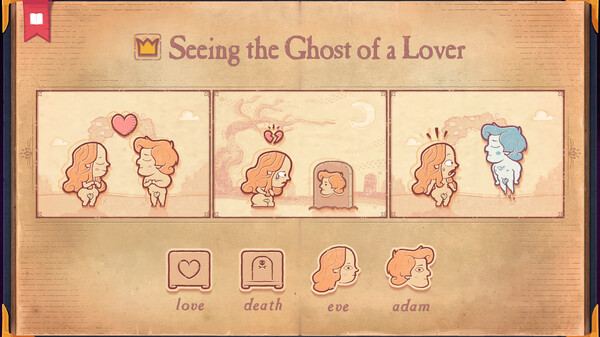 Storyteller (from the Steam store page)
Why the answer lives in the seam, never in the player's hand
Line the three up and the verbs themselves look almost trivially simple: move, rotate, place. What actually creates difficulty is how large the space of candidate seams is.
Exactly three catalogued games on this site carry the panel-composition mechanic (as of September 2026). Two of them, Gorogoa and Moncage, judge the seam by visual match — brute force eventually works. Storyteller alone judges it by causal meaning, which no blind search can shortcut.
That gap isn't explained by verb minimalism alone. Whether a seam is judged visually or semantically changes the feel of the whole puzzle. These three sit right next to the site's essay on observation as play.
Closing
Gorogoa, Moncage, and Storyteller all tell the player the same thing: find the seam. None of them explain the answer in words — you keep looking, trusting that meaning sits somewhere between two images. In that sense, all three are less about the verb than about the resolution of your own observation.
If I ever design with this verb, I want a game that switches how the seam is judged partway through — visual match early, meaning-only match late — and hides, for as long as possible, the moment a player realizes brute force stopped working.
Reactions (no login)
Anonymous • one of each per visitor per day
Part of these series