REVIEW · 2016-11-28
Quern - Undying Thoughts
Reading the Steam reviews of the island puzzler hailed as Riven's heir
First Impressions
A first-person puzzle adventure: teleported to an island with no way back, you open some fifty doors by combining gears, crystals and alchemy. Zadbox Entertainment, a four-person studio, shipped it in 2016. I write this from the Steam review pool: 'Very Positive,' 90% of 2,523 English reviews, ~91% across 4,002 in all languages (snapshot 2026-07-20). Metacritic 83.
Across the helpful positive reviews the most frequent proper noun isn't a genre or the studio — it's Myst, and above all Riven. 'The best modern Myst-like,' 'the Riven we never got.' The vocabulary rhymes: logical, no guessing, a-ha moments, and 'the world builds on itself.' PCWorld called it 'the closest we may ever come to a Riven sequel.'
The negative side keeps returning to moon logic, obtuse, tedious, and 'the world is too big with nothing in it.' The same thin hinting reads as elegant to one camp and unfair to the other. My job isn't to stage that as a fight but to translate where the split happens into design terms.
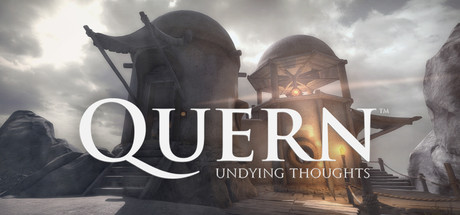 Quern - Undying Thoughts — Steam store key art
The World
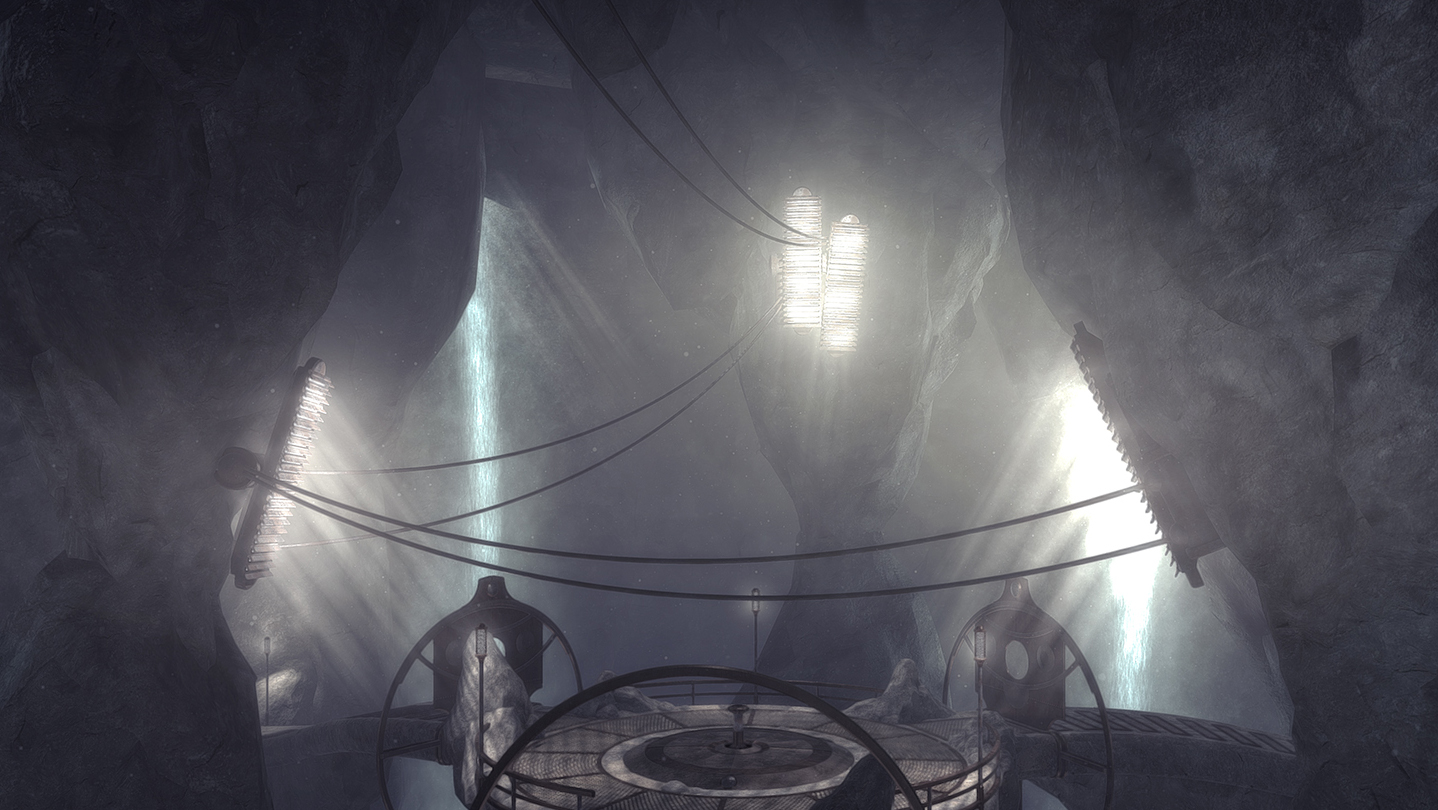
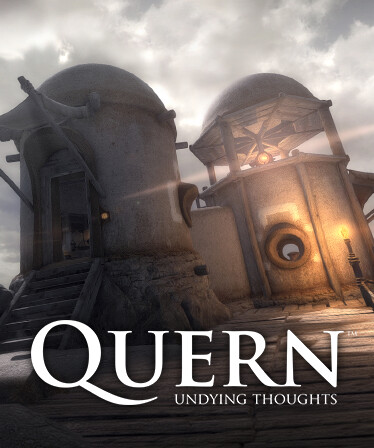
What the positive reviews praise first is the island itself: bleached adobe huts, weary copper machinery, ambient sound and soft light. More than one reviewer says it recalls Riven's jungle village, and PCWorld notes it 'reeks of Cyan's mid-'90s output.' Here the developer's 'immerse yourself in the scenery' and the players' experience agree.
But the same world reads the other way too. Several negatives call it 'too big, mostly empty corridors,' 'grey and drab after five hours.' Even a recommending review adds 'it lacks colour.' What splits here isn't the visuals but the density of space — is the distance between puzzles atmosphere, or emptiness?
In Puzzlebyrinth's terms this is a question of observation resolution. Read the island at high resolution — doors, machine fragments, faint marks on the floor — and the corridors are full of information; read it low and they are blank. Riven and Obduction split players on exactly this line.
 Quern - Undying Thoughts — Steam store background art
Putting the Mechanics into Words
The core of every positive review points at one thing: a puzzle you solved comes back later wearing a different face. One reviewer calls it 'Metroid crossed with a quest,' another 'the world building on itself.' The developer's own line — 'reusable puzzle mechanics that make you think about the game as a whole' — matches the pool here rather than overselling.
In Puzzlebyrinth's terms this is verb reuse: the whole island woven as one grammar. If each puzzle is a word, its solution isn't spent once but folded into a later sentence. Where most Myst-likes are a string of one-room clauses, Quern uses the answer to the previous sentence as the subject of the next. That consistent grammar is why the positives keep saying 'trustworthy.'
The same reuse flips, though: the negatives complain of 'holding seven unsolved puzzles in your head while running across the island.' A grammar spread over the whole map inflates the cost of finding which rule applies where — a grammar that bites through breadth, not depth.
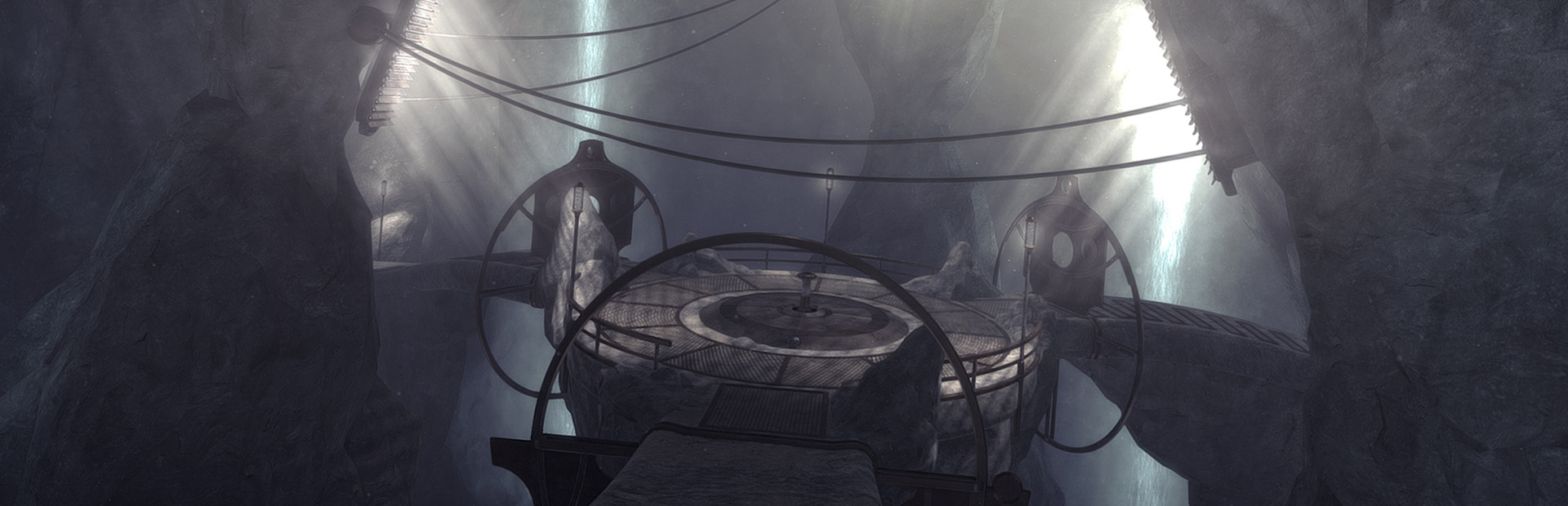 Quern - Undying Thoughts — Steam library hero art
The Texture of Difficulty
Difficulty is where opinion splits hardest. 'Everything is logical, no guessing' sits beside 'the late solutions are unfairly opaque and I quit,' about the same island. Sorting the negatives and qualified positives, the stuck points fall into three kinds.
One: puzzles that become transcription — translate an upside-down template through a 16-symbol table and enter it, all busywork. Two: spatial search — 'where does this part go?' brute-forced on foot, where most negatives cluster. Three: a few genuinely opaque puzzles — the sound frequencies, the stone wheel, the alchemy book — that even top reviewers flag as needing a fix.
So most complaints are about the kind of difficulty, not the amount: working memory and travel, not puzzle depth, muddy the texture. The gap between the store's 'Relaxing' tag and a recent 'rage quit' lives here. That isn't a flaw so much as a matter of design range — like The Witness, it draws its line and leaves the one-and-done crowd outside it.
 Quern - Undying Thoughts — Steam library capsule
Sources
This piece was written by reading the user reviews on the Steam store page as of 2026-07-20. No review text is quoted directly; typical claims are reconstructed.
- Steam: Quern - Undying Thoughts (Very Positive, 90% of 2,523 English reviews, ~91% of 4,002 across all languages)
- Read via WebFetch: the top 11 helpful positive reviews and the top 10 negative (recently updated, including 2026 reviews)
- Press: PCWorld, plus Adventure Gamers (4/5) and Metacritic 83
Closing
Steam reads 'Very Positive' at 90%; my design-critique score is 8.0, close to Metacritic's 83. The core achievement — verb reuse, weaving solved contraptions into one island-wide grammar — pushes the Myst-like past its string-of-clauses past. The marks come off for the search-and-memory cost that breadth adds to difficulty, and for the handful of genuinely opaque late puzzles.
What lingers after the pool isn't the 90% but how sharply the game sorts its audience. For anyone who wants to read an island as a single machine — who wants the feel of Riven or Obduction again — it's still among the best. For anyone after quick one-and-done puzzles or narrative momentum, the size and grey corridors will catch their feet. The split is the reverse side of its reach.
 Quern - Undying Thoughts — Steam store key art
Reactions (no login)
Anonymous • one of each per visitor per day
Read next
Related reviews
Obduction
Touch an artifact that falls from the night sky by a lake and you are flung to an alien landscape stitched from fragments of Earth across times and places. Walk, observe, and solve the machinery linking world to world to find your way home—a first-person adventure from Cyan, the studio behind Myst, that makes observation its only verb.
Poly Bridge
A 2D physics puzzle in which you span two banks on a fixed budget, using a handful of parts — wood, steel, cable, hydraulic pistons — to carry cars and buses across. Alongside its campaign, Dry Cactus adds a sandbox and Workshop for sharing your own bridges.
SHENZHEN I/O
A programming puzzle in which you play an engineer at a fictional Shenzhen firm, writing terse assembly for cramped virtual microcontrollers and wiring circuits onto a board to build client products. Zachtronics ships no tutorial — its 30-plus-page datasheet manual is the first puzzle.