REVIEW · 2024-05-22
Isles of Sea and Sky
An oceanic open-world Sokoban built from a single verb
Introduction
Isles of Sea and Sky is an oceanic open-world Sokoban: you wake as a memory-less castaway on a tropical island and slip past traps and portals using blocks you can only push. You ride a turtle between islands and read a wordless myth told through terrain, statues and light. It was made in 2024 by the small US studio Cicada Games (Jason Newman) and published with Gamirror Games.
To be clear, this is not a record of my own playthrough. It is a meta-review: I read the Steam review pool and parse it through Komugi's design vocabulary. The numbers: Very Positive overall, 92% of 1,361 Steam-purchaser reviews (snapshot 2026-06-30), 89% over the last 30 days, Metacritic 85.
What's striking is that although only 104 reviews are negative, their complaint converges almost to a single point. Below I first gather what each side is actually pointing at, then translate it into verbs, grammar, subtraction, the learning curve, observation resolution and a design's reach.
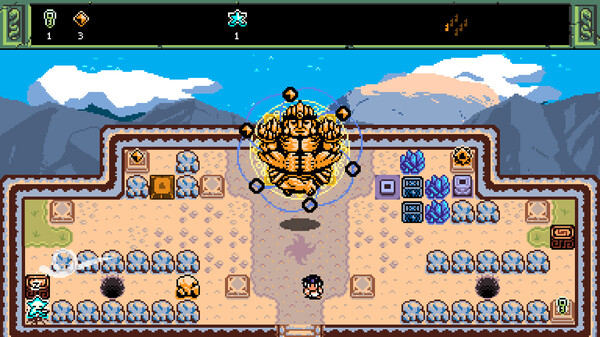 Crossing the sea by turtle, island to island — Steam store
First Impressions
Reading through the helpful positive reviews, the first thing I received is how tightly the first impression converges. "The 16-bit look fooled me; underneath is a bottomless thinker" appears again and again, as does "box-pushing dragged into the modern era." GMTK and others single out the pleasure of hopping between modes of play.
Where most puzzle games scatter praise and complaint across many points, here both sides are pulled toward one verb and one structure. A high-resolution, easy-to-read review pool.
That convergence is itself a sign of a sharp silhouette. The 1,361 positives and 104 negatives are written about the same two places, not different ones — which is exactly why they are worth opening in turn.
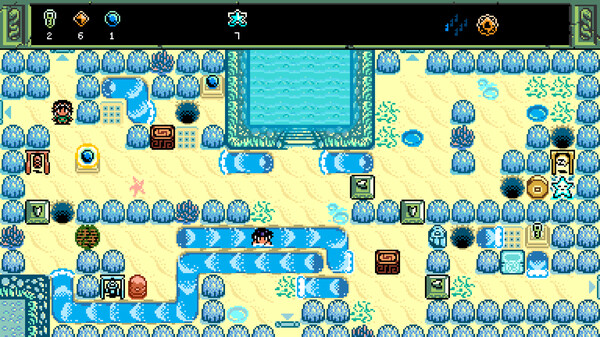 A thinker beneath the 16-bit surface — Steam store
Putting the Mechanics into Words
Positive reviews and the press (Thinky Games) agree on one thing: all you can do is push. No pulling, no throwing, no carrying. Spikes, portals, one-use planks and lava pile up, but your only verb stays push to the very end.
This is verb subtraction taken to its extreme. As Sokobond and Stephen's Sausage Roll showed, the fewer the verbs, the heavier each move. A box shoved against a wall can't be pulled back; because moves are irreversible, the board becomes something you read, not something you fiddle with.
On top of that, each island changes the grammar — water streams and flow-bending jelly, lava and obsidian. When positive reviewers say it "feels constantly new yet continuous," that is a carefully tuned combinatorial explosion: one constant verb, many shifting grammars.
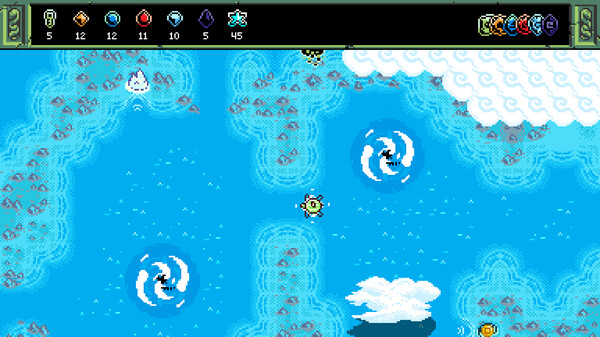 One verb, push; the grammar changes per island — Steam store
The World
Nearly every positive review and outlet mentions the atmosphere: "South Pacific," "a wordless creation myth," "meditative." Many describe riding a sea turtle between islands in concrete detail.
Thinky Games invokes The Witness — "you start seeing puzzles in everything." That is where this game's observation resolution lives. With text stripped away, the terrain, the statues, the path of a dragonfly all become clues.
The store page calls it "relaxing" and "approachable." The top positive reviews happily hold "relaxing" and "harder than expected" in the same sentence. My read: the atmosphere works as a cushion that softens the tension.
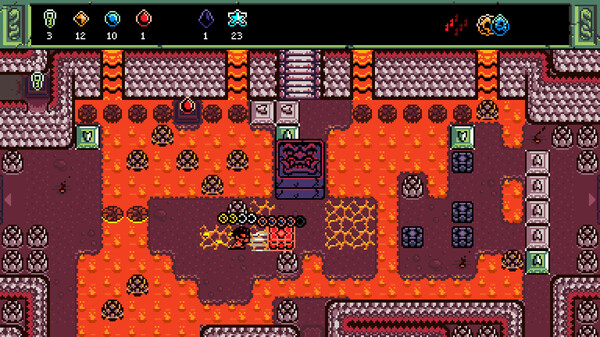 A wordless South Pacific myth — Steam store
Design Craft
The open world is where opinion splits hardest. The developer's store text says: stuck? Go to another island. A pressure valve against getting roadblocked. Thinky Games agrees — the open structure is meant to make the game easier, not harder.
Yet most of the 104 negative reviews strike exactly here: "I can't tell whether a puzzle is solvable now or needs an ability I haven't unlocked," "the map carries almost no information," "travel between islands is slow." The same openness reads as freedom to one side and as lost bearings to the other.
I see this not as good-versus-bad but as a question of design reach. Linear puzzlers prop up the learning curve by guaranteeing a next problem. This game drops that guarantee and hands progression over to the player's observation resolution. Where A Monster's Expedition minimized wandering on its connected islands, this one folds the wandering into the experience itself.
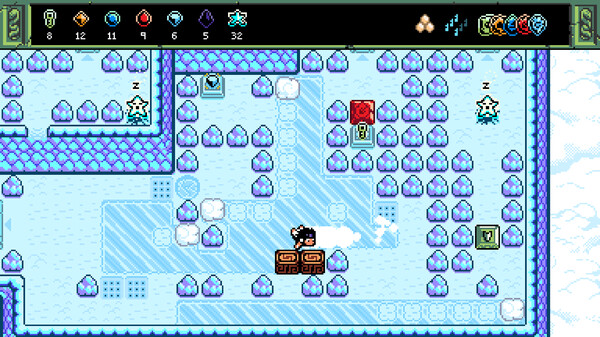 The open-world structure of island-hopping — Steam store
The Texture of Difficulty
"Just right" and "unfair" split cleanly. The top negative reviews are specific: around the third island, Frozen Spire, difficulty leaps from 2-3 to 8-9. Mechanics from several islands tangle at once, and there are no free experimentation rooms — you must force first-time interactions on crowded boards. One detailed review called a blue-box-and-portal solution "moon logic" and "brute force."
I split the complaint into three textures of difficulty. One is the combinatorial kind (grammars crossing) — the design's core, welcome. Two is the signposting kind (you can't read from the board whether a puzzle is solvable yet) — the side effect of subtracting too much information. Three is the input kind (the avatar moves fast, inviting slips), which undo mostly rescues. What the negatives truly stab at is almost entirely the second.
Some recent reviews note that updates added obstacles, so old solution videos no longer match and progress stalled. Long-term support is a virtue, but it can also fracture the learning curve of an existing save — a double edge.
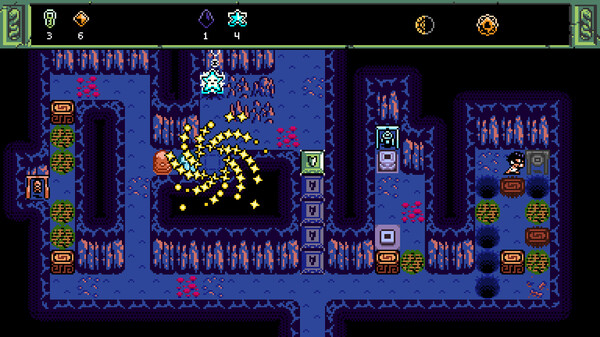 Boards where island mechanics cross — Steam store
Reviews Consulted
This article was written by reading the Steam user reviews as they stood on 2026-06-30. No review text is quoted; typical claims are reconstructed.
· Steam: Isles of Sea and Sky (Very Positive overall, 92% of 1,361 Steam-purchaser reviews, 89% over the last 30 days / 46).
· 20+ reviews read via WebFetch across helpful-positive, helpful-negative and recent (positive returns to art, experimentation, relaxing; negative to obtuse, moon logic, open-world disorientation).
· Press: Thinky Games — Isles of Sea and Sky review (Rick Lane).
Closing
Steam sits at 92% positive (1,361 reviews, 2026-06-30 snapshot). From a design standpoint I give it 8.4. The gap: the aggregate prizes the purity of the single push verb and the South Pacific mood, and I agree there — but I dock points for subtracting so much signposting that the board never tells you whether a puzzle is solvable yet.
Who it's for is clear: people who can enjoy the wandering through sheer observation, who solved The Witness or Sokobond bare-handed. Not for those who want a linear guarantee of a next problem. Reviews cite roughly 15-20 hours to finish, far longer for the 120-star completion; difficulty divides sharply by player.
Pulling this much grammar out of the single word "push" is the real thing. The pity is that it never wrote onto the map when each grammar can be learned. The split in the reviews turns on exactly that one point.
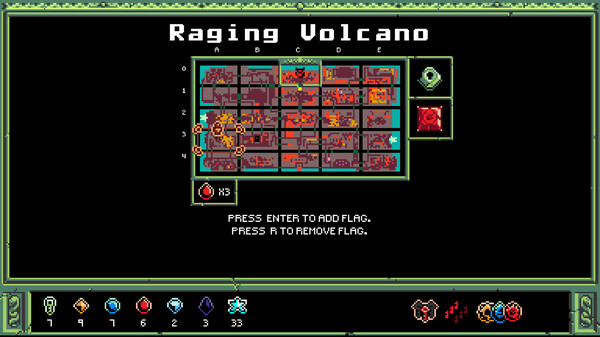 A labyrinth grown from a single verb — Steam store
Where are you with this game?
Press one and the game goes on your shelf. You can see it on your account page.
Reactions (no login)
Anonymous • one of each per visitor per day
Read next

Related reviews
Paper Trail
A top-down puzzle game in which the screen is a sheet of paper: fold it over and the terrain on the reverse joins the front, building a path for Paige as she journeys through a hand-drawn world. From Newfangled Games.
Riven
Cyan Worlds' own ground-up 3D remake of the 1997 classic — a first-person puzzle adventure with no hints and no highlighting, where you walk a collapsing island and read its water, machines and D'ni number system to unlock its secrets.
ANIMAL WELL
A puzzle-box metroidvania: hatch from a flower and descend a dense, interconnected 2D labyrinth. You do not fight — you combine multi-use tools and notice things (a hole in a wall, a picture in the background) to solve it. Past the ending lies a layer of secrets only a community can crack, made largely by one person, Billy Basso.

