REVIEW · 2020-08-03
Relicta
Reading the split verdict on a lunar magnetism-and-gravity puzzler
Introduction
You play Dr. Angelica Patel, a physicist on the lunar Chandra Base, carrying cubes with gloves that bend magnetism and gravity, dropping the energy fields that seal each door. After an accident scatters the crew and her daughter, the story unfolds over radio chatter. A first-person physics puzzler made by Spain's Mighty Polygon and published by Ravenscourt in August 2020.
I write this from the Steam review pool. The label is 'Mostly Positive,' 77% of 227 Steam-purchaser reviews (snapshot 2026-07-01); count all 466 and it slips to about 67%. Metacritic sits at 74, OpenCritic averages 75 yet only 47% of critics recommend it. The numbers are middling, and the opinion underneath them splits.
The proper noun almost every review reaches for is neither the studio nor a genre: it is 'Portal.' I've written about Portal and The Turing Test here too. This is a game read through comparison, so I'll read it comparison and all.
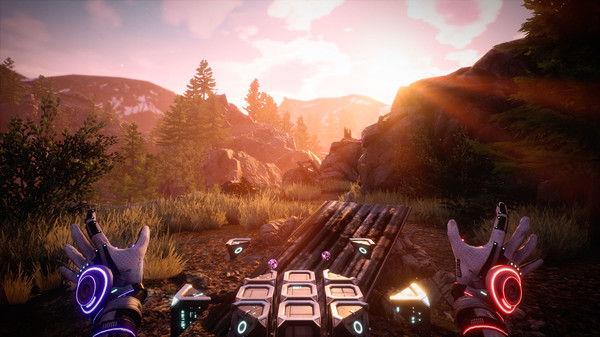 Relicta — Steam store
First Impressions
Line up the helpful positive reviews and the vocabulary rhymes: gorgeous, 'astonishing visuals,' clever, and 'you get to feel like Magneto, surfing a cube through the air.' Most praise the beauty of the lunar biomes and puzzles that stack physics into thinking several steps ahead — then close with 'buy it on sale.'
The negative side and the qualified positives keep returning to: overstays its welcome, repetitive, tedious, 'artificial difficulty,' plus invisible walls and janky physics. Many add it could have been half as long. Years on, even recent reviews barely move the talking points.
What interests me is how often praise and complaint point at the very same thing. One reviewer's 'meaty back half' is another's 'just long.' One reviewer's 'detailed world' is another's 'invisible walls everywhere.' My job isn't to stage that as a fight, but to translate where opinion forks into design terms.
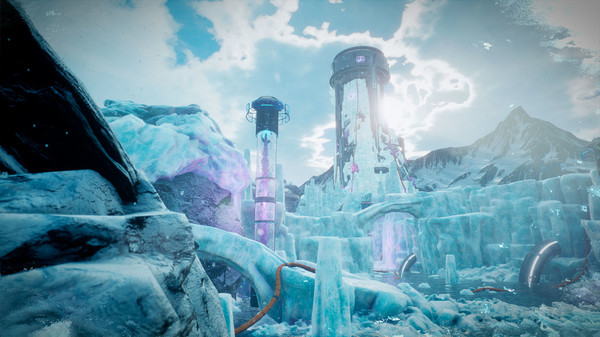 A lunar biome on Chandra Base — Steam store
Putting the Mechanics into Words
There are two verbs. One recolours a cube's magnetic polarity to red or blue — like colours repel, opposite colours attract. The other cancels gravity, so a cube floats and flies the way you push it (you can ride it). When positive reviews praise 'thinking several steps ahead,' they mean composing the magnetism grammar and the gravity grammar in your head.
But the helpful reviews name a design habit in unison: 'once a mechanic is introduced, it's used in nearly every level after.' The game never subtracts; it only adds. In Puzzlebyrinth terms, that's the opposite of subtraction. As elements pile up, the available moves grow exponentially — one reviewer calls it 'dozens of next steps to prune, so it feels like random fumbling rather than an aha.' That is combinatorial explosion, narrated live.
The store copy frames it calmly: a psychological thriller you can rush or take slowly. The helpful reviews report the opposite — the later levels don't calm down, they sprawl. That gap between the developer's pitch and the reviewers' experience is one of the game's real fault lines.
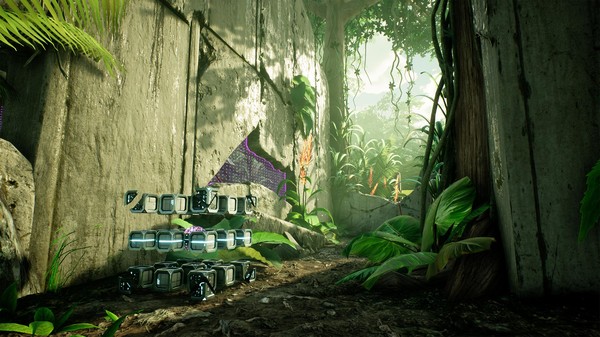 Red and blue cubes in a magnetic field — Steam store
The Texture of Difficulty
This is where opinion splits hardest, and it's about the kind of difficulty. The negative side's most repeated claim is 'it isn't getting harder, just longer' — a reading of padded difficulty. Several write that the back half builds bulk from level size and step-count, not density of thought.
A second common complaint is about observation. The cube or panel you need is often hidden somewhere in a large level, so you must wander and scout before you can even start. One reviewer notes, half-joking, that 'searching first' is the skill you have to learn. The difficulty axis quietly drifts from logic toward exploration.
To me it's the kind, not the amount. The learning curve rises by accretion, not insight. Outside its reach for anyone who wants quiet, tight logic; a virtue for anyone happy to walk a big board and grind it down like a chess problem. That's a different feel from the room-sized focus of The Turing Test or Lightmatter.
 A large, tangled late-game level — Steam store
Feel of the Controls
Here is the weakness pros and users agree on most: the floating physics can't be trusted. ScreenRant likens it to 'playing pool — line up the same move twice and get a different result,' and scored it 3.5/5. Steam users echo it: 'cap your framerate at 60fps or trajectories break, causing softlocks and restarts.'
The other issue is fiddliness. 'I have the solution in my head, but it takes 20 minutes just to land the cube where I want — there's no snapping, you eyeball it,' the helpful reviews say. The execution layer presses down on the thinking layer.
I read this as a broken contract. A puzzle's grammar should be deterministic: same input, same output. When physics depends on framerate or small jitter, that promise fails, and you can't tell a wrong idea from a wrong throw. Even fans append 'cap it at 60' — patching the contract by hand. The verb is appealing; its repeatability isn't guaranteed.
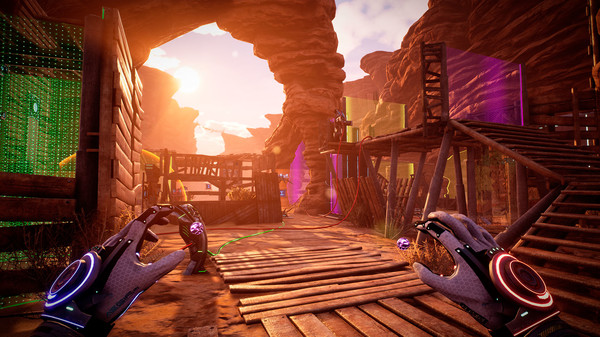 Riding a floating cube across a gap — Steam store
Sources
This piece was written by reading the user reviews on the Steam store page as of 2026-07-01. No review text is quoted directly; typical claims are reconstructed.
- Steam: Relicta (Mostly Positive, 77% of 227 Steam-purchaser reviews; about 67% across all 466)
- Read via WebFetch: the top helpful positive reviews, representative negative complaints, several recent reviews, and community threads
- Press: ScreenRant (3.5/5), plus Metacritic 74 / OpenCritic 75 (47% recommend)
Closing
Steam reads 77% positive; my design-critique score is 6.5, and the gap is the list of marks off. The two core verbs, magnetism and gravity, are clear, and the lunar biomes are as handsome as reviewers say. Three deductions: an additive design that never subtracts and tips into combinatorial explosion late; a difficulty axis that drifts from logic to searching and reads as padding; and physics whose repeatability isn't guaranteed, so the puzzle's contract wavers.
The pool's practical verdict is remarkably consistent: 'buy it on sale, cap it at 60fps, use a guide if you're stuck.' Completion runs about 10-12 hours for the story, 15-22 with collectibles and extras. Outside its reach for anyone wanting only quiet logic; well worth a discount for anyone who enjoys walking a beautiful moon and the sheer feel of flinging boxes with magnets. What you bring to it decides almost everything — and the split itself is what tells you so.
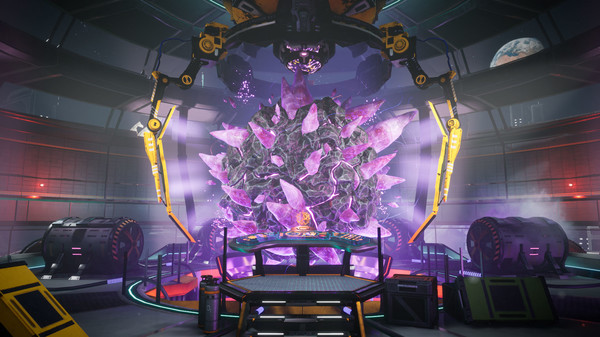 Relicta — Steam store
Where are you with this game?
Press one and the game goes on your shelf. You can see it on your account page.
Reactions (no login)
Anonymous • one of each per visitor per day
Read next
Related reviews
SUPERHOT: MIND CONTROL DELETE
The sequel to SUPERHOT, the first-person action puzzle where time only moves when you move. It drops the hand-built one-screen levels for randomly dealt rooms fought in runs, and adds abilities you pick up along the way. The third game from SUPERHOT Team.
Portal Reloaded
A free community mod built on Portal 2: alongside the familiar blue and orange spatial portals you fire a third, green time portal linking the present to the same facility twenty years on, and solve twenty-five test chambers by moving between them. Released in 2021 by the solo developer PORTANIS, with twenty cooperative puzzles added in 2023.
Observation
You are S.A.M., the AI of a damaged space station: switch between cameras, drift through the corridors as a spherical drone, and piece together what happened to the vanished crew — and to yourself. You aren't on the station; you are the station. From No Code, makers of Stories Untold.


