REVIEW · 2024-07-22
The Operator
Do you solve it, or operate it? A man-in-the-chair investigation
Introduction
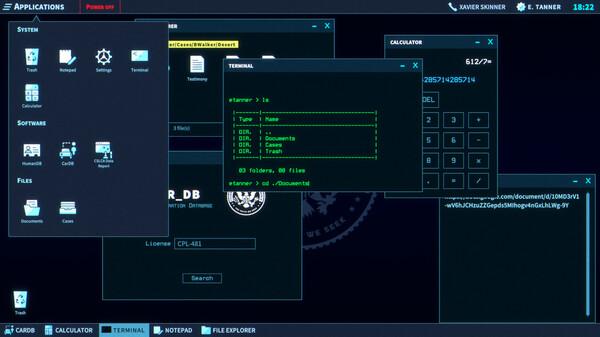
You are a rookie Operator at the FDI, chasing cases from a single computer console: a video and photo analyzer, citizen and vehicle databases, the ChemScan, a notepad, and a terminal that behaves like the real thing. You connect evidence, support field agents as the voice in their ear, and step into a widening conspiracy. Bureau 81 released it on 22 July 2024, with indienova also credited as publisher.
I write this from the Steam review pool. English reviews sit at 'Very Positive,' about 90% of 3,598 (snapshot 2026-07-18); across all languages it clears 8,000, also 'Very Positive.' Metacritic reads 78. The usual shape at a glance: warm players, cooler critics.
But beneath the count, the axis of disagreement is remarkably single. Praise and complaint point at the same spot: is this a game you solve, or one you operate and watch? I will read that one question out of the pool's own vocabulary.
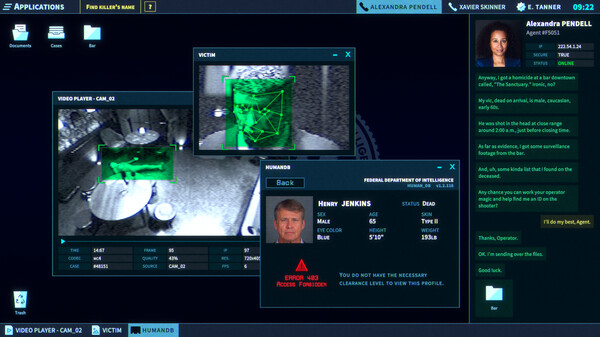 The operator's console — Steam store
First Impressions
What the helpful positives keep saying is the thrill of finally being 'the man in the chair' — sitting before a screen, scrubbing footage, typing 'enhance' to pull a face. The cop-show daydream, made playable, fresh and gripping.
And it is tense for a desk game: some write that because you *are* the protagonist, the gun feels aimed at *you*. Even the negative side concedes the craft of the interface and sound; almost no one disputes it.
In Puzzlebyrinth terms, this is observation resolution as staging — looking itself is promoted to a verb. On first impressions nearly every review shakes hands here. The split comes later.
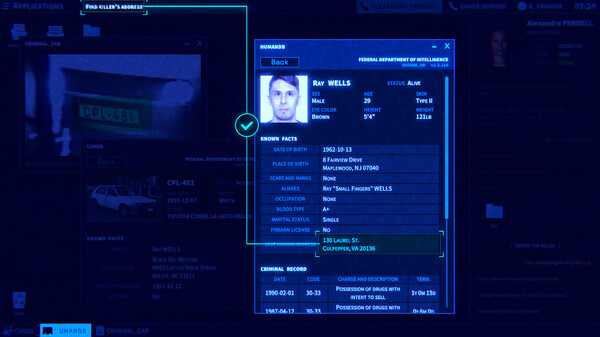 Scrubbing footage at the console — Steam store
Putting the Mechanics into Words
Whenever reviewers list the tools, one complaint rides along: each is used only once. Video analyzer, database lookup, ChemScan, terminal — fresh on arrival, then never seen again, say positives and negatives alike.
This is a problem of verbs. The Operator has many verbs but never builds a grammar from them; it discards each as soon as it teaches it, so no combinatorial explosion ever fires. The learning curve is a run of dots, not a line.
'It gives you a notepad, but nothing worth writing down,' one puts it. You are shown you can 'call' someone from an IP in the terminal, but that verb is a one-off and never feeds a later deduction. Each tool flares once as staging and never grows into a system.
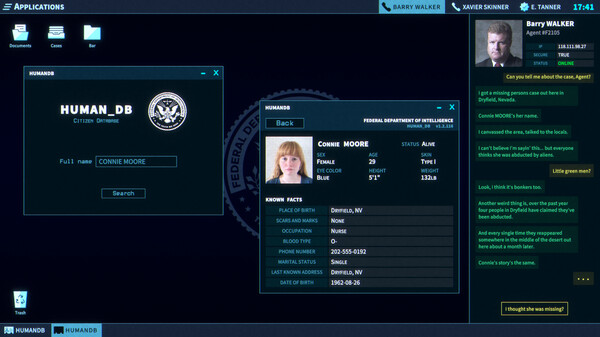 The FDI toolset — Steam store
Place in the Lineage
The most-summoned proper nouns in the pool are not the studio's — they are other games. Orwell, Hacknet, Cyber Manhunt for the desktop-investigation line; Her Story, Return of the Obra Dinn, The Roottrees Are Dead for the assemble-it-yourself deduction line. Nearly all the praise and complaint rests on those two reference lines.
Which lineage you expected decides your verdict. Orwell people balk that choices never reach the ending; Obra Dinn people balk that there is no room to build a conclusion — answers arrive side by side. One negative calls it 'the walking simulator of detective games.'
But this is scope, not quality. The Obra Dinn line hands observation resolution to the player and makes 'look, compare, commit' the core grammar. The Operator has no such grammar; it chooses cinematic, single-track flow instead. Measured by a deduction ruler it will always look short and shallow — the ruler, not the game, is the mismatch.
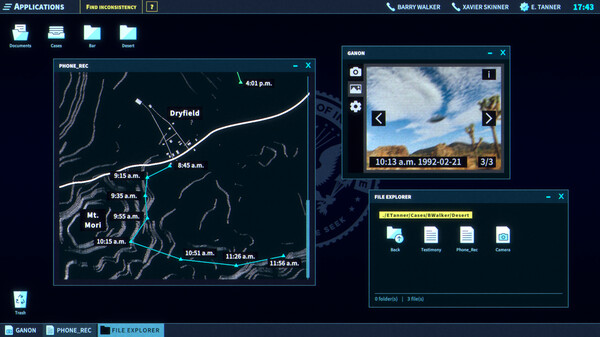 The evidence interface — Steam store
The Texture of Difficulty
On difficulty the pool agrees, unusually: easy. Even checklist reviews tick 'Easy'; negatives say the answer sits right next to the question and that looking closely is not rewarded. The more you came for a mental workout, the flatter it lands.
The one exception several reviews name is a timed section that forces you to read a manual. 'That part was genuinely great — I wanted more of it,' they repeat. The rare moment of being stuck became the favourite.
By the texture of its difficulty, the load leans almost entirely on reading and noticing, not on building. Raising your observation resolution does not bring you closer to a solution — attentiveness is not converted into reward. Only that timed scene makes you hold tools, time and information at once, and briefly becomes a real puzzle. Its popularity quietly names what the rest is missing.
 Working the terminal — Steam store
Sources
This piece was written from the Steam user reviews as of 2026-07-18. No review text is quoted directly; recurring typical claims are reconstructed.
・Steam: The Operator (English reviews 'Very Positive,' ~90% of 3,598; ~8,169 across all languages; developed by Bureau 81, published by Bureau 81 and indienova)
・Read the top 10 helpful positive, top 10 helpful negative, and 10 recent reviews, including developer replies.
・Cross-checked Metacritic 78 to gauge the gap between critics and players.
Closing
What is left after reading the pool is that no one argues about quality. The dispute is length and scope — three to five hours, tools that never grow, an ending that cuts at 'the end of Act One.' Tellingly, many negatives write that they would press a 'neither' button if Steam offered one.
The developer, in replies, likens it to a movie: '$12 for a 90-minute film; I chose the quality of a first playthrough over padded runtime.' That is subtraction, in Puzzlebyrinth terms — trim filler, raise density. Positive reads it as restraint; negative reads it as thinness. Two faces of one choice.
Against Steam's ~90%, I give it 7.5 on the ruler this site uses: puzzle design. The staging, immersion and script are excellent — but here the verbs never become grammar and observation is not converted into reward. Nearly a gem as an experience you operate; light as a puzzle you solve. If a sequel gives these tools a grammar, I will gladly measure again.
 The case, assembled — Steam store
Reactions (no login)
Anonymous • one of each per visitor per day
Read next
Related reviews
Mind Over Magnet
A 2D puzzle-platformer where a monitor-headed robot and a cast of magnet companions climb a factory one single-screen puzzle at a time, using pressure plates and magnetic fields. Place a magnet, throw it, flip its polarity — a small verb set solves 50-plus single-screen conundrums. Made by Mark Brown of the YouTube channel Game Maker's Toolkit.
Arranger
A grid puzzle-adventure where taking one step moves everything sharing your row or column, and the board loops at its edges. No sword or keys — you shove the things on the floor to open the way. The debut from Furniture & Mattress, folding movement, combat, and exploration into a single verb.
Botany Manor
A first-person puzzle set in an 1890s English manor, where you play retired botanist Arabella Greene and deduce each forgotten plant's ideal growing conditions from letters, posters, and clippings to coax it into bloom. Reading clues and binding them to a herbarium page is the core verb.


