REVIEW · 2025-01-15
The Roottrees are Dead
The family tree behind a dial-up modem
First Impressions
Skimming about four thousand Steam reviews, the first thing that catches is how the recommendations all land on the same word: "addicting." Long or one-line, warmer or cooler, they slide into it by the end. A 97% score is awkward material for a critic — you cannot reverse-engineer the design from a rift between camps. So this piece reads for what both sides cannot stop doing, and what they got tired of doing.
The aggregates: Overwhelmingly Positive, 97% of 4,325 English reviews positive (about 7,600 across all languages, only 235 of them negative; 2026-06-23 snapshot). The last 30 days sit at 96% of 480, and the line has held flat and high since the January 15, 2025 release. Developed and published by Evil Trout Inc.: a genealogical mystery in which you scour the early, dial-up-era Internet to work out who is truly blood-related to a crashed dynasty.
It began as a free Global Game Jam 2023 browser game; the Steam build adds hand-drawn art, a 3D living-room frame, voiced cinematics, and a new mystery, "Roottreemania." The pool's favorite metaphors are "late-90s online stalking" and "falling down a Wikipedia rabbit hole." You are neither participant nor detective but an observer peering at a family's history from behind a modem.
 The Roottrees are Dead — Steam store
Putting the Mechanics into Words
Boil the reviews down and this game also has two verbs: search and fill. Type keywords into a fake browser and old magazines to harvest fragments, then drop the names, portraits, and jobs into the blanks of a family tree. When the positive side says "everything seems solvable" and "tightly scoped," this is what it means: every clue is in principle in hand, and three correct entries lock automatically — the same latch Return of the Obra Dinn used.
The negative side reads the same mechanism differently: "you don't reach a real site, just a text summary," and "most reasonable search terms return nothing." When they call this "paperwork" and "busywork," the load they resent sits not on resolution of observation but on brute-forcing inputs. The verb "search" tips observation-deduction toward a type-and-guess game; scenes that test what you noticed get mixed with scenes that ask you to exhaust keyword combinations by hand.
Almost everyone praises the rubber-duck hint: "never abandoned, just a nudge." The interesting part is that the duck sometimes exposes the underside of the learning curve. When the reason it gives for an answer is essentially "just look at it," players realize they were matching the author's intuition rather than their own deduction. The duck is a kind tool and also an instrument for measuring where this game's reasoning slides from observation into guesswork.
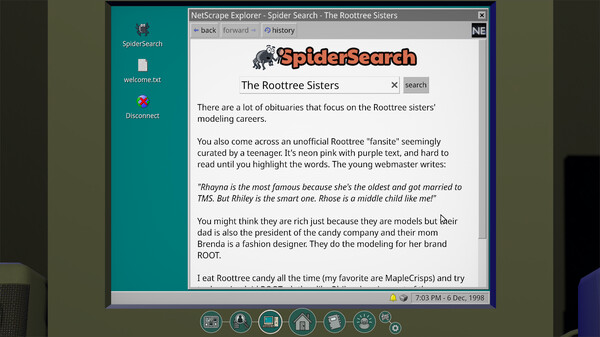
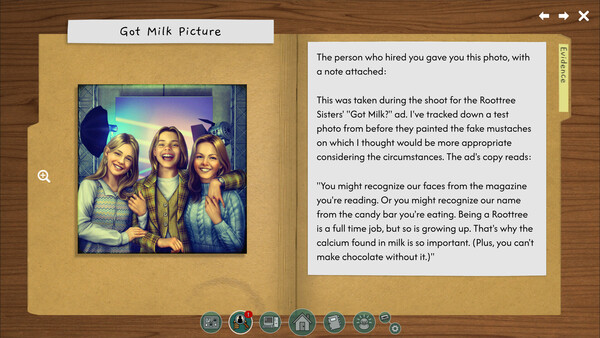
 Gathering clues through a period search engine — Steam store
The Feel of the Story
Reviews of the story split right down the middle. The positive side writes "I realized I'd memorized the family's whole history" and "a satisfying ending"; the negative side writes "all setup, no payoff" and "dry." Reading the same plot, one camp calls the accumulating family drama a pleasure, the other calls it "digging up gossip about rich people you don't care about." Same object, different axis.
In design terms, the game does not fully hand the story's subject to the player. Where The Case of the Golden Idol had you write the truth word by word, here you fill only the tree's slots while the interpretation arrives as fixed text. So the satisfaction of completing the tree separates easily from the satisfaction of reading the story. The "no twist" complaint is the flip side of a structure whose answer format rewards consistent connection over shocking revelation.
A year and a half on, though, recent reviews have cooled this argument. Most newcomers arrive via Obra Dinn word-of-mouth, expecting patient legwork rather than spectacle. With expectations reset, the contested ground has moved from the story to the late-game difficulty and the UI — the score holds steady while the complaints simply change address.
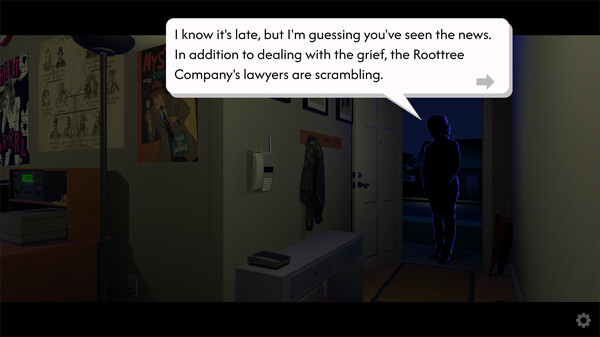
 The interludes are fully voiced — Steam store
The Texture of Difficulty
The difficulty distribution echoes Golden Idol's: near-unanimous "just right" early, splitting once the diary and the DLC open. Three qualities of "stuck" separate out: (1) you missed something in a scene, (2) the inference distance is long, (3) you are meant to guess from a portrait or a name "by vibes." Reviewers welcome (1) and (2) — legwork and inference are the body of the game. The resentment concentrates on (3): "I knew the truth, but the confirmation came down to 'look at his face.'"
One reviewer puts it sharply: the reason the hint finally gives is "you could've checked the filename" tier. That is not failed deduction but the moment a check meant to measure observation turns into a mismatch between the author's intuition and the player's. As late-game blanks collapse the combinatorial explosion of candidates, a brute-force exit opens too — verifiability and brute-forceability growing from the same design, the chronic ailment of this lineage.
Meanwhile the hints carry no penalty and cost no achievements, and the pool splits on whether that is kindness or a test of self-restraint. Logged clear times run roughly 6–10 hours for the main case and longer with Roottreemania, so the experience of difficulty genuinely varies — which is why this page takes the middle marker.
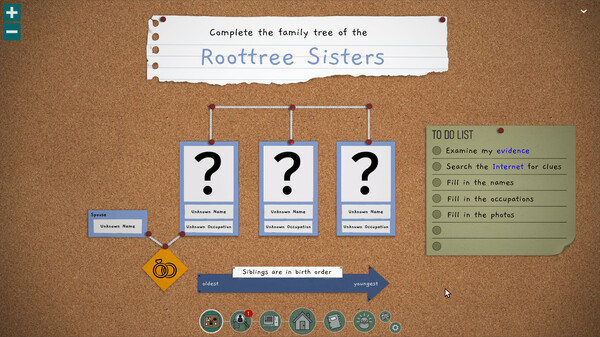
 Filling in the fallen dynasty's family tree — Steam store
Place in the Lineage
This review section, too, doubles as genre criticism. Return of the Obra Dinn is the runaway comparison — "if you liked Obra Dinn" is a stock phrase — followed by Her Story, The Case of the Golden Idol, and Hypnospace Outlaw. Within the small genre of observation-deduction, this game is usually placed as the more approachable first step.
What it adds to the lineage, as I read it, is setting the stage of deduction on the early Internet. Obra Dinn made you observe memory; Golden Idol, frozen crime scenes. Here you observe search results and link-less summaries — the very source of the divide, praised as "net archaeology" and dismissed as "a fake web you can't browse." The same device is both the core of the atmosphere and the core of the busywork.
One more gap worth recording: pros versus users. PC Gamer called it "a game for the quiet hours at your desk… one of the best about unglamorous detective work" (87); Metacritic sits at 86. The professional verdict measures novelty and mood at release. The user pool weighs more practical scales — the feel of the search UI, the late-game difficulty, and whether the post-game DLC is "more of the same." Even inside the same 97% there are strata.
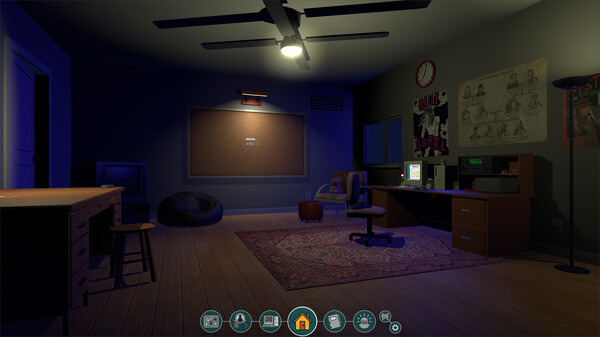
 Bookshelves and magazines are clue troves too — Steam store
Reviews Consulted
This piece was written from the Steam store page and community review pool as of 2026-06-23. No review text is quoted; typical claims are reconstructed.
・Steam: The Roottrees are Dead (Overwhelmingly Positive / 97% of 4,325 English reviews positive; about 7,600 across all languages with 235 negative; last 30 days 96% of 480; 2026-06-23 snapshot)
・Read the top 15 helpful positive, top 10 helpful negative, and 8 recent reviews via WebFetch. The playtime estimate follows the 6–10 hours for the main case logged in reviews.
・Professional verdicts are taken from the quote on the Steam store page (PC Gamer 87 / Metacritic 86).
Closing
Against Steam's 97% I put down an 8.2, and the gap is everything above: searches that resolve into summaries and tip observation toward data entry, late-game confirmations that slide into "guess by vibes," and a family-tree answer format that structurally dampens the story's payoff. None of it breaks the experience — the 97% proves that — but in a design-criticism grade these are real deductions.
Still, the fact four thousand reviews point at together holds: with only two verbs, search and fill, the game made players reconstruct a fallen dynasty's bloodline from behind a dial-up modem. What stays with me is that even most of the 235 negative reviews never dispute that core. What is contested is the search UI, the late-game feel, and the story's rise and fall — the packaging, not the contents. As an entry point to observation-deduction, this page's 97% can be trusted.
 When every slot is filled, the family snaps into focus — Steam store
Where are you with this game?
Press one and the game goes on your shelf. You can see it on your account page.
Reactions (no login)
Anonymous • one of each per visitor per day
Read next

Related reviews
The Rise of the Golden Idol
A 2D deduction adventure where you click through frozen crime scenes and drop harvested words into blanks to reconstruct who did what, why, and in what order. A standalone sequel to The Case of the Golden Idol, set across twenty linked cases in the 1970s.
The Case of the Golden Idol
A deduction game: examine frozen crime-scene tableaus, gather words from the evidence, and fill in the blanks to reconstruct each murder across an 18th-century mystery.
Duck Detective: The Secret Salami
A 2.5D observation-and-deduction adventure where a down-on-his-luck duck detective peers at evidence and slots words into fill-in-the-blank sentences to crack the case of a stolen lunch. Happy Broccoli Games takes the Golden Idol style and makes it light, fully voiced, and pun-heavy.


